


DRIGGS — Officials with the Shoshone-Bannock Tribes said they plan to lobby to have Native American mascots removed throughout the state.
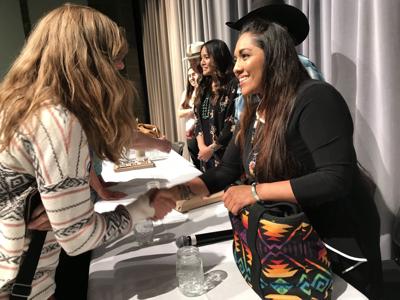
Randy’L Teton, public affairs manager for the Shoshone-Bannock Tribes, made the announcement Wednesday night during a lengthy meeting organized by concerned community members about the future of Teton High School’s Redskins mascot.
About 140 people were in attendance of the meeting at Teton High School in Driggs to argue about whether or not the Redskins should remain the high school’s mascot.
Randy’L said the Pocatello High School Indians and Salmon High School Savages are also concerning.
The Teton School District 401 Board of Trustees will decide within less than two weeks if the mascot should be changed.
“My kids attend Teton School District 401,” said Michelle Beitinger, who lives in Teton Valley and is a descendant of Washington state’s Colville Confederated Tribes.
Beitinger served on a panel of Native Americans from various tribes assembled to offer perspectives on the issue during the community meeting.
“It is very important to me that they grow up respecting all individuals, and I believe our current mascot does not do that,” Beitinger said.
Members of the panel also included Randy‘L Teton and Larry Teton, members of the Shoshone-Bannock Tribes in Southeast Idaho; Amanda Blackhorse, an activist and member of the Navajo Nation; and Northern Arapaho member Sergio Maldonado, who travelled from the Wind River Reservation in Wyoming for the evening’s event.
The Teton Valley News live-streamed the panel on its Facebook page.
“I am Northern Arapaho and Mexican-American,” Moldonado said. “I am not a redskin. I am a human being with children and grandchildren and thousands of students who I have worked with. Utilizing an Indian or tribal mascot is nothing more than a veiled attempt at hate speech. That’s all it is. Let’s be pragmatic. You want to put your cards on the table, put your cards on the table face up. Let us know where you are.”
The event was planned by a handful of community members, including Dale Sharkey and Sue Berkenfield, who introduced the evening’s moderator, Marcia Franklin, a producer and host with Idaho Public Television in Boise. Sharkey said a few weeks ago that the hope was to bring Native American voices into the conversation, specifically local and regional tribes.
Teton School District Superintendent Monte Woolstenhulme first brought the idea of changing the mascot to the school board six year ago. Randy’L reminded the community that at that time, Woolstenhulme went to the tribes and asked how her community felt about “redskin.”
“We had the superintendent come to us and ask us in our Tribal Government what we thought,” Randy’L said of what transpired in 2013. “That means a lot. In my line of work, that’s important. It’s important to build those relationships so we can communicate, so we can talk together about whatever it it is — health, education, economic development — it all goes hand in hand as neighbors, and that’s what we are, neighbors.”
Randy’L was the model for the Sacajawea dollar coin that was in circulation from 2000 to 2001, and again from 2009 to 2011.
She is the only living person to have their likeness appear on United States currency.
In 2013, Woolstenhulme told the school board that he was making the decision to remove the mascot from Teton High School despite generations of his own family who had graduated from the school as Redskins, himself included. The school board at the time, moved by public pressure, opened the conversation up to the greater community. In a historic meeting that filled the Teton High School auditorium, several members of the public protested the decision. The intensity of the meeting left some school board members in tears.
Randy’L said during Wednesday night’s panel event that the Teton mascot issue is just one facet of a statewide initiative for change.
“We have officially approved a position paper and are taking the steps needed to make changes throughout the state,” she said. “This isn’t just happening in Driggs. We are hoping to make changes statewide.”
Members of the Save the Redskins group were in attendance that evening, having set up a table just outside of the high school auditorium and wearing “Save the Redskins” T-shirts. The closed Facebook group, which has about 1,100 members, had supported a local panel discussion of the Native American Guardians Association. At that event in early June, members of NAGA spoke about saving the imagery of Native American culture through school and sports mascots. During that presentation, members of NAGA said community members who support the name “Redskin” are not racist and that people who are seeking to change the name, specifically people who move into a community, should be challenged.
But on Wednesday evening, when asked what they thought about NAGA, Amanda Blackhorse, a national advocate for changing the mascot, said the word “redskin” is a racial slur.
Additionally, Randy’L called into question a NAGA member’s tribal membership, specifically challenging NAGA member Mark Onewolf’s claim that he is a member of the Apache Tribe.
Randy’L explained the history of boarding schools in the area, saying that when the Native Americans were told to leave this area, they were told not to use their native language. She became emotional while explaining that generations in her family cannot speak the Shoshone language because of this history. She added that now the reservation had a school specifically to teach young children entering kindergarten the native language, thus preserving the history and culture for future generations.
“We now have our young children learning to speak our language that just 100 years ago we were forced to not speak our language,” Randy’L said. “This is all part of this whole issue with the mascot. Know what you are representing. You are representing people.”
Beitinger closed with reading the Teton School District mission statement and said that the mascot does not embody the section that defines education as safe and respectful.
Victor resident Stephanie Crockett urged the board to reconsider changing the mascot during March’s school board meeting. The school board will discuss the Teton High School mascot at its regularly scheduled meeting on July 8. The meeting will begin at 5:30 p.m. in the auditorium of Teton High School. Public comment will be taken on the issue at that time.

(0) comments
Welcome to the discussion.
Log In