

REXBURG — Hemp is being grown in Madison County. And it’s perfectly legal to do so.
The government gave hemp the go-ahead in 2014 after the plant spent decades off the market over concerns that it was just like the hallucinogenic marijuana. High taxes attached to the then Schedule 1 drug as well as competition from other companies making items similar to those produced by hemp limited any production of the plant.
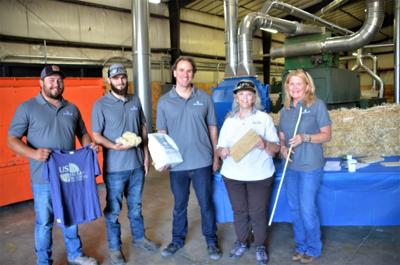
Today hemp is used to make everything from clothing to kitchen tile, said Jamie Petty of the recently opened Whitefield Global Holdings Processing Plant located at 4861 S. Highway 91 inside the Wilcox Warehouse.
Hemp will not get anybody high, she said.
“Hemp has a trace amount of THC,” she said. “It has 3/10ths of a percent. Marijuana has 18 to 30%. If you were to smoke hemp, you will get a headache for sure.”
Whitefield Gold’s hemp is used for industrial applications, said the company’s John Read.
“Our primary application is for construction, plastics and insulation,” he said.
Hemp may reach 10 feet high. A modified hay harvester is used to glean the plant.
A stalk of hemp resembles bamboo, Read said.
“It’s the same concept as a stalk of corn,” he said.
The hope is that area farmers will consider raising hemp, Read said.
“It’s something to help our farmers here locally,” said hemp farmer Tristan Sponseller of Roberts. “It’s to help us to make a living.”
Sponseller recently partnered with Whitefield in raising hemp and grows 560 acres of the plant. He is the largest hemp grower in the state.
Hemp does have a similar aroma to marijuana and concerned neighbors have called the police to investigate. Sheriff’s deputies have visited Sponseller’s farm on occasion.
“I’ve had the sheriffs out there a handful times where they tested (the plant),” he said.
The tests always show there was no illegal drug being grown on Sponseller’s farm.
“(One officer) was pretty disappointed,” he said. “He thought he had the biggest drug bust.”
Now the region’s sheriff’s offices have a directory of farmers growing hemp.
“If they’re concerned about a field, they’re able to look it up,” Sponseller said.
In the 1930s, hemp production decreased drastically after it was heavily taxed and inadvertently placed on the U.S. Schedule 1 of dangerous drugs. Competition from other industries selling similar items produced by hemp, effectively shut hemp production down following World War II, Petty said.
Petty said W.R. Hearst wanted hemp outlawed as it threatened his paper businesses.
“You had Hearst who bought up all these forests,” said Petty, “He wanted to focus on the wood for paper.”
It wasn’t until 2014 that the government removed hemp from the Schedule 1 list. Four years later the U.S. Farm Bill allowed for hemp to be sold.
“There was a ridiculous amount of regulation, and hemp was not treated like a true crop, but we’re getting there,” Petty said.
In hopes of spreading the word about its hemp production facility, Whitefield Global contacted Sponseller and other Idaho farmers from a list provided by the state.
“We cold called them and started building a relationship,” Read said.
Building those relationships is a way to help farmers spread their roots financially, Petty said.
“One of the primary goals is to provide a diversified income stream for farmers,” she said. “Hemp’s root system is pretty intense. It can help aerate the soil and keep it looser.”
Read added that hemp is a great rotation crop for hay and potatoes.
“It removes heavy metal and toxins from the soil,” he said.
University of Idaho Potato Processing Systems Weed Specialist Pam Hutchinson says she’s looking forward to seeing the positive effects of hemp on soil.
“If hemp has some good production, good sales and makes the farmers money, they would love to put that in a rotation,” she said. “If it would help suppress weeds, that would be great.”
The new Rexburg facility has the capability to run four tons of hemp in an hour, said the company’s Chief Innovation Operator John Lupien.
“It’s generally similar to cotton ginning,” he said. “It’s like taking a big bale of cotton off the field and separating the sticks and seed to get to your fiber. The fiber gets refined and cleaned. It’s a cottonized type of fiber that will go into all sorts of projects.”
Whitefield Global plans to hire a crew of five people to help run the facility. Its shop foreman, Jared McKenna, says he’s looking forward to seeing the company serve area farmers.
“I’m learning all about it right now,” he said. “I think it’s cool. I think there’s a lot of potential there.”
The company is thrilled to set up shop in Madison County, Lupien said.
“This facility should be one of the larger facilities in the nation when it’s fully functioning,” he said.
Petty says she’s gotten a kick out of seeing everyone working together on the project.
“It’s really fun seeing people collaborating to move this industry forward,” she said.
For more information on the new company visit https://www.whitefieldglobal.com/.

(0) comments
Welcome to the discussion.
Log In