

MINNEAPOLIS (AP) — An autopsy commissioned for George Floyd’s family found that he died of asphyxiation due to neck and back compression when a Minneapolis police officer held his knee on Floyd’s neck until he stopped breathing, ignoring his cries of distress, the family’s attorneys said Monday.
The autopsy by a doctor who also examined Eric Garner’s body found the compression cut off blood to Floyd’s brain, and that the pressure of other officers’ knees on his back made it impossible for him to breathe, attorney Ben Crump said. He called for the third-degree murder charge against Officer Derek Chauvin to be upgraded to first-degree murder and for three other officers to be charged.
The family’s autopsy differs from the official autopsy as described in a criminal complaint against the officer. That autopsy included the effects of being restrained, along with underlying health issues and potential intoxicants in Floyd’s system, but also said it found nothing “to support a diagnosis of traumatic asphyxia or strangulation.” The family’s autopsy found no evidence of heart disease and concluded he had been healthy.
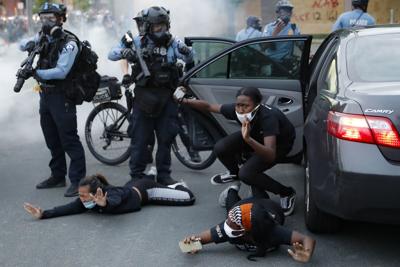
Floyd, a black man who was in handcuffs at the time, died after Chauvin, who is white, ignored bystander shouts to get off him and Floyd’s cries that he couldn’t breathe. His death, captured on citizen video, sparked days of protests in Minneapolis that have spread to cities around America.
The official autopsy last week provided no other details about intoxicants, and toxicology results can take weeks. In the 911 call that drew police, the caller described the man suspected of paying with counterfeit money as “awfully drunk and he’s not in control of himself.”
Crump said last week that he was commissioning the family’s own autopsy. Floyd’s family, like the families of other black men killed by police, wanted an independent look because they didn’t trust local authorities to produce an unbiased autopsy.
The family’s autopsy was conducted by Michael Baden and Allecia Wilson. Baden is the former chief medical examiner of New York City, who was hired to conduct an autopsy of Eric Garner, a black man who died in 2014 after New York police placed him in a chokehold and he pleaded that he could not breathe.
Baden also conducted an independent autopsy of Michael Brown, an 18-year-old shot by police in Ferguson, Missouri. He said Brown’s autopsy, requested by the teen’s family, didn’t reveal signs of a struggle, casting doubt on a claim by police that a struggle between Brown and the officer led to the shooting.
Chauvin, who was also charged with manslaughter, is being held in a state prison. The other three officers on scene, like Chauvin, were fired the day after the incident but have not been charged.

(0) comments
Welcome to the discussion.
Log In