

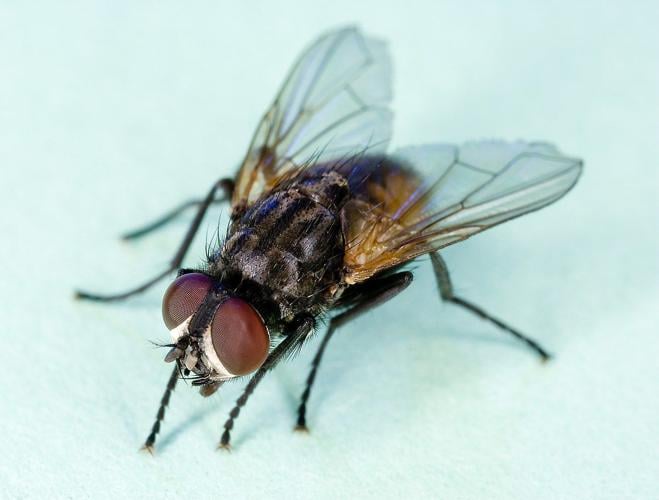
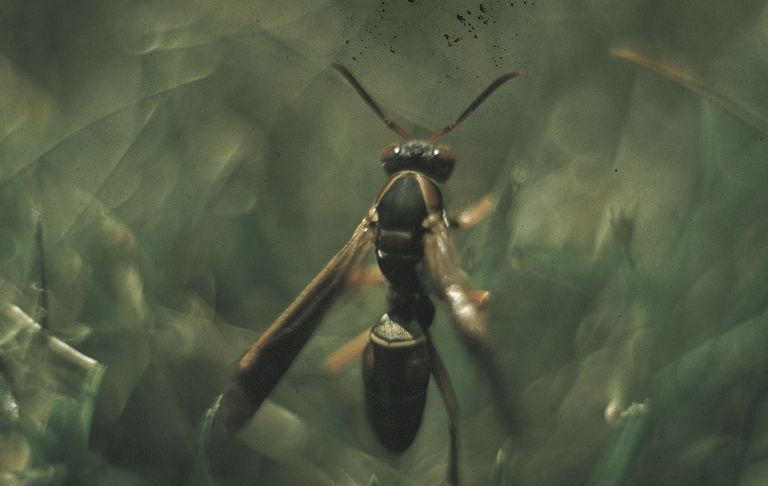
The peskiest pests of summer seem to be out in full force lately.
Wherever there’s food, garbage or feces in the state, flies have been ubiquitous, ruining picnics and buzzing around peoples’ ears and hair. Household pets have shared their outdoor water bowls with omnipresent colonies of wasps, and gardeners have had to exercise vigilance regarding the stinging insects lurking in the nozzles of hoses.
Area retailers can’t seem to keep fly swatters, fly strips, traps and other products for controlling fly and wasp populations in stock.
At least based on anecdotal evidence, some University of Idaho bug experts agree people who feel more pestered than usual by these insects may be on to something.
A manager at Ace Hardware & Element Outfitters in Pocatello said for more than a month, fly swatters have sold out almost immediately after a new shipment arrives at the store. So have the Bug-A-Salt guns that shoot salt to control pests. She’s never seen such hot demand for bug-control products, whether it’s the result of increased pest populations or supply chain challenges created by COVID-19 — or possibly a combination of the factors.
Jason Thomas, a University of Idaho Extension educator for Minidoka County, has heard lots of complaints about the apparently large house fly populations in recent weeks. He pointed to evidence that the fly problem may, in fact, be greater than usual this year. A recent study evaluated several years of data on stable fly populations. The researchers concluded 70 percent of stable fly population variation from year to year correlated with temperature and precipitation.
“The temperature and precipitation this year have not been normal,” Thomas said, referring to an extraordinarily hot and dry summer.
Stable flies tend to live around livestock, but Thomas believes the precipitation and temperature conditions they like must also be good for house flies.
“Seventy percent of variation tied to two factors like that is huge,” Thomas said. “That’s a very good predictor.”
Joseph Sagers, UI Extension educator for Jefferson and Clark counties, believes flies may produce more generations during a hot summer. He emphasized fly populations gradually ramp up throughout the season and are always largest near the end of the summer.
Sagers agrees that there seems to be more flies now than is normal for this time of year, nonetheless. He also believes wasp numbers are up.
“I don’t have any hard data, but there’s been a large amount of wasps,” Sagers said. “I have seen them a lot more present, maybe a little more aggressive.”
When the first frost of the year arrives, only the queen wasps will survive. Sagers said the frost will also nail the flies, which he emphasized are an important part of the ecosystem, as they play an essential role in breaking down dead material.
Brad Stokes, the UI Extension educator for Elmore County, noticed paper wasps were abundant at the start of the year in his area. He believes wasps and flies were likely less active during the extreme heat of the summer and have come out now that the weather has cooled somewhat. Their sudden reappearance may have created the perception of a dramatic increase.
“They’re out foraging and they’re hungry right now,” Stokes said of wasps.
He added, “You always see an abundance of flies at the end of the year.”
Stokes believes the fly population in his area is strong but not out of the ordinary.
Ed Lewis, head of UI’s Department of Entomology, Plant Pathology and Nematology, concurred that wasps are typically more aggressive toward the season’s end as they seek to accumulate resources to carry them through the winter.
“That might be happening a little bit earlier because of our limited rainfall,” Lewis said.
Regarding flies, Lewis hypothesizes that they’re congregating more in towns, where they can find food and water, as the challenging conditions this summer may have made resources harder to find in the surrounding foothills.

(0) comments
Welcome to the discussion.
Log In