


During the long and cold Idaho winters, an indoor aquatic center can be a ray of sunshine — a warm, family friendly activity for those less inclined to snow sports, or even just those looking for a change of pace.
At least that’s what Chubbuck City Council member Melanie Evans, who is leading an effort to build an indoor aquatic center in Chubbuck, cited as one of the reasons people seem to clamor for year-round water sports.
Eastern Idaho city leaders offer a host of reasons in support of their indoor swimming complexes, but they acknowledge they’re not cheap to build or maintain. Big-budget plans to build or update aquatic centers are pending or under consideration throughout the region.
Indoor aquatic centers can provide safe and controlled environments for swimming lessons and “aquatherapy.” The Blackfoot Swimming Pool and the Wes Deist Aquatic Center in Idaho Falls are both used by their county search and rescue departments for training. People can use them to become certified for scuba diving.
Any city official will tell you that there is no shortage of uses for these aquatic centers.
However, there is a question these officials, as well as the residents of any city with an indoor pool, must ask themselves, according to Blackfoot Mayor Marc Carrol.
“What value does a citizen place on that kind of place?” Carrol asked.
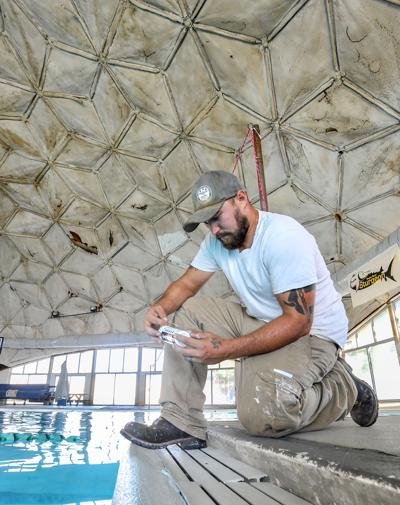
The Blackfoot Swimming Pool, which was built in 1972, is currently facing a potential end to its 46-year life.
The city of Blackfoot is proposing a $3.9 million bond that would extend the life of the dilapidated pool another quarter of a century. The Blackfoot City Council has agreed to put the bond on the ballot for November. However, even if the bond passes, it must also pass a levy election in May before the bond money will be drawn.
A group called “Save the Blackfoot Swimming Pool,” which is attempting to ensure the passage of the bond and levy, has nearly 1,000 followers on Facebook.
Carrol said that while he would very much like to see the Blackfoot pool live on, it’s essentially on borrowed time.
“Indoor pools are interesting because you have a natural sort of deterioration of the facility,” Carrol said.
Bud Cranor, spokesman for the city of Idaho Falls, also said that indoor pools require a lot of maintenance.
“There’s so much that goes into making an indoor aquatic center function,” Cranor said. “Besides your one-time cost for building it, you’ve got a lot of maintenance costs.”
According to Cranor and PJ Holm, the recreation superintendent for Idaho Falls, the Wes Deist Aquatic Center costs about $100,000 a year in utilities and $30,000 in chemicals.
And in addition to the money it takes to maintain the pool, Holm said another costly aspect is staff.
Because there must always be two to three lifeguards on duty, as well as a front-desk person, Holm said it often takes at least three people to keep the pool open for just a single lap swimmer.
“An indoor pool never makes money,” Carrol said.
The Blackfoot pool has a total operating cost of $425,000 a year. Its gross revenue is $90,000 a year.
The Wes Deist Aquatic Center, which Holm said had its best year last year with 122,000 visits, has a typical total operating cost of just under $1 million and a revenue of $450,000.
Why then, do communities form committees and scrimp and save and petition their councils to build such money pits in their own cities?
“We did multiple surveys when establishing (budget) needs,” Evans said, “and without question, hands down, aquatics was the No. 1 thing people wanted.”
Though plans for a Chubbuck aquatic center were put on hold due to budget needs within the police and fire departments, Evans said they are by no means forgotten.
However, Evans added that if and when Chubbuck receives its own indoor pool, it will be after extensive planning and consideration.
“We are trying to be very careful as we go about studying this center because we do not want to have to bond for much of it,” Evans said. “We’re trying to figure out how to fund it through community partners and programming because that would help cover these ongoing costs.”
Evans said the city is working with an architect out of Utah who has assured her that the future of indoor aquatics centers will require much less maintenance.
“That was one of our big concerns was paying millions of millions of dollars for a pool, and right when we get done paying for it, it needs remodeled,” Evans said.
That certainly seems to be the trap into which many cities have fallen victim.
Carrol said he has discussed indoor pools with other mayors from different cities, and one thing they can unanimously agree on is that they are difficult.
The Wes Deist Aquatic Center, which is 14 years younger than the Blackfoot pool, has held up well, but it now faces maintenance problems for which the city will have to respond.
However, Holm said the Idaho Falls Department of Parks and Recreation recently started a comprehensive master plan for the entire department, which includes the aquatic center.
Through this they will ask the public what should be done with the center, be it expansion or complete demolition and the construction of a new pool.
Not in the plan, however, is a complete closure of the pool, which Holm and Cranor both said has been an integral part of the community.
“(Aquatic centers) are costly, but they’re valuable parts of the community,” Cranor said. “It just provides a lot of different benefits to the community.”
Carrol said he can remember teaching his children to swim at the Blackfoot pool, and despite the cost to taxpayers, he would grieve its loss.
“You don’t know how many lives could be saved because a kid learned how to swim at the Blackfoot pool,” Carrol said.
Carrol added, “What kind of value does a citizen place on that kind of a place? Those are questions that the individual has to answer, and they answer at the polling booth.”

(0) comments
Welcome to the discussion.
Log In