


POCATELLO — If you’ve used the Idaho Supreme Court Data Repository website to look up criminal or civil cases or have plans to pay off that speeding ticket in the Bannock County Courthouse, be aware both services have recently undergone some changes.
Idaho’s 6th and 7th Judicial Districts, which incorporate most East Idaho counties, replaced the old legacy court repository with iCourt, a new electronic document submission and retrieval system that went live Oct. 9.
Court employees who use the services regularly will be impacted the most. However, the transition also changes the public’s access to criminal and civil court records traditionally found on the Idaho Supreme Court Data Repository website, which was built on technology that is no longer supported.
“One of the biggest benefits will be electronic filing (e-filing) and electronic court records,” said Kerry Hong, the trial court administrator for Bannock County. “One of the central administrative demands on court users is managing the movement of paper. With electronic filing and electronic court records, we hope to streamline this process and reduce how dependent court users are on paper.”
Hong said that the Idaho Supreme Court has developed online iCourt resources for the public and other court users. The iCourt Portal, accessible online by visiting icourt.idaho.gov, replaces the Idaho Supreme Court Data Repository which was previously accessible by visiting idcourts.us. Guides and video tutorials on the new system are available by visiting icourt.idaho.gov/portal-resources. E-filing training and resources are available by visiting icourt.idaho.gov/efile-resources.
“The iCourt Project has required partnership at all levels,” Hong said. “In Idaho, the state and the counties work together to operate the court system. Anytime we have a project of this size, it challenges us to adapt our processes, fit training and learning into already busy calendars and to make sure we have the right equipment and facilities to support iCourt. I’m truly grateful for the commitment of our elected clerks, their deputies and commissioners to support this project.”
Hong continued, “We anticipate there will be challenges as we manage this change but with patience from the public, support from the Idaho Supreme Court and the local leadership of our counties, we will be successful.”
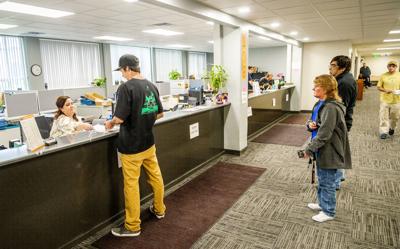
Also, courthouse officials recently put the finishing touches on a $100,000 renovation project that, among other improvements, moved the bonds and fines department from the second to the first floor of the Bannock County Courthouse.
“Jeff Underwood, our county maintenance supervisor, has been using bubble gum and baling wire to hold this place together,” Bannock County Commissioner Terrel “Ned” Tovey said about the physical condition of the Bannock County Courthouse. “His contributions have been immeasurable, so to actually get some of these projects done that he has been advocating about forever will help the building function properly for years to come.”
Tovey told the Journal on recently that part of the renovation project at the courthouse was implemented in conjunction with a statewide transition from a paper-based court document submission system to an electronic method.
As part of Idaho’s transition to a modernized judicial system, the first iCourt Portal was launched in Twin Falls County on June 22, 2015. This new application replaces the Idaho Statewide Trial Court Automated Records System, or ISTARS, Data Repository. The new iCourt system continued to roll out to the rest of the state in phases over the next several years. The last phase of that process became effective on Oct. 9.
Tovey said that because Bannock County is the head of the 6th Judicial District it was selected as the training location for all 6th and 7th district court officials and judicial partners to become familiar with the new electronic filing system.
Though the bonds and fines department inside the courthouse was in need of additional space, considering 19 people were working in what was essentially two small rooms, the county also needed to find a location to establish a classroom for training on the new repository system, Tovey said.
So not only did the relocation provide the necessary operating space for bonds and fines employees to remain effective, but it also saved the county funds by hosting the training in the space previously occupied by bonds and fines.
“Instead of renting out space for the training we used the space where bonds and fines was located to host the iCourt training,” Tovey said. “We set up in a classroom-type environment in that space, and now that the training is complete, we will look at the future use of that space.”
In addition to relocating bonds and fines, Tovey said all of the fluorescent light bulbs were replaced with energy-efficient light-emitting-diodes, or LEDs — with Idaho Power covering about two-thirds of the cost. The flooring on the first floor went from linoleum tile to carpet, the carpet on the third floor was replaced and roofing work to remediate water damage was completed on the main courthouse building and the adjacent annex building that is across the street and currently houses the public defender, motor vehicle and assessor’s departments.
Moreover, when completing work on the third floor, Tovey said that a wall with built-in observation windows was uncovered. Instead of spending a costly amount to remove the windows Tovey decided to take a landscape photo of the Pocatello area that was taken by Court Marshal Hermenejildo “Herman” Garcia and put a vinyl wrap on the window.
Tovey also said the heating, ventilation and air conditioning system in the courthouse was updated and the county has put out for bid a project that would see the bathrooms remodeled, too.
“The restrooms inside the courthouse are at the end of their life cycle,” Tovey said. “They are the original restrooms that were installed in the early 1950s when the building was constructed. They do not meet (Americans with Disabilities Act) requirements and we would like to update those facilities while bringing them up to compliance, as well.”

(0) comments
Welcome to the discussion.
Log In