

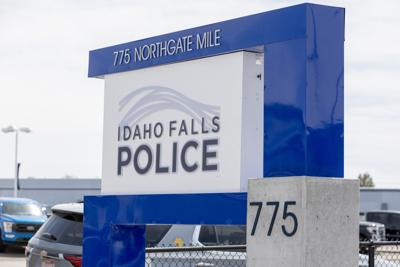

The Idaho Falls Police Department and an Idaho Falls man have settled out of court for $600,000 in a lawsuit filed against an officer and the department for excessive use of force and violations of his civil rights.
The complaint was filed in May 2022 over an incident that occurred on July 14, 2020. According to the complaint, Tony Irvine sustained eight broken ribs, of which five were reportedly severely displaced, and metal screws were used to fix them after being pushed to the ground by IFPD Officer Dustin Cook.
IFPD Public Information Officer Jessica Clements told the Post Register in a phone interview that the department still employs Cook.
In Jan. 30, 2023, U.S. District Judge B. Lynn Winmill issued a summary judgment against Cook where, in his memorandum, he stated that even if the facts of the case are interpreted in a favorable light for the officer, he would still conclude Cook violated Irvine’s rights and used excessive force when detaining him.
A judge can issue a summary judgment in cases where the facts are undisputed. This means that even if the interpretation favors the party opposing the judgment, there still wouldn’t be enough support for their case. This pertained only to Cook, who allegedly pushed Irvine off a bicycle when Irvine attempted to ride away from an incident that Cook was addressing.
Attorney Jason Wood, representing Irvine, said that after the summary judgment was issued, discussions revolved around the actual settlement. He told the Post Register that Cook’s attorney sent an offer of judgment that offered less money, but after months of litigation and discovery, they settled for $600,000.
Wood said his client’s settlement and summary judgment have helped Irvine feel vindicated, that it wasn’t his fault, and he didn’t do anything wrong.
“It was the officer who made the egregious errors,” Wood said. “It’s extremely important that our public officials who are imbued with this much power over people’s lives to be held responsible when they when they break the law.”
Police Chief Bryce Johnson said that he respects the process and the judge’s decision in this case.
Discussing the incident, Johnson said it revolved heavily around COVID-19, which created this unique situation. During the pandemic, Johnson said offenses that would’ve normally led to an arrest and later taken the offender to jail were not happening due to COVID-19 regulations.
“With those restrictions in place, we saw that there were a couple of calls in which our officers had to use force on people, and when the detention was made, they were just let go. We recognized that as being a problem, because that use of force is an arrest,” Johnson said.
Johnson said the call that was made to dispatch the night of the incident was for a fight happening with a bat being used.
According to the probable cause affidavit, Irvine, who was homeless at the time of the incident, confronted the man with the bat over a parking space in the lot that Irvine said was for homeless people. The man with the bat, who also was reportedly homeless, told police he told Irvine to leave multiple times, but that Irvine was aggressive. He said he hit Irvine on the hand with the bat when Irvine approached him.
Cook wrote that when he arrived, he told the man with the bat to drop his weapon, and that he complied. Cook also wrote that Irvine got on his bicycle when police arrived and ignored orders to stop. Cook said he then ran to Irvine and pushed him off the bike.
Johnson said Cook was investigating a crime and had reasonable suspicion to stop Irvine, but since Irvine began to leave and Cook told him to stop, the need to use force to get compliance resulted.
“In any other period outside of COVID, I believe an arrest would have been made because there’s that original reasonable suspicion stop,” Johnson said. “We have the authority to tell people to stop. If people don’t do that, there’s a crime of obstructing, and that is a probable cause for obstructing. So it’s no longer a reasonable suspicion.”
In Winmill’s memorandum, he wrote that “Even after construing the facts in a light most favorable to the Defendants, Officer Cook did not have probable cause to arrest Irvine, and he did not have a reasonable basis to conclude Irvine was armed or dangerous, or that a risk for ‘ongoing or repeated danger’ or ‘escalation’ existed.
“A reasonable officer in these circumstances would have known that it was unreasonable to use nontrivial force to detain Irvine. In fact, a reasonable officer in these circumstances would have known that it was unreasonable to use any force to detain Irvine. Cook is therefore not entitled to qualified immunity on Irvine’s false arrest or excessive force claim.”
Johnson said that during litigation, since Irvine wasn’t arrested, and the report doesn’t list any probable cause to justify the use of force, it was deemed as an unlawful arrest.
According to Johnson, the lesson from this case is to ensure that police reports detail the whole incident and include the facts. Even with the aid of a bodycam and testimony, Johnson said the judge made his decision based on that report.
Wood claims that the bodycam was turned on after Cook pushed Irvine off the bike, but it doesn’t show him arriving at the location of the incident. Winmill also corroborated that Cook should’ve seen Irvine as a victim, stating, “(i)f anything, given the other guy had the bat, and Irvine had no weapon, Cook had more reason to believe that Irvine was the victim of a crime, not the perpetrator.”
“I’m really ashamed to be from Idaho Falls to see somebody treated like this by our police officers. Not only did he violate my client’s constitutional rights and injure him severely, but then blamed him for it. Treated him like a criminal and it was inexcusable,” Wood told the Post Register.
Wood said Irvine had every right to bike away and was in the process of leaving before he was shoved off his bike. Winmill wrote in his memorandum that “even if true only reasonable suspicion was required to detain Irvine, neither of Cook’s cited reasons justified his running after Irvine and pushing him off his bicycle to prevent him from leaving.
“Yelling at someone thirty feet away in a parking lot is not a crime,” Winmill goes on to state.
The affidavit states an ambulance was called to treat cuts found on Irvine’s right shoulder and forehead. Irvine received treatment but declined further medical care or to be taken to the hospital.
Overall, Johnson said that he has worked with Cook on calls before and testified that Cook “is one of the most patient police officers I’ve known.”
“What he did was what we train police officers to do at that moment. He recognized he needed to do a better job of documenting what he did, and he actually came to me and told me that first. So folks recognize, we stand behind our officer and recognize the courts made a correct decision.”
Wood believes that the IFPD hasn’t learned its lesson in this case, as Johnson, during his deposition, doubled down that this is how they train their officers.
“It should be a matter of great concern to the residents of Idaho Falls that their police department, even when they make a mistake and are told by a federal judge that they’ve made a mistake, still haven’t changed any of their policies,” Wood said.
The $600,000 settlement will be handled through Idaho Counties Risk Management Program. ICRMP is a property and casualty insurance and risk management service for local governments and entities like the IFPD use.


(0) comments
Welcome to the discussion.
Log In