

In North Idaho, patients should expect longer wait times and care in makeshift rooms as hospitals, which are stretched thin treating hordes of COVID-19 patients, struggle to provide routine levels of care.
And the rest of the state is not far from declaring a formal resource crisis, one top official said.
”The best method we have to prevent crisis standards of care in the rest of the state and get out of crisis standards of care in north Idaho is the individual actions of the people of Idaho,” state health department Director Dave Jeppesen said.
Idaho Public Health Administrator Elke-Shaw Tulloch said people in Idaho should “be careful and avoid” activities that could result in them needing the emergency room, avoid using the ER for asymptomatic COVID-19 testing, get vaccinated against COVID-19 and wear a mask indoors and in crowded outdoor spaces.
”If you need care, please seek it, but do your best to avoid going into the emergency room,” Shaw-Tulloch said.
She said people can call 211 to get a free, at-home COVID-19 test.
The number of people hospitalized for COVID-19 in Idaho, both in regular hospital beds and intensive care unit beds, recently reached new highs. There were 548 COVID-19 hospitalizations and 173 ICU admissions due to the virus on Aug. 31, state data show.
Southeastern Idaho Public Health announced on Monday a total of 452 confirmed and probable cases of COVID-19 throughout the region between Aug. 31 and Sept. 6. That number includes 253 confirmed and probable cases in Bannock County, 120 in Bingham County, 20 in Bear Lake County, 19 in Power County, 13 in Caribou County, 12 in Franklin County, nine in Butte County and six in Oneida County.
SIPH also confirmed five deaths due to COVID-19 in Southeast Idaho. The deaths include a man in his 70s from Bingham County, a man in his 30s from Bannock County, a man in his 60s from Bannock County, and two men in their 80s from Bannock County. This brings the total to 257 deaths due to COVID-19 in Southeast Idaho.
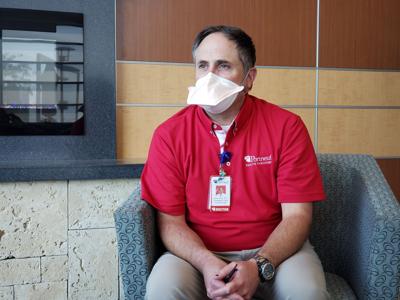
Portneuf Medical Center Chief Medical Officer Dan Snell says the COVID-19 outlook at the Pocatello hospital has not warranted a conversation about implementing crisis standards of care, adding that administrative staff are monitoring the situation closely. Snell said understanding how the capacity fluctuates at the hospital is a key part of knowing whether or not the hospital is equipped to treat any person who comes through the doors.
“Capacity is a funny thing because it’s not just the amount of beds or staff that you have, it’s really the whole overall general picture from an illness, staffing and physical bed standpoint,” Snell said. “We are doing all right right now, but that does not mean we are out of the woods and we don’t have our challenges.”
The vast majority of people who contract COVID-19, get hospitalized with the disease or die from it are unvaccinated, officials say. A graphic released Tuesday by the Idaho Department of Health and Welfare shows that between May 15 and Sept. 4, 90 percent of cases, 91.6 percent of hospitalizations and 88.7 percent of deaths were among people who were not fully vaccinated against the virus.
At Kootenai Health in north Idaho, which requested crisis standards of care on Labor Day, patients are experiencing longer waits before they get access to the intensive care unit, and some are being treated in a conference center converted to house patients, said Dr. Robert Scoggins, the hospital’s chief of staff. The hospital’s third floor is entirely dedicated for COVID-19 patients, he said. He said the hospital is also seeing “significantly more younger patients with” the delta variant.
A group of hospital disaster planners that recommended the state’s two northernmost health districts enter crisis standards also discussed but did not support a statewide declaration, Jeppesen said.
”Ultimately, the reason that the committee recommended and I agreed and decided for just north Idaho, is in talking to those health care entities throughout the rest of the state — they are not quite there for crisis standards of care. Really, really close, but not quite there,” Jeppesen said.
Asked how long crisis standards of care will continue, Jeppesen said state officials will monitor the situation daily in north Idaho and “make decisions that are appropriate for the situation on the ground.” Scoggins said Kootenai Health is also monitoring the situation closely, but he expects hospitalizations will not decline immediately because of the rate of coronavirus tests that return positive.
More than 800,000 Idahoans have received at least one COVID-19 vaccine dose. Only 58 percent of Idaho adults have received at least one dose, compared to 75 percent of American adults. Idaho has the fourth-lowest adult partial vaccination rate in the U.S., according to Centers for Disease Control and Prevention data.


(0) comments
Welcome to the discussion.
Log In