

POCATELLO — A direct response from law enforcement during an active shooter scenario is imperative to limiting casualties. But even then, you can’t always fully prepare for the unexpected.
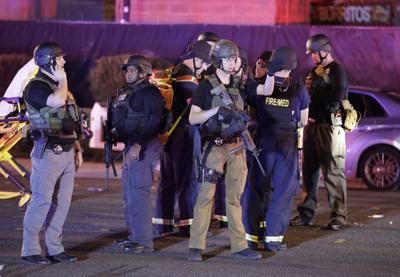
In addition to law enforcement agencies, active shooter scenarios — situations like the recent shooting in Las Vegas that left more than 50 people dead and 500 others wounded when a gunman opened fire on concertgoers — are events that demand a unified response from not only the police, but emergency medical services, hospitals, businesses and sometimes schools or day cares.
To better understand recent active shooter trends and how to proactively develop a plan to coordinate a unified response in case a gunman did open fire on a group of people in Southeast Idaho, Detective Nick Edwards and Cpl. Matt Shutes of the Pocatello Police Department hosted a training for members of the Pocatello Fire Department.
“The police department has had active shooter training for quite some time now but we are starting to talk about a unified response between police, fire and other agencies,” Edwards said. “We talk about active shooter trends in America and the lessons that law enforcement have learned in the wake of these events.”
Edwards said that in the last 20 years, active shooter scenarios have increased in frequency in the U.S. by 300 percent.
“On average, there are about 20 of these types of events in America every year,” Edwards said. “Yeah, you hear about the big ones — just recently we had the largest mass casualty event in the history of the United States with the Las Vegas shooting — but it’s not the only one, and it certainly won’t be the last unfortunately.”
The two-hour classroom-based seminar incorporates the Advanced Law Enforcement Rapid Response Training, or ALERRT, model. First created in 2002 as a partnership between Texas State University and law enforcement agencies to address the need for active shooter response training for first responders, ALERRT was named the National Standard in Active Shooter Response Training by the FBI in 2013.
Edwards said that every officer of the Pocatello police department has previously completed the first and second levels of active shooter training, adding that the purpose of Friday’s meeting with the fire department was to understand what each department’s responsibility would be during an active shooter scenario and establishing a response plan for the future.
“Fire and emergency medical services will have a different response than the police department but we all need to work together to accomplish the goal, which is to save lives,” Edwards said. “All of this comes down to training. If we don’t train, then on the day that it happens we won’t be prepared or ready for what to expect. We do these trainings and have these conversations now so that, heaven forbid, when it does happen we are ready for it.”
Mike Williams, the PFD battalion chief said the department was extremely receptive to the new information, not only because active shooting scenarios are not something firefighters typically train for, but also because some of the problems that arise during other incidents stem from not properly planning beforehand or communicating during the event.
“We were able to identify and talk about scenarios where communication has broken down and had discussions about how we can avoid them in the future,” Williams said. “This applies not only to active shooter scenarios but to any event. Communication is always the No. 1 problem that people talk about in any large-scale event, so to have those conversations now about how we are going to work together will only lead to better service for our citizens.”
A difficult dynamic to training for active shooter situations is that the events often make little sense, which is one reason why Williams said he hopes a massive shooting doesn’t happen in Southeast Idaho but he also can’t be certain that it won’t.
“In no case were any of these active shooters in the history of the United States something that I would deem rational,” Williams said. “Expecting that a person like that would choose a rational target is a ridiculous assumption, so I don’t think we’re at a greater risk but we’re also not at a lesser risk because these events don’t really make sense in any context I can place them in.”
Williams continued, “It’s a possibility and for that reason alone we need to prepare for it.”
In addition to understanding correct initial response and communication methods, the training covered police and first responder tactics when an active shooter scenario is ongoing upon arrival.
“The response from law enforcement is different than what it was in 1999 when Columbine happened,” Edwards said. “The tactics were different, and back then it was the job of the police to surround the location and call out a SWAT team. The tactics have changed because we can’t wait to deal with an active shooter scenario. We have to act immediately.”
Edwards said that because of the sensitive nature of the training and to try and keep the information out of hands reach of the next gunman, most of the advanced training materials are not readily available to the public.
However, the Pocatello Police department does host Civilian Response to Active Shooter Events, or CRASE, trainings. Edwards said he has hosted several dozen of the events at local businesses, schools, daycares and medical facilities. The training is free of charge and those interested can contact the Pocatello Police department.
For Williams, it’s not a matter of if an active shooter scenario could happen in the region, it’s a question of when. And when it does happen, it’s better to have a plan in place as opposed to creating one as the situation develops.
“Nobody in Pocatello wants something like what happened in Vegas, but being prepared for it is our responsibility, whether we want it to happen or not,” Williams said. “We aren’t trying to scare people we just want to ensure we provide optimal service to our citizens. That’s where this comes from, it’s about being ready to give the public what they need whether they ever need it or not.”

(0) comments
Welcome to the discussion.
Log In