

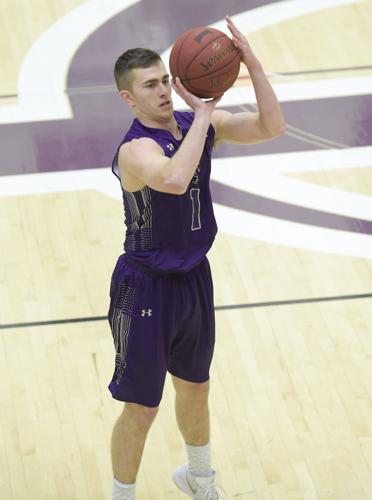
It wasn’t until he blacked out and nearly dropped the weights on his throat while performing the bench press that Gibson Berryhill decided he needed to get checked out.
For a few days this past June, he had been experiencing splitting headaches after working out. But the College of Idaho basketball player had too much to look forward to. For one, he was preparing for his upcoming senior season with the Yotes. Additionally, he had landed a position working at the Fellowship of Christian Athletes summer camp at Northwest Nazarene University.
But less than a week earlier he blacked out while deadlifting. A second instance was cause for concern.
“I’m kind of a stubborn guy, and I was a little naive about the situation,” Berryhill said about the first incident. “So I worked out for another four or five days and kept having those pains. Finally, when I was doing a set on the bench and I almost dropped the weight on my neck and I blacked out, I was like ‘OK something is definitely wrong, this isn’t normal.’”
The decision might have saved his basketball career, not to mention his life. He was diagnosed with a brain aneurysm at Saint Alphonsus in Nampa, then rushed by ambulance to Saint Alphonsus in Boise, where he spent the next three nights.
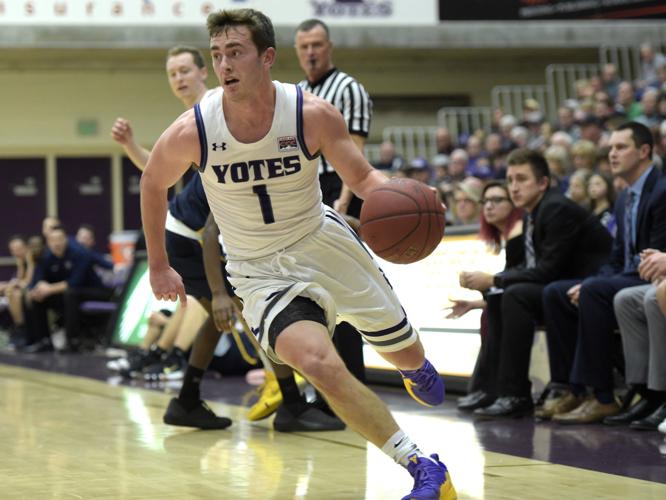
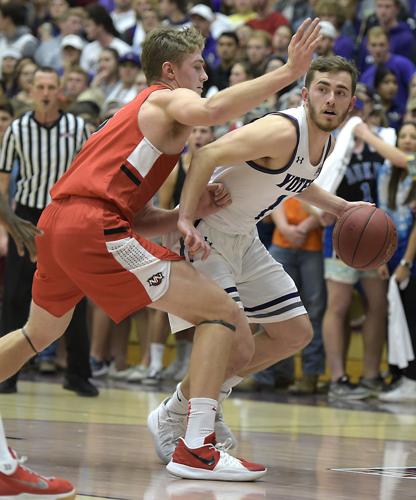
Eight months after the ordeal, Berryhill is enjoying a successful final season on the court with the College of Idaho. His playing career will come to an end sometime in the next week, as the Yotes (28-5) play in the NAIA Division II Tournament in Sioux Falls, South Dakota. The College of Idaho will open the tournament against Voorhees College (24-5) on Thursday.
It’s an opportunity Berryhill thought might never come while sitting in the hospital.
“It’s nothing short of a miracle,” he said. “I thank God every day, every time I’m reminded of this summer and what I went through mentally and physically. It’s really a blessing that I get to be on this team, especially to be able to be on the court and compete for what we’re competing for.”
Often the first guy off the bench for the Yotes, he enters the tournament third on the team in scoring with 11.1 points per game. The guard is averaging 22.5 minutes per game and leads the team with 82 3-pointers.
“We’ve really needed him in a couple games because of his ability to make plays,” said College of Idaho coach Colby Blaine. “Not only shoot but get into the key and make plays for other people. Not a lot of teams have a guy like him coming off the bench that can do that.”
It’s a senior season that almost never was.
For Berryhill, this was his first experience with a serious medical condition. The Timberline High graduate had been blessed with good health his entire life up until that point.
“He had broken his wrist three times and that was about it,” said his father, John Berryhill. “He had a bad wreck on the bike coming down the back of Brundage (Mountain). But nothing like this.”
Gibson Berryhill said the nurse who gave him the initial diagnosis came into the room in tears, dreading the news she was about to give him. If an aneurysm ruptures, it can lead to death.
The trouble for Berryhill was that doctors couldn’t locate exactly where in the brain the aneurysm was located.
“The first night in the ER, they wanted to pop my head open and do a spinal tap,” Berryhill said. “My parents and I are sitting there and I’m like ‘that’s probably not the best idea to do.’ It ended up that I definitely didn’t need to do that.”
After three nights in the hospital, Berryhill was released. But for two weeks, he was on bed rest. After that, he was under doctors orders not to physically exert himself too much. For two months, he wasn’t able to participate in any basketball drills.
“I love working out, I love lifting, I love the basketball workouts,” Berryhill said. “It was really tough, one physically, because I didn’t feel good, but two mentally, thinking about this moment that we’re at now, I was thinking ‘man I’m going to be riding the bench, I’m not going to be getting better, I’m going to be doing this, this and this.”
He’d do what he could to stay active. Every day he walked with his parents, John and Amy, along the Boise Greenbelt. And then there were the large dinners, where Berryhill’s friends would come over, eat and play cards. On many nights, John said, there were more than 20 people over.
“It was just an abundance of love for Gibby,” John Berryhill said. “He was surrounded by his best friends that he had grown up with and they wanted to be with him. They wanted to be there laughing with him. We weren’t talking about the aneurysm, we weren’t talking about that stuff. We were just having this wonderful time.”
Eventually, doctors were able to tell him that the aneurysm was in the basilar artery, which carries oxygenated blood to the brain. But it was located in an area that was difficult to operate on, as coiling it could potentially restrict other parts of the brain.
But Berryhill was given the clear to return to practice. The only restriction placed on him was a 200-pound limit while lifting weights. It was around that time that he returned to campus to begin the fall semester.
“We gradually brought him back in,” Blaine said. “For the first week or two we only did about 50 percent of activity, and then he went 60 percent and 70 percent week after week. But he’s been full go since October.”
Berryhill says he will have to go back once or twice a year to get MRI’s and CT Scans so doctors can look at the status of the aneurysm. There is no treatment for it, but he has been told it should eventually go away. Through this season, he hasn’t let it slow him down.
He did, however, give his parents a scare during a game earlier this year when he got knocked down and stayed on the ground. Fortunately for everyone, he had only hurt his ribs and was fine after the game.
“But it was (scary),” John Berryhill said. “I don’t know if a parent wants to think about those things. I didn’t want to think about the worst-case scenario. But he was being careful, the coaches were being careful. The coaching staff and his teammates, they’re all really good friends and they care for each other.”
For Gibson Berryhill, this week marks the end of his chapter as a competitive basketball player. He is taking a position as a Graduate Assistant in Athletics and Outreach Ministry at Whitworth University where his girlfriend, Jadyn Baumgartner, is a soccer player. He will be pursing a Master’s Degree in Theology there.
But it will be a bit of an adjustment not being on the basketball court.
“It’s definitely the place where I’ve spent most of my time and energy,” Berryhill said. “Even though I’m going to miss it like crazy and I won’t be spending as much time doing it, I just know it will always have a special place in my heart. I’ve poured so much into it and it’s given me so much back. It’s been really my refuge for 10 years now.”

(0) comments
Welcome to the discussion.
Log In