

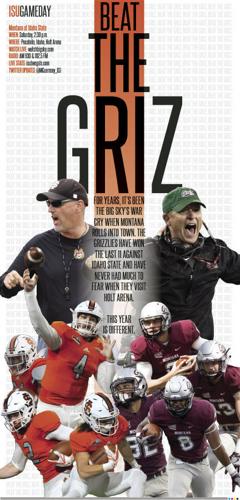
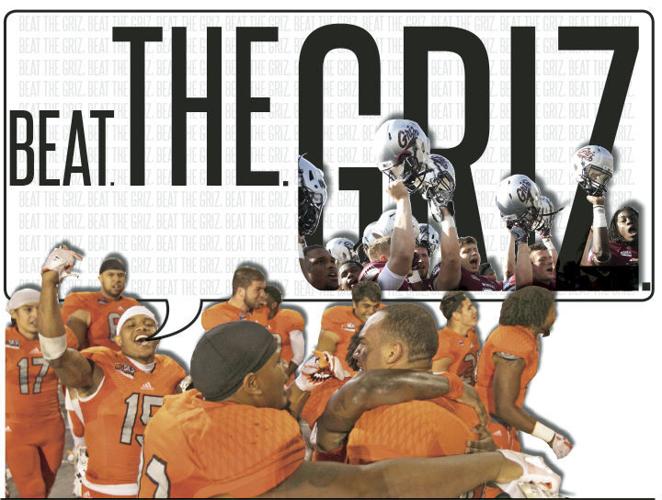
Rob Phenicie sat in a room full of media and appeared to have his answer planned out. No one knew how to react.
It was Monday of Montana week – five days before Idaho State's first-year head coach was playing his former employer for the first time as captain of his own program. Would he downplay the matchup and its history, droll on with coach-speak about faceless opponents and ignore the carryover between the coaching staffs? Phenicie hasn't started any wars of words in his first few months as head coach.
The first question came.
“Rob, you're coaching against your old school, Montana,” one reporter inquired.
Then, the unexpected.
Phenicie began: “First of all...”
The histories
In the 54-year history of the Big Sky Conference, no school has won more league titles than Montana.
The school's 18 conference championships stake a third of the Big Sky's football crowns. Montana's seven national championship appearances are tied for second among FCS programs, and the team's 23 playoff appearances are the most in the FCS.
From 1993-2009, the Griz won 15 Big Sky titles, played for seven national championships and won two. The era cemented Montana as one of the top FCS programs in America and placed the Grizzlies on a pedestal high above their Big Sky counterparts.
Montana owns a 44-13 head-to-head record against Idaho State, with 11 consecutive wins dating back to 2003.
“Obviously, the past success of this place puts a little bit of a target on your back,” said Montana quarterbacks coach Andrew Selle, who played QB at UM from 2007-10. “But it's something that our guys embrace and us as coaches embrace.”
While Montana's legacy has been built through decades of sustained dominance, Idaho State's success has been much more sporadic.
The Bengals rose to their peak in 1981, winning the program's lone FCS championship. Ever since, ISU has mostly been an afterthought, with a shared Big Sky title in 2002, seven winning seasons and five seasons with one or no wins.
Idaho State's recent struggles led to the abrupt retirement of former head coach Mike Kramer in March – just days before the team was set to start spring camp. Kramer is one of the most successful football coaches in Big Sky history but couldn't draw up more than one winning season in six years at ISU.
While the technical term is retirement, Kramer was really dismissed. ISU Director of Athletics Jeff Tingey said Kramer would not have returned to coach the Bengals in 2017 if he did not retire, and the timing of the transition uttered bemoans of “typical ISU.”
In the 14 years since Larry Lewis coached ISU to its last conference title, the program has averaged three wins per season.
“After Larry Lewis left, there's kind of the dark ages of Idaho State football, where they didn't really do anything,” said Colter Nuanez, who has covered the Big Sky Conference since 2006 and grew up entrenched in Montana football as a season-ticket holder in the mid-1990s.
Despite the programs' contrasting identities, Idaho State has managed to keep its games with Montana competitive.
Since 2001, five of ISU's 13 losses to Montana have been by six points or fewer. Most recent are the 2009 game in Pocatello featuring the 8-0 Grizzlies and 0-9 Bengals that UM won 12-10 on a last-second field goal, and the 2015 matchup that came down to a bad snap on ISU's game-winning field-goal try that turned into a game-ending touchdown for the Griz in overtime at Holt Arena.
“It's never an easy game in Pocatello,” said Selle, who played in the 2009 game and coached in the 2015 game, “and we expect no different this year.”
Coaching crossover
Saturday's game features plenty of familiarity between the two coaching staffs.
First, there's Phenicie, who orchestrated Montana's offense from 2003-09 and, alongside mentor and then-head coach Bobby Hauck, took the Griz to three national title games.
Phenicie coached Selle, UM receivers coach Mike Ferriter, UM running backs coach Justin Green and UM safeties coach Shann Schillinger during his tenure at Montana. Ferriter and Griz offensive line coach Chad Germer were on staff at UNLV with Phenicie and Hauck, and Ferriter coached Idaho State's receivers and running backs in 2012 and 2013. Ferriter was also the best man at the wedding of ISU Director of Strength and Conditioning Dan Ryan.
Then, there's ISU offensive coordinator Matt Troxel. Troxel played under Phenicie at Montana, has coached at ISU since 2010 and briefly returned to Montana this past offseason.
Following ISU's 2-9 2016 campaign, Troxel accepted a job to coach receivers at his alma mater. Once Phenicie was elevated to head coach, Troxel returned to Pocatello to be his mentor's offensive coordinator.
Troxel and Griz head coach Bob Stitt say there's no animosity or scheme overlap from Troxel's brief stint at Montana.
“We really haven't talked about it much,” Stitt said of the coaching familiarity. “We go into (the game) and prepare the exact same way. … It really hasn't been brought up, so I don't know if it's a big thing for them, but it's not on this side.”
Proof in people
Montana's Washington-Grizzly Stadium is known as a premier venue around the FCS. The 31-year-old, 25,000-seat stadium has led the FCS in attendance each of the last three years and has ranked in the top three each year this decade.
Griz fans are rabid and well-traveled. Since 2001 – as far back a the Big Sky's attendance figures date – four of Holt Arena's top 10 crowds have been against the Griz, partially due to Montana fans traveling in droves.
“I guarantee you, there's legitimately thousands of Montana fans that go to Pocatello this weekend,” Nuanez said.
“You think it's your crowd until you get tackled for a loss,” said ISU assistant coach and former Bengals player Aaron Prier.
While games against the Griz consistently draw notable audiences to Pocatello, Idaho State doesn't have the same effect in Missoula.
None of the top 25 attended games at Washington-Grizzly Stadium have featured Idaho State. Montana is 192-29 all-time at Washington-Grizzly and played its first game at the venue in 1986 – a 38-31 win over the Bengals.
“It's the history,” Troxel said. “That's the culture and the tradition that they've built over that time. Now, you're seeing the culmination.”
***
Phenicie continued... “We're playing the flagship team of the conference. They have the best facilities, they have the offensive genius as a head coach, they come out of the tunnel with all these neat flags, and we're just lucky to be on the field with them. We're just poor little Idaho State, and we don't have a big stadium. Our stadium's old. ... We'll give our best and hopefully keep it close.”
It was met with a mixture of silence and awkward laughter. Was it tongue-in-cheek, a shot at ISU's naysayers? A fight promotion?
“I'm serious,” he said.
This is Phenicie's big game, a chance to end a decade-long losing streak against his old team and start ISU's path toward solidifying success.
“Our goal is to get respect – earn the respect of our brand on our helmet instead of people looking at us, 'Oh, we got that one,'” Phenicie said. “We want it to be a bear of a game.”

(0) comments
Welcome to the discussion.
Log In