

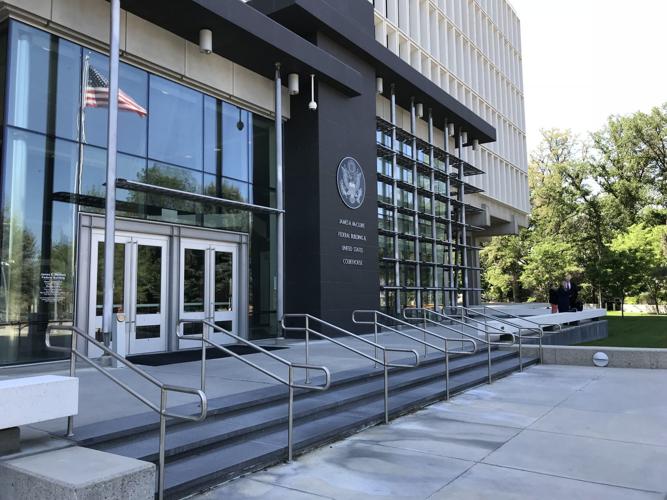

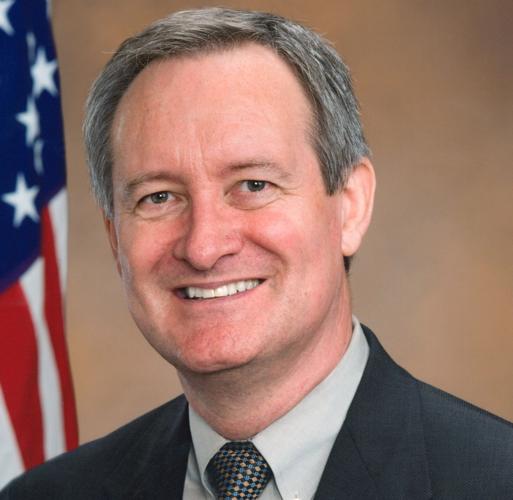



Idaho Sens. Mike Crapo and Jim Risch this week sent a letter to the White House requesting a meeting about Idaho’s federal district judge vacancy, saying it “cannot be filled” without a “mutual agreement” between them and the administration.
“The blue slip procedure regarding filling United States District Court vacancies is alive and well,” the two senators wrote in a Nov. 2 letter to Dana Remus, counsel to the president.
That’s a system that for years gave home-state senators a veto over federal judicial nominees, but the procedure was thrown out during the Trump Administration, when federal judges were appointed over objections from Democratic senators.
In March, Idaho’s top Democratic elected officials interviewed candidates for the judge opening and submitted an all-female list of four nominees to the White House, but there’s been no further word on the nomination since; U.S. District Judge B. Lynn Winmill took senior status in August, making Idaho eligible for another judge.
“This is a critical appointment and we remain ready to support the Administration in filling it,” Boise Mayor Lauren McLean, one of the Democratic elected officials who submitted the nominations, said Thursday.
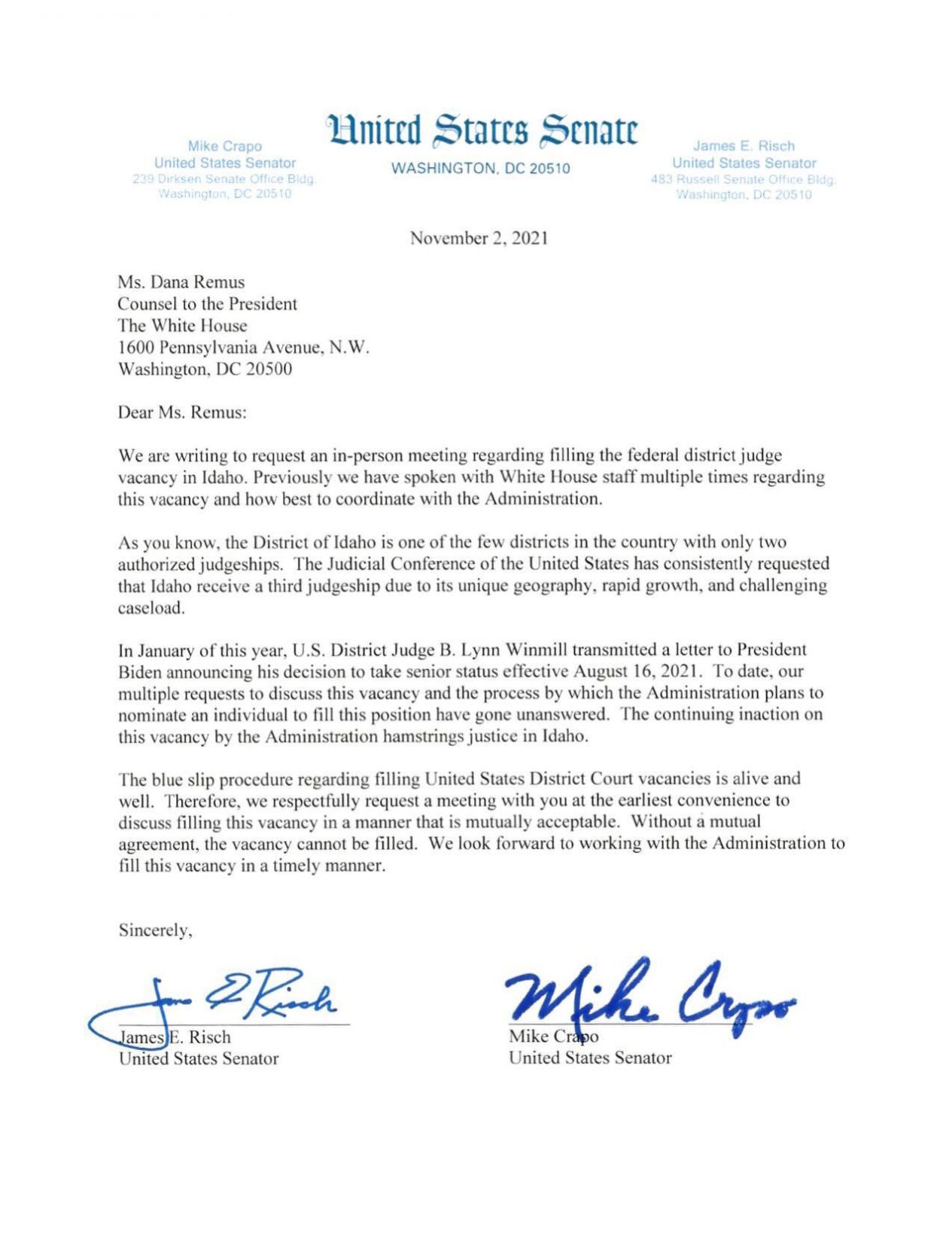
The two GOP senators requested “an in-person meeting regarding filling the federal district judge vacancy in Idaho,” and said, “We respectfully request a meeting with you at the earliest convenience to discuss filling this vacancy in a manner that is mutually acceptable.”
They also said they’ve spoken with White House staff about the matter “multiple times,” but their requests to discuss the vacancy have “gone unanswered.”
A request for comment from the White House press office drew no response by press time.
It’s been unclear since President Joe Biden took office how the Senate would approach the “blue slip” rule, and Russell Wheeler, a fellow with the Brookings Institution, former deputy director of the Federal Judicial Center and an expert on the selection of federal judges, said, “It’s not as if the ‘blue slip’ is a binary choice, it’s either on or it’s off. It’s more like there are various gradations.”
When Sen. Patrick Leahy, D-Vermont, chaired the Senate Judiciary Committee from 2007 to 2015, “It was very strict,” Wheeler said. “If a home-state senator said ‘no,’ that was the end of it.”
But the procedure was “dead as a doornail” when Republicans controlled the Senate under the Trump Administration, he said, and Trump made circuit judge appointments over Democratic objections.
Wheeler said Biden so far has nominated dozens of federal district and circuit judges, but nearly all were in jurisdictions with either two Democratic senators or no senators, like Puerto Rico and the federal circuit in the District of Columbia. The only state that has a Republican senator that’s gotten judicial nominations from Biden so far is Ohio, which has one Republican and one Democrat representing it in the Senate.
As for the “blue slip” rule, “I don’t know what the basis is for the senators’ statement that it’s alive and well,” Wheeler said. “They may know something in the cloakroom that we don’t know.”
But he said the nomination record so far shows no sign of cross-party agreement on judges beyond Ohio.
Idaho is one of just three states with only two U.S. district judges; it hasn’t gotten an additional judgeship in 60 years, though its caseloads have soared. Idaho’s congressional delegation has long pushed for the state to get an additional judgeship, and all four of its members are currently sponsoring legislation to do just that, though it hasn’t advanced. The nonpartisan Judicial Council of the United States has been recommending a third judgeship be added for Idaho since 2003.
Wyoming, with less than a third of Idaho’s population, has three district judges. So does Montana, with less than two-thirds of Idaho’s population.
Idaho is also one of just two states that has never had a female U.S. district judge; the other is North Dakota.
Idaho House Minority Leader Ilana Rubel D-Boise, who also was among the Democratic officials who interviewed and submitted nominees to the White House, said she met in-person with her White House contact a couple of weeks ago, and pressed for updates.
“I didn’t get any more sign of progress,” she said. “I certainly am doing everything I can to nudge progress on this front, because we certainly need a third judge here in the district of Idaho, but we certainly can’t afford to get back to one.”
Winmill, 69, made it known long in advance that he would take senior status but continue to hear a full caseload, allowing Idaho to get another badly needed judge.
Rubel bristled at the senators’ contention that the “blue slip” veto rule is back.
“It would be one thing if that were something that was consistently honored by both parties,” she said. “If it continued to be a bipartisan tradition, then I would be supportive of maintaining that. However, the Trump Administration decided to blow that up in order to gain an advantage in judicial appointments while they had control of the White House and the Senate.”
The slate of nominees that the Democratic officials sent the White House, in alphabetical order and not ranked, were Idaho Falls attorney DeAnne Casperson; Boise attorney Keely Duke; Boise attorney Deborah Ferguson; and former U.S. Attorney for Idaho Wendy Olson.
Crapo’s press secretary, Melanie Lawhorn, said in an email, “We are aware that there are some candidates, but do not have information on how long the process has been under way or the status of the interviews and we are unable to say who at this time. Part of the request for the meeting is to understand the White House’s timeline and current status.”
She wrote that the “blue slip” process “previously applied to Circuit Court and District Court judges, but now only applies to district judges. Sen. Durbin, chair of the Judiciary Committee, wasn’t completely clear before about retaining the process at all, but currently it appears, especially with some Pennsylvania and Wisconsin judges, he’s allowing the blue slip process to stay in place for district judges.”
Crapo declined to comment on whether any or all the Democratic nominees are acceptable to the GOP senators. “Senator Crapo is requesting a meeting with the White House to discuss and work to find a mutually agreeable nominee,” Lawhorn wrote. “He is not commenting prematurely on individuals before any formal nomination.”
Rubel said of the four nominees, “I think they’re superb. I think Idaho would be very fortunate to get any of those four women on the bench.”

(0) comments
Welcome to the discussion.
Log In