

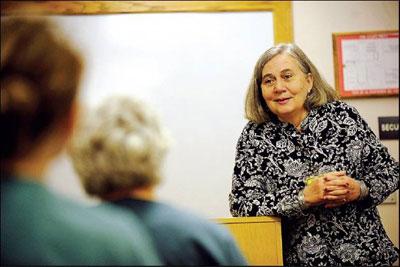
POCATELLO - Author Marilynne Robinson laughed and the women's book group laughed with her, basking in the presence of the Pulitzer Prize-winning novelist. The questions, incisive and earnest, came one after another. Are your characters based on actual people? How did you name your fictional town? Were any of the events real? Robinson answered each question and offered her definition of an author.
"Writers are people who have walked, blinking, out of some squalid little room," she said.
Twenty minutes later, Robinson walked from the room and into a cold and rainy Idaho autumn morning. Her audience remained behind, unable to follow, segregated from society by concrete walls and steel doors.
For the women of the Pocatello Women's Correctional Facility, the visit by Robinson was an extraordinary treat, a chance to ignore the constraints and routine of prison and simply share their common love of literature.
Many women come to the facility with educational deficits. The inability to read and write at a sixth-grade level is as hampering to success in prison as it is on the outside. Sentencing judges or the board of pardons and parole often require inmates to obtain a high school equivalency diploma, referred to as a GED. The requirement is not only for the betterment of the inmates, it is also necessary to enable them to effectively comprehend the required course work they must take in prison.
Every new inmate is given the TABE, or test of adult basic education, upon arrival. This test gives the facility's teachers an idea of the work that lies before them. The prison employs three full-time teachers and one full-time and one part-time assistant. Two AmeriCorps volunteers also help.
Vicki Thomson and David Krauser are two of the full-time instructors at the prison. Given the environment of a penal institution, it would be understandable if either seemed dissatisfied in their work.
"There's no other school that I can have a greater effect on the community than this one," Krauser said.
"It's much better than teaching in a public school," Thomson said.
To understand their passion for their work, one needed only watch the interaction of the women at the Oct. 4 meeting with "Housekeeping" author Marilynne Robinson. The collective thirst for every molecule of knowledge Robinson could offer the women was nearly palpable. After the session was over, several of the inmates appeared euphoric that they had been able to ask questions of the author of a book the women had all read.
One of those women was Annie Barkey. Barkey serves as the prison's librarian. She is also a tutor to many of the women working toward their GED. More importantly, she is a tireless cheerleader for the role of education in the penal system. Sitting in the small but vibrant and well-stocked prison library, Barkey seemed at home.
"I think this department is the most important in the whole prison," she said. "There's people who come in here who can't read, who go out reading at a 10th-grade level."
Movies and television depict prison life as fraught with hostilities and skirmishes between inmate factions. While there are frictions in such close quarters, they are seldom so dramatic, and those inmates who step into the library enter a safe haven.
"This is a very safe environment," Barkey said.
Indeed, the library and the testing center are cheery, with updated bulletin boards in fall colors, some touting professional football teams, others portraying Barack Obama's and John McCain's presidential tussle.
Barkey sits down at a table in the library, joined by Lisa Marie Varie, 43, and Denise Whittle, 39. All three serve as tutors and mentors for their fellow inmates and attest to the therapeutic nature that obtaining and passing on knowledge has had for them.
"We are trying to be greater as a group than (we were as) individuals," Varie said.
Varie, convicted of second-degree murder, has served the seven-year fixed portion of her sentence. She has been denied parole on two occasions. With no firm date when she might be released, she retains hope and takes comfort in books and helping other inmates meet their educational goals.
"Eleven years into it, I'm not as broken as I was," she said.
She attributes her positive attitude in great part to the "incredible kindness" of fellow inmates.
"Every judge intends this to be a crossroads," Varie said, explaining that inmates who fail to take advantage of the educational opportunities often come back.
"The wrong people will accept them before the right people will," she said of those women unprepared to re-enter society as knowledgeable and productive citizens.
Barkey seconds the necessity of inmates getting an education.
"I think this is the only department that prevents recidivism," she said. "I think everyone who leaves here should have a GED."
Denise Whittle is one of the rare women who enter the facility with both a high school and a college degree, but she is modest about her educational accomplishments.
"There are so many women here who are brilliant," she said.
Whittle, with convictions for felony injury to a child and two counts of grand theft, credits journaling as her main method for coming to terms with her situation and finding a sense of self-worth, something she tries to help other inmates achieve.
"You can't send someone up here and expect them to come out exceptional," Whittle said. "You've got to want, to desire to change. You've got to be persistent. It's coming to terms that you are valuable."
Whittle describes journaling and reading as a means "to let what's in you go another direction."
All of the women agree that finding a semblance of self-esteem is the first step on the path to getting inmates' lives in order, and that education is the best conduit toward that goal. The instructors and inmate tutors exert no pressure, but simply encourage the women to learn.
"In this environment, people are always quick to help someone," Varie said.
"Most people don't realize there's an education department up here," Thomson said.
"Many people have the impression that people who are incarcerated are sitting in their cell," Krauser adds.
Thomson is in her 12th year teaching at the facility; Krauser is in his second. Both makes no bones about their preference for teaching inmates rather than kids, citing more control of the curriculum, no parental interference and much more respect from their pupils.
They have witnessed the transformation of a number of their pupils. Krauser notes one woman who came to the facility about two years ago.
"She couldn't read more than a stop sign," he said. "Last week, she proved to ISU that she could write at a 10th-grade level."
Thomson and Krauser said the prison has an environment of accomplishment. Educational milestones are celebrated, and inmates are mindful of others who have reached them.
"We make a big deal around here about graduation," Krauser said. "It's a little more meaningful than what goes on in Holt Arena."
One of the biggest obstacles Thomson and Krauser face is that many inmates feel they are stupid, incapable of learning. They need reassurance on a constant basis to overcome those feelings of slowwittedness which have been hammered into them by parents, acquaintances and even teachers.
"We're giving them a second chance," Krauser said. "We're just helping them realize their own potential."
Thomson sees her job as just the beginning.
"We're instilling a love for learning … that's a life-long process."
Once the women realize they're capable of learning, their enthusiasm can be boundless.
The GED test covers reading, writing, math, science and social studies, and the staff focuses on these core subjects. Thomson's expertise is in math; Krauser's are writing and history. Inmates such as Barkey, Varie and Whittle primarily aid in reading and writing skills.
"Peer tutoring is a good help," Thomson said.
The testing is conducted by Idaho State University. Approximately 100 people per year are tested at ISU. In 2007, the prison had two inmates score in the top 10 of all those tested, and three cracked the top 10 in 2006.
"We have some that perform very high here," Thomson said of GED testing.
Besides obtaining a GED, an inmate must be able to read at a sixth-grade level to take programming courses. These classes, often a prerequisite for parole consideration, include cognitive therapy, drug and alcohol counseling and anger management. Other classes, known as workforce readiness, prepare the women for release, with subjects such as self-care, vocational math, computer proficiency, employment skills, customer service, financial planning and advanced ethics.
Barkey, Varie and Whittle see room for improvement in the system. Barkey would like to see funding for correspondence classes. Varnie said cognitive classes would be more beneficial if inmates received them before interacting with the prison population. They list other ideas for improvement and address various grievances with the institution, but they have nothing but kudos for the educational staff.
"These people have shown me a lot of respect," Barkey said of the prison's educational staff. "They've let me express myself through education."
Barkey has seen many women come through the prison's educational system.
"Seventy-five percent of them change because the people here go the extra mile," she said.
The prison's library contains between 10,000 and 11,000 books. For many of the inmates, books '97 no pun intended '97 are their escape.
"If you're a reader, you read a book a day," Varnie said.
"They take you to another place," adds Whittle. "Use (the resource) until the books are worn out."
"This has got to be the best library of any institution anywhere," Barkey said, summing up.
Besides books, the library also has periodicals, which the inmates readily consume. On the conference table are recent issues of Time, Newsweek and other news magazines. The consistent theme of all, of course, is the presidential race, which the women are following intently. On Nov. 4, approximately 100 of them will cast their ballots in an inhouse "election."
Marilynne Robinson's allotted time to speak with the inmates ran out well before the questions ran dry. During a momentary pause, she looked out at the women, many of whom held copies of her book for the author to autograph, and reflected on the visit with her readers.
"You find out why people write books," she said. "You find out what they mean to people." }

(0) comments
Welcome to the discussion.
Log In