

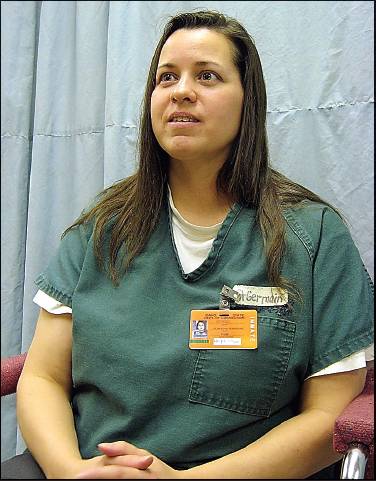
POCATELLO - Teresa St. Germain is a quiet and respectful woman, but it wasn't always so.
"I've done a complete 180," she said.
St. Germain came to the Pocatello Women's Correctional Center in September 2007. She spent her first year in "the hole," the term inmates use for an isolation cell. Despite being wheelchair-bound, St. Germain's antisocial conduct was so egregious she was forced to remain in disciplinary segregation. She refused to participate in any classes and wanted no part of medications.
"I didn't want anything to do with anything or anybody," she said. "I was very rude and obnoxious."
"And sick. And scared," added Jeannie Malek, the facility's psychiatric RN.
St. Germain's original diagnosis while she was in Ada County Jail was a broad "personality disorder" verdict. After coming to the prison, the medical staff came to more concrete diagnoses, including dependent personality disorder, depression, substance-induced psychotic disorder and conversion disorder.
A vast number of inmates suffer from some mental health issue, including anxiety, depression, suicidal and homicidal ideation.
"It's difficult to differentiate between mental health issues and drug-induced issues," Malek said.
St. Germain's conversion disorder presented an unusual challenge for medical staff.
"Ms. St. Germain believed that she could not walk and could not read and could not write when she got here," Malek said.
In reality, St. Germain had so internalized the difficulties in her life - foremost was an extremely abusive relationship - that her anxiety was converted into physical symptoms. She fell while in the Ada County Jail. She believed that the injury had made her unable to walk.
Finally, St. Germain let down her guard enough to allow Malek to begin to help her. She gave her some therapy for her back, including electronic stimulation and massage. It was a way for St. Germain to save face and believe her physical symptoms had some basis in fact. In a short time, she had graduated to a walker. But her obstructive behavior had not abated.
"I tried to put my walker through that window," she said, pointing to one of the medical unit's windows.
Soon after, St. Germain was walking normally. With the building of some trust in the medical staff, she began taking classes to address some of her underlying choices and difficulties.
"It hurts a lot," she said. "You do a lot of crying in those classes."
St. Germain began to address her prior relationship, which was abusive.
Her inability to leave her relationship in a conventional means eventually landed her in prison. With only a day's planning, she and another woman decided to hold up a bank. Her co-conspirator tipped authorities, who were waiting for her when the car pulled up to the bank.
She describes hearing a two-way radio going off inside the car before she got out. Her fellow robber - working with law enforcement - had inadvertently left it on in the car. St. Germain got out of the car and was immediately subdued and arrested.
"I knew I was getting caught," she said. "I think it was an easy way out."
She now feels safe, a feeling she last felt "when I was a little girl."
Last Thursday, St. Germain's progress was rewarded. She was transported to Boise to the Therapeutic Community, a transitional facility that addresses substance abuse and readies inmates for parole.
Mental health screenings are part of the intake process for all women entering the penal system. Some women who are slated to go to other facilities end up staying due to the severity of their mental health issues.
"We know they're going to crash and burn, so why send them back?" Malek said. "They'll fail and it won't be pretty."
Malek noted that many of the women begin suffering situational depression when they are first jailed. Often, they are treated with medications to combat their depression from being locked up.
"We have to play the bad guy here and get them off (medications)," she said.
"We're obligated to do gradual dose reductions in medications," said Tyson Christensen, the facility's clinician. "It's the same standard as any medical facility."
Most inmates with underlying mental health problems are able to function in the general population with medication, support groups or both. Those who can't are housed in the maximum security unit to ensure their personal safety and that of others until they can be stabilized and reintegrated into the general population.
Medication is one tool to help the women, but they often must address their underlying emotions to achieve more durable mental health.
"We've got lots of angry women in here," Malek said. "It's valid anger. Giving them that validation sometimes is a good thing."
The trick is to try to get the women to channel their anger and grief constructively. Some women choose to participate in classes and support groups, while others avoid it. Some chose to "top out" their sentences without taking any classes, rather than addressing and reliving many of their past traumas.
Conversely, some women find the programs to be the only place they can openly express their emotions and address their hurt without being perceived as weak.
"This is a bitch of a place to try to grieve," Malek said.
The classes offer the women tools to cope with their emotions, something they often lacked on the outside.
"In most cases, the only way they addressed grief was to use (drugs)," Christensen said.
Unfortunately, some inmates resolve to never make any breakthroughs.
"There are some people we're not going to fix," Malek said. "You just have to move on. It becomes a matter of self-preservation."
Shirley Ruth Pesce sits in a small room containing a television with a camera, which is used twice a week for inmates to speak with Dr. Adrian Dean, a Twin Falls psychiatrist who counsels the women via videoconference.
Pesce, 56, has been in the prison since September. A talkative woman, she freely admits to a troubled past.
"I've done lots of drugs," she said. "I'm not proud of that. I used to be the wheelman in armed robberies. I've done a lot of things."
Pesce's latest encounter with the law came after her mother's husband died. Care for her mother fell to her and Pesce buckled under the pressure.
"Instead of doing the right thing, I messed up and did drugs," she said.
During her incarceration in Bonner County, Pesce had what she describes as a nervous breakdown. Although she has no memory of it, she was told she removed her clothing on the transport bus to the prison and ran up and down the aisles.
"I don't take my clothes off for anybody," she said emphatically. She points to some scars she has accumulated from a tumultuous life.
"I was in the war on drugs, and I lost," she said.
Shortly after she arrived at the prison, Malek and her staff determined Pesce was too vulnerable to remain in the general population. She was moved to Unit 4 - maximum security.
One of the things plaguing Pesce prior to her arrival was an unremitting belief that a grandchild was in danger. Within a month of her arrival, Malek and Christensen had to break tragic news to her. Her son, Tyler, had died in an automobile accident. Pesce's world closed around her.
"If I was free at that time, I wouldn't be alive now," she said. "He was my best friend."
It is clear that Pesce's mental health has made great strides - with proper application of psychotropic drugs and grief and loss counseling - in the last few months. Part of Pesce's healing has come through video conference psychiatric sessions with Dr. Dean.
"You've had a rough time, haven't you?" Dean said to her in one of her first sessions.
That simple acknowledgment of her pain brought her to tears, knowing somebody cared about her.
She is also taking several medications, one of which is a mood elevator that has given her relief from her incessant crying and depression.
"I didn't believe that was possible," she said.
Christensen said it is likely that Pesce will rejoin the general population soon. She is looking forward to reintegration and being able to mix with women her own age.
She can speak without tears about Tyler now, although he is constantly on her mind.
"I know I'll see him again one day," she said. "That makes it so perfect."
And she is resolved to not dishonor her son's memory, the son who loved the mother but hated her drug habit.
"I'll never go back to drugs," she vows.
Tammy Ann Hoover has been incarcerated for seven years. Suffering from anxiety, paranoia and depression, she attempted to self-medicate her symptoms by using methamphetamine before her arrest. While her drug use evened out her depressive episodes, it increased her paranoia.
"I was a basket case," she said. "My anxiety was out of control."
After arriving at the prison, Hoover, 38, was treated with various medications. As is often the case, finding the correct combination and proper dosage has been an ongoing task.
Strides were made in addressing her anxiety and depression, but one set of symptoms continued, unknown to medical staff. For years, Hoover had been hearing voices.
About two years ago, Malek, having noticed some peculiar behaviors, gently confronted Hoover about whether there were other problems. Hoover finally told Malek that she had been hearing voices - three voices, to be exact - for years.
"They would attack me," Hoover explained, noting she was particularly vulnerable later in the day, during inactivity or when she was tired.
The voices would denigrate her, attacking her self-esteem and whispering that others were belittling her.
Hoover thinks the medical team has finally dialed in her medications.
"I feel like a normal person," she said. "I hope this is what a normal person feels like."
Hoover has three more years on her fixed sentence. She is pragmatic about her incarceration.
"If I hadn't have got here, I'd have been dead," she said. "That's the way I was going."
She is looking forward to her eventual release.
"I think I've gotten enough programming," she said. "I think I can make it. I really do. I'm nervous, but I'm looking forward to it."
Malek smiles at her longtime patient.
"You've come a long way, Ms. Hoover," she said.

(0) comments
Welcome to the discussion.
Log In