

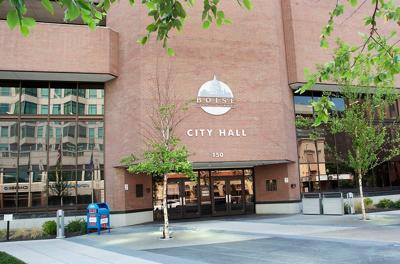
BOISE — The city of Boise announced the settlement of a federal lawsuit Monday, bringing an end to a legal battle on the city’s anti-loitering ordinance first initiated over a year ago.
A challenge to Boise’s ordinance was made by Luke Schuchardt in January 2024 after he was stopped and questioned under the statute by Boise Police officers and subsequently arrested and prosecuted.
Under the terms of the settlement, the city agreed to pay out $200,000 “after both parties evaluated the merits of the case and the resources required for extensive litigation.”
The ordinance has been suspended by executive action due to a ruling by U.S. District Court Judge Barry Lynn Winmill in August, and the city council will be taking up the repeal of the ordinance as part of the settlement agreement, a news release from the city said.
Schuchardt’s arrest stemmed from a March 4, 2022 encounter between Schuchardt, a woman and Boise law enforcement at a 24/7 car wash. At the time, both Schuchardt and the woman were parked in adjacent, unilluminated manual car wash bays just after midnight. Schuchardt contends he was searching for change in his car and did not realize the woman was there, court documents said.
Citing police reports, however, the city said Schuchardt “took out methamphetamine, put on a latex glove, and unbuckled his pants,” leading the city to infer he was at the car wash to “engage in a sex-for-drugs transaction” with the woman, court documents said.
Boise Police arrived at the car wash at approximately 12:30 a.m. and detained both Schuchardt and the woman on suspicion of violating the city’s anti-loitering ordinance. Under the ordinance outlined in Boise city code, 5-2-3(A)(2) states that anyone engaged in “loitering, prowling or wandering upon the private property of another, without lawful business, permission or invitation by the owner or the lawful occupants thereof” is guilty of a misdemeanor.
Officers used this ordinance to detain Schuchardt and the woman. They would then determine Schuchardt had an outstanding warrant for his arrest and a BPD drug dog gave a positive alert to his vehicle, leading to the discovery of marijuana and methamphetamine after a vehicle search, court documents said.
Though Schuchardt was charged for drug possession in state court, the case was dismissed after the trial judge found police had violated the Fourth Amendment by “initiating the stop without reasonable suspicion,” court documents said, adding that this dismissal led Schuchardt to bring his lawsuit against the city of Boise and the arresting officers — BPD Officers Craig Sousa and Ryan Pollard — with allegations of constitutional violations.
The U.S. District Court found that the ordinance used to engage Schuchardt was “unconstitutionally vague because it fails to provide sufficient standards to govern law enforcement.” Since vague law results in policy being interpreted on an “ad hoc and subjective basis” by “policeman, judges and juries,” statute must clearly define what conduct is prohibited in a way that ordinary people could understand, court documents said.
After laying out the facts of the case, the Winmill ruling noted the “undisputed facts show” Schuchardt went to the car wash for a drug transaction and, since he was engaged in outlawed behavior, he had “fair notice that his conduct would violate the anti-loitering ordinance.”
Though this resolved a facial challenge of the ordinance (in which the statute is argued to be unconstitutional whenever it is applied), the challenge of the ordinance based on arbitrary enforcement remained. To address this challenge, the court needed to determine whether BPD could make the determination as to whether Schuchardt violated the ordinance as written.
Winmill wrote that, at the time of the encounter, officers only knew that two cars were parked next to each other at a 24/7 car wash — they did not know Schuchardt had illegal drugs until he was already detained. With this in mind, Winmill said in his decision it was “far from clear” the city’s ordinance prohibited “briefly parking at a car wash without cleaning one’s car.”
Citing past precedent in anti-loitering case law, Winmill pointed to a decision from the Nevada Supreme Court that struck down state and municipal laws prohibiting “‘loitering, prowling, or wandering upon the private property of another, without visible or lawful business with the owner or occupant thereof’” — a wording very similar to Boise’s ordinance.
In that case, the Nevada Supreme Court ruled that, without “actionable standards,” the laws end up giving law enforcement broad discretion, opening up the possibility of “arbitrary and discriminatory enforcement.” This possibility is also true of Boise’s ordinance, Winmill said.
Like in Nevada’s case, Winmill ruled Boise’s ordinance failed to provide standards that would prevent arbitrary enforcement and, in failing to define unlawful loitering as opposed to lawful detour, “vests police with tremendous discretion to determine when an individual’s presence on private property becomes a crime,” running afoul of due process principles.
For each of these reasons, Winmill ruled Boise’s ordinance to be unconstitutionally vague.
Per the terms of the settlement, Boise’s anti-loitering ordinance repeal will be considered within 90 days and might be included in the city council’s agenda in early December, a city spokesperson said in an emailed statement.

(0) comments
Welcome to the discussion.
Log In