



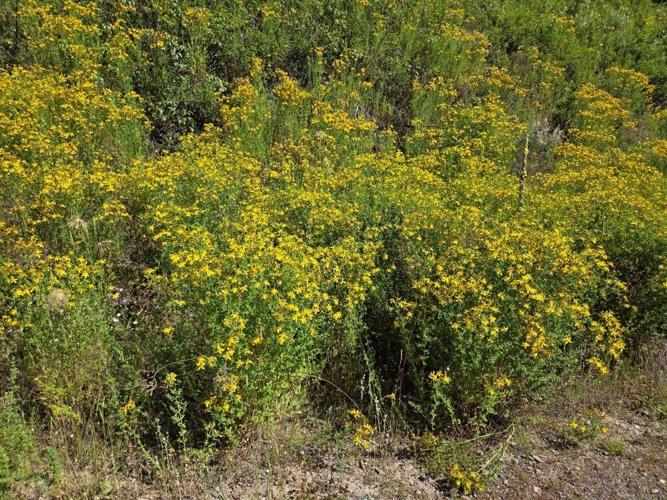
About a month ago, we drove down to the Warm River Spring and former fish hatchery site in Island Park. This is a favorite place for us, and I have been saddened to see noxious and obnoxious weeds such as spotted knapweed, hoary alyssum, yellow toadflax, plumeless and musk thistles, and common mullein, gaining ground each year in spite of efforts (mine and others) to control them. This trip, though, I noticed large patches of a perennial shrublike herbaceous plant (dies back to the ground each year) with yellow flowers. I had never noticed it there before, nor did I recognize it as a native. I did a little research and discovered that it is St. Johnswort, or St. John’s Wort, Hypericum perforatum, a native to Europe, Asia and Africa.
This didn’t seem like it was a good thing, and further research proved that to be the case. This plant came to this country for the first time likely in 1696, brought here by German colonists who transported it with them as an herb used in mystic rites and “to exorcise the devil, protect newborns, and ward off imps and demons of melancholy.” Along with English settlers, they brought seeds for gardens, from which the plant promptly escaped from Maine to Florida. It was introduced into California in 1900, and by 1930 it was blamed for severe economic losses because of impacts on pasture, rangelands and livestock. Today it is in nearly every state and listed as a noxious weed in California, Colorado, Montana, Nevada, Oregon, South Dakota, Washington, Wisconsin and Wyoming. Several northern Idaho counties list it as a noxious weed as well.
St. Johnswort is a member of a genus with more than 400 species, and there are native species of this genus in the continental United States. And that makes it sometimes challenging to know which specific species is being referred to. That makes the use of the scientific name very important. There are many nurseries that sell St. Johnswort of other species than Hypericum perforatum. Not all of these are invasive. However, I did find at least one popular nursery in Idaho Falls that actively promotes the sale of Hypericum perforatum as a garden plant.
And therein lies the problem. One of the most common ways for invasive plants to become established is through the garden and landscape trades. Plants such as purple loosestrife, giant hogweed, reed canary grass, kudzu, Japanese knotweed, and many more were exotic plants valued for their ornamental flowers, foliage, or utility (e.g., erosion control, shade, ground cover). But once loose in a new environment without predators and pathogens, they went wild.
In the case of St. Johnswort, not only is it a pretty specimen plant, but it is also sought after as a medicinal herb. In Europe, it is approved for treatment of depression and has been used for treatment of wounds for over a thousand years.
The dark side to this plant, and again I am talking specifically about Hypericum perforatum, is as large as a black hole. It can readily take over disturbed areas. Montana reports over 500,000 acres lost to this weed. It spreads by rhizomes forming dense monocultures, and each plant can produce 10-30,000 seeds which might persist in the soil for 30 years, just waiting for a chance to re-establish a colony wiped out through intensive control measures. The Forest Service says it will not invade established vegetation, but that wasn’t what I saw on Warm River.
From a livestock and wildlife standpoint, consuming even relatively small amounts of this plant can lead to neurological effects and a sensitivity to light that causes “photosensitization, blisters, and lesions; especially in light-skinned animals. More severe symptoms include loss of appetite, diarrhea, blindness, convulsions, coma and death,” according to the U.S. Forest Service.
Why St. Johnswort isn’t listed as a noxious weed in Idaho is a bit of a mystery to me. Five of our surrounding neighbors recognize it as such and take aggressive measures to control it. It seems foolish to wait until it becomes a huge problem before taking action. It is a lesson, though, that each of us needs to be cautious with the plants we choose to landscape with. Selecting native plants is always a safe way to go, but do your research on exotics.

(0) comments
Welcome to the discussion.
Log In