

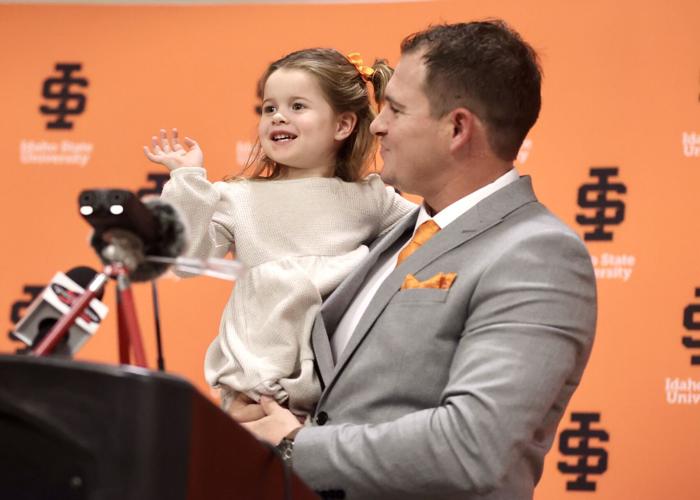
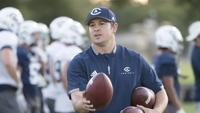
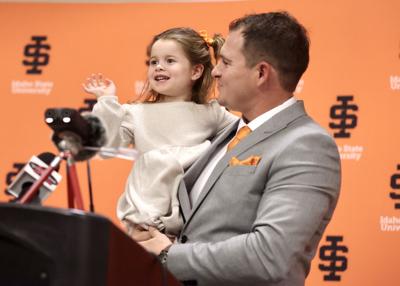
When Cody Hawkins was introduced as Idaho State’s head football coach Sunday, he talked about a lot of his mentors: Bob Johnson, a high school coach in southern California who first convinced him he could play quarterback at a high level; the late major league baseball star Bill Buckner, who coached his little league baseball team and showed him that athletics could be a “force multiplier in his life”; Tim Brennan, who led his Bishop Kelly football team to back-to-back state championships. And of course, there was his dad, Dan.
“I wouldn’t be here without him,” Cody said. “He’s been a mentor, a leader, an inspiration for me and my family. I think he taught us that football can be great and powerful when done right.”
Dan Hawkins, you may know already, has had a long and fascinating coaching career. He posted a 53-11 mark in five seasons as head coach at Boise State, floundered in five seasons at the University of Colorado, then coached the Montreal Alouettes in the Canadian Football League, the United States national team, and worked as offensive coordinator for professional teams in Sweden and Austria before taking the head job at Cal-Davis.
During much of that football escapade, Cody was beside his dad, as a curious kid hanging out in the locker room in Boise, as a player at Colorado and in Sweden, as a player/coach for the U.S. national team, and as an assistant coach for the last six seasons at Cal-Davis. You’ve probably already drawn a lot of conclusions about how much influence Dan has had over Cody’s playing and coaching career. Many of those conclusions are probably wrong.
“It’s interesting,” Dan said. “Everybody thinks, ‘Oh, you made him a football player, you made him a football coach, and I really didn’t. My wife and I, we always just wanted our kids to do something — it was not football. We were not a football-centric family by any means.”
Cody became a locker-room rat all on his own, watching videos of potential Boise State recruits, sitting in on calls with those recruits, hanging out in then offensive-coordinator Chris Petersen’s quarterback meetings.
“I mean, he was just around. Hee was a junkie,” Dan said.
“I grew up in locker rooms,” Cody acknowledged. “I hit my head more on lock-room floors jumping off lockers trying to put on helmets that were too big than I ever did actually playing the game. Jumping on pads, using athletic tape to build bungees and swings from the ceiling… I love it, and that’s why I want my kids to be around it.”
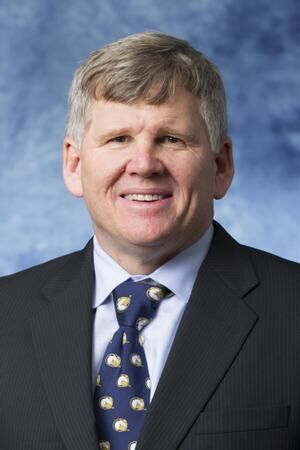
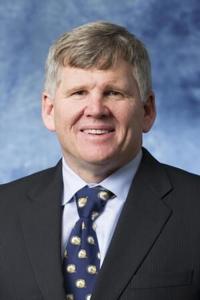
UC Davis football coach Dan Hawkins.
It wasn’t until his sophomore year at Bishop Kelly that Cody started taking seriously the notion of a college football career. He started seeking out information from Dan, attending camps with Johnson in southern California and, eventually, getting invited to the Elite 11 quarterback camp that showcases the top high school signal callers in the country.
Cody acknowledges he wasn’t optimal size for the quarterback position (he was listed at 5-11), nor was he particularly athletic. But he loved the game, was very bright and driven to succeed. He got scholarship offers from places like Oregon and BYU, both known for developing great college quarterbacks over the years.
“Really, if you’d have told me his freshman year that he was going to play major college football, I would have said no way,” Dan recalled. “…The thing that’s interesting about him is he’s 34, but you’ve gotta remember, this kid has been on team buses, he’s been around practice, he’s been in meetings since he was probably 10 years old.”
Still, Dan wasn’t quite sure what he had when it came to a recruiting commodity. He asked Petersen if he wanted to recruit Cody to Boise State and Petersen responded in the affirmative. Then, when Hawkins made the decision to leave Boise for Colorado after Cody’s senior year, Dan still wasn’t sure he wanted to recruit Cody to the Buffalo program.
“Some of the people who were involved in the Elite 11 and coached all these camps, they said, ‘What are you doing?’ “ Dan said. “ ‘You need to walk down the hall and go, ‘Hey Cody, do you want to go to Colorado?’ “
After consulting with Mark Helfrich, his offensive coordinator at Colorado, Dan decided to do that just that. He offered Cody a scholarship, but he didn’t pressure him to follow him to Boulder. In fact, he said he didn’t really know which way Cody was leaning until national signing day.
“So somebody comes walking in — of course in those days it was fax — and said, ‘Hey, Cody just sent in his (letter of intent),’ “ Dan said. “I go, ‘You’re kidding me!’ Seriously, that’s how it went down.”
The original plan was that Cody would grey-shirt (not arrive on campus until spring semester of his first year), and not play until the year after his high school career ended. It quickly became apparent, however, that the Buffs were short on quarterback talent and Dan told his son he was going to have to show up in the fall. Cody was not happy. Later that year, when Helfrich approached Cody about burning his redshirt and playing his freshman year, Cody declined. He was named the scout team offensive player of the year by his teammates instead.

New ISU football head coach Cody Hawkins.
His redshirt freshman season went reasonably well, with the Buffs beating both Nebraska and Oklahoma for the first time in the same season in many years. Colorado finished 6-7, losing to Alabama in the Independence Bowl, and Cody set the Colorado record for most pass attempts in a season (424), with the second-most completions (239).
Things deteriorated from that point on, however. The Buffs went 5-7 and 3-9 the following two seasons and then, after a 3-6 start in 2010, Dan was fired as head coach with three games left in the season. Cody had already been benched as starting quarterback. It was under these circumstances that Dan really grew to admire the strength of his son.
“We were having a hard time getting the thing to lift off the ground,” Dan said of the Colorado experience. “I get it. So then everybody wanted to jump on the bandwagon. ‘Well, it’s Cody’s fault, it’s his dad’s fault. The only reason he’s playing is his dad.’ All that stuff is so ridiculous. I get it, but we also benched Cody and played the other guy, and we really didn’t have any more success.”
After being benched and seeing his father fired, it would have been easy for Cody to quit the team, or, at the least, to give less than maximum effort over the final three games. He did neither.
“I mean, he was a man’s man through that whole thing,” Dan said. “He was a rock star… He was just very mature about understanding the business and what happened to me. I mean, hey, I was his dad, but he’s still a Colorado Buff and he was still a member of the team, and he was there to do whatever the team needed. He didn’t complain, he didn’t moan, he didn’t pout, he didn’t make excuses. He was extremely mature and then he actually came back in and started playing and they won two out of the three games with him as quarterback.”
It would have been very easy to become cynical about college football in general, and the coaching profession in particular at that point. But Cody continued his playing career overseas, then punched his coaching ticket at a number of places: at Bishop Kelly, as a graduate assistant at Ohio State, as an assistant at a high school in Oregon, head coach at a Los Angeles Junior College, and working for his dad at Cal-Davis.
“There are certain characteristics that define people and one of them is growing and thriving through adversity,” Dan said. “In the good life, you have to take risks… It’s interesting because we make such a big deal about people failing. Failing, failing, failing. They failed. They’re not any good, they stink, get them out of here…. You’re going to fail. And it’s from those failures that you learn, those are where the lessons that you learn in life are really forged.”
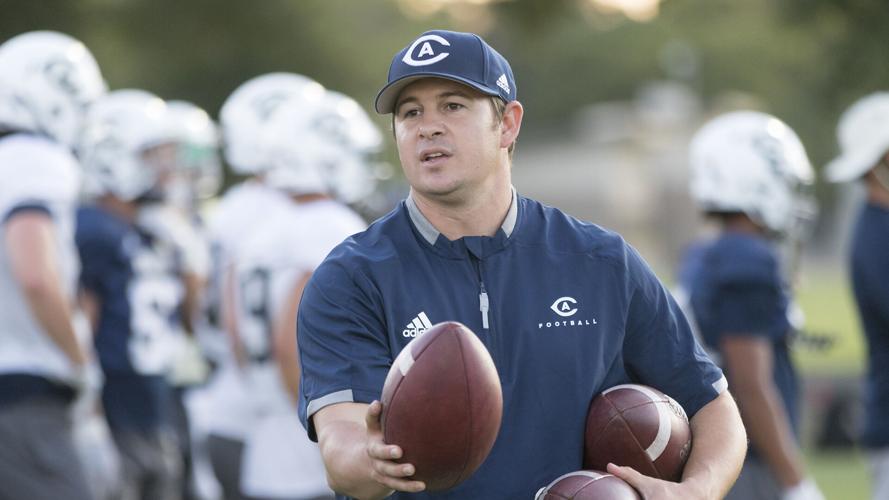
Again, there were no favors accorded Cody by his father when he arrived at Cal-Davis. He came to the program as a volunteer assistant, moved up to wide receiver coach and left as offensive coordinator. It is a route many of Hawkins’ assistants have taken during his six-year tenure at Cal-Davis.
“I think he’s actually my 28th coach to leave,” Dan said. “I’m in the coach development business. We get a lot of young guys here and I teach them how to coach. Our O-line coach, who probably will be our O coordinator, came here as a volunteer. Our special teams coach came as a volunteer. I take a lot of pride in developing coaches.”
When Idaho State contacted Dan about Cody’s availability as a head coach, Dan referred them directly to Cody. Then father and son discussed the pros and cons of taking the Bengal job.
“Truthfully, I think if there were 10 jobs that came open in the country looking for a head (coach), maybe 9 of those he does not fit the profile,” Dan said. “But given where the Idaho State program is right now emotionally, he’s a great, great solution for that. He obviously knows Idaho, he obviously has name recognition in Idaho. He’s been in the conference for six years.
“He’s been to the playoffs twice; he’s had a championship here. Our quarterback did amazing things this year. You got a top 10 offense. He knows the conference. So really when you start going, ‘Okay, there’s a recruiting component, there’s a geographical component’ — he kind of fits all that.”
Come Nov. 11, 2023, then, father and son will meet in Holt Arena when the Bengals host the Aggies. “Oh, it’ll be fun,” Dan said. “And Cody is going to tell you this too: it’s about being the best version of yourself. It’s not about competing against Idaho State, and for him it’s not about competing against Davis.
“It’s going to be about if we go out and be the very best we can be. I know people go, ‘Oh that’s corny,’ well it’s not,” Dan added. “That’s what elite athletes do, that’s what elite teams do. It’s not about who you’re playing, it’s about you. That will be the quest. And honestly, somebody will score more points than the other team and we’ll live with it and move on.”
Well, maybe it won’t be quite that perfunctory.
“Everybody in our family is circling Nov. 11 right now,” Dan acknowledged. “So that seems to be a big date right now.”
Brad Bugger has been observing athletics in southeastern Idaho for over 40 years as a sportswriter, broadcaster and fan. He can be reached with comments, questions and column suggestions at bpbugger@gmail.com.




(0) comments
Welcome to the discussion.
Log In