


Those of us living in southern Idaho have become used to late summers and early falls bathed in the orange light of wildfire smoke. As July unfolds each year, I wonder how deep into the month we can get before the fires start. Last year we got lucky. This year we’re back to what has become normal.
I fought fires for the Bureau of Land Management and U.S. Forest Service between the summer of 1973 in Craig, Colorado, and the summer of 1991 in Dickinson, North Dakota. In the summer of 1977, I was on the Kirkham Hot Springs fire near Lowman. Every time we head that way for camping, I look at those steep slopes and check the vegetation, still slowly recovering after all these years.
I’ve seen small lightning strikes on patches of junipers that could be put out by three people in less than a day. And I spent a month in Yellowstone in 1988 where humans were powerless to do anything about multiple huge fires, despite all the resources civilization could bring to bear.
As an ornithologist and birder the whole time, I was always watching how birds responded to the fires in real time and fascinated by the ecology of ecosystems after they burned. I’ve seen birds foraging in burning trees and others hopping about a smoldering forest floor. When you can fly away instantly, you can take chances other animals can’t. Food is there, and birds are almost always about finding food.
Fires kill people and destroy property. But the media get it wrong when they say, for example, “100,000 acres were destroyed by fire.” No. The vegetation burned, but the acres weren’t destroyed. Those acres are still there. And they will soon be full of life again.
But not all vegetation responds in the same way to being burned. One of the worst cases is sagebrush in the Great Basin, which used to respond to fire just fine. But with the relatively recent (since 1900) invasion of many weeds (cheatgrass, mustards, knapweeds), the recovery from burned ground to healthy sagebrush steppe has been derailed. Millions of acres are now stuck as huge weed patches which burn frequently. We can’t restore those acres without enormous investments in seeds, weed killers and physical manipulations. Even then, there is a high risk it will all burn again, and the weeds will be back.
Happily, forests are a different thing … so far. Forests in the Intermountain West will eventually grow back to what they were before. It may take hundreds of years, like on the steep slopes along the Payette River. But at least there are no invasive plant species taking over and making those forests more vulnerable to more fires.
Nearly 90 bird species have been detected in burns one or two years old in the Northern Rockies. These include calliope hummingbird, rufous hummingbird, Williamson’s sapsucker, northern flicker, dusky flycatcher, Steller’s jay, red-breasted nuthatch, hermit thrush, Cassin’s vireo, warbling vireo and black-headed grosbeak. The combination of some larger, older trees, along with more open structure and younger vegetation that result from burns, provides the nesting and foraging sites these species prefer.
Both hummingbird species need nectar from flowers, which are more abundant and diverse in open, early successional vegetation, than in mature forests. Dusky flycatchers prefer to forage in open forests with a good shrub layer, exactly what emerges when a burned site has several years of recovery.
Patches of shrubs attract species that don’t need trees but will tolerate a few around their breeding territories. The orange-crowned warbler, Nashville warbler, MacGillivray’s warbler, lazuli bunting, dark-eyed junco and spotted towhee quickly occupy sites in the early stages of succession following burns.

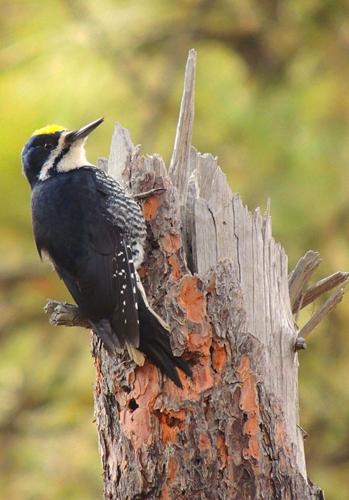
The black-backed woodpecker will seek out newly killed trees after a fire.
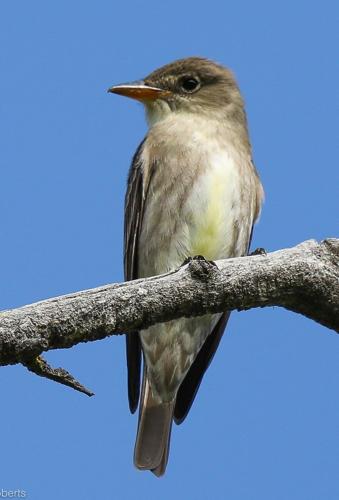
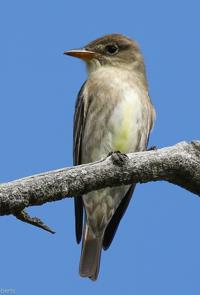
For me, the most interesting species are those that seek newly killed trees. The most common ones in post-fire forests include the black-backed woodpecker, American three-toed woodpecker, Lewis’s woodpecker, hairy woodpecker, northern flicker, olive-sided flycatcher, western wood-pewee, American kestrel, western flycatcher, western bluebird, mountain bluebird and American robin.

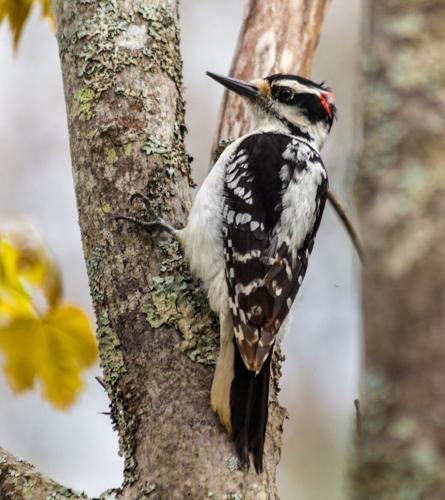
Hairy woodpeckers are among the species that can be found in forests after a fire.
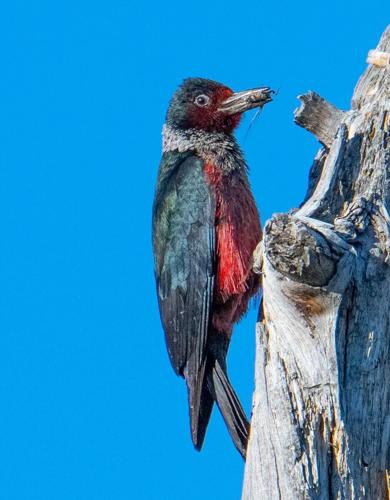
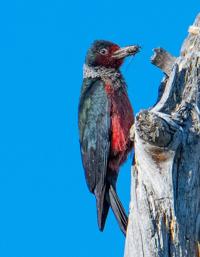
The highest nesting densities of Lewis’s woodpeckers ever recorded were found in a burned forest east of Boise. Anyone remember the “Foothills Fire” of 1992? We were at Alive After Five and the gigantic smoke plume looming over us is still etched in my memory. In the following years, Lewis’s loved it!

The highest nesting densities of Lewis’s woodpeckers ever recorded were found in a burned forest east of Boise.
But the black-backed woodpecker is most intriguing, being almost entirely dependent on newly burned forests. After five or six years, black-backs abandon the site and move on to search for new burns.
Another group of birds visit newly burned forests for the seeds made available by simple exposure or, in the case of some conifer cones, opened by the fire’s heat. Seed eaters like Clark’s nutcracker, Cassin’s finch, red crossbill and pine siskin may be abundant in the first year after a fire but then quickly decline as the seed storehouse is depleted. As with other species attracted to burned forests, these birds are wide-ranging, always on the lookout for the next burned area.
Fires create an abundance of nest cavities, both directly through the fire itself, and indirectly, as insects and decay soften the wood for primary excavators over time. Primary excavators (aka primary cavity nesters) are those powerful enough to chisel holes in trees. These are mostly woodpeckers. Secondary cavity nesters can’t create a new cavity but can touch up and clean out an existing one. These include chickadees, nuthatches, house wrens and bluebirds.
Cavity nesting species benefit from the aftermath of forest fires for decades to come. When we cut dead trees for firewood or timber salvage, we destroy habitat, not only for birds, but for a variety of small mammals and other wildlife.
By the time a burned forest has rested under a blanket of winter snow, and the spring melt has soaked the soil well, seeds of grasses, flowers and trees germinate and bring a green cast to the ground. Nutrients from the ash are taken up by growing vegetation and the site is again on its multi-hundred-year track to old growth, to eventually attract species who love big, old forests.
All of this smoke, day after day, can be depressing. Hopefully, it will help to realize that many birds will benefit, both soon, and in the long run.

(0) comments
Welcome to the discussion.
Log In