

Rare birds of any kind, any time of year, are a special treat for birders. And in case you didn’t know, we’re looking for rare birds every time we go out. It’s the endless treasure hunt. But most days we enjoy the usual species, being happy to see some unusual behavior or to get an especially good photo of a common bird.
In winter, one of the groups of species that provide rarities are the sparrows. And I would break this group into two subgroups. First are species that breed here but mostly leave in winter. This bunch includes the chipping, savannah, fox and Lincoln’s sparrows. Of course, it’s fun to see one of them in the winter, but I’m really interested in the second subgroup.
These are sparrows that don’t breed anywhere around here. So, they are even more fun when they show up. They include the white-throated, golden-crowned, Harris’s, swamp and American tree sparrow. I’ve seen the first three already this winter, so that’s a great start to the season. They’ve attracted a lot of birders and bird photographers — people who look normal but who will stand for hours in the cold waiting for the chosen bird to appear.
I’m a big fan of sparrows. They are scorned by those who don’t appreciate subtleties as “little brown jobs” or “little gray birds.” They are mostly brown, for the record, so I don’t know where LGBs comes from.
I got my MS degree studying the behavior of sagebrush sparrows (sage sparrows in those days), so that’s when I went deep. Another common bird in my study area near Atomic City was Brewer’s sparrow. I was immersed in sparrows all day for many weeks over two breeding seasons.

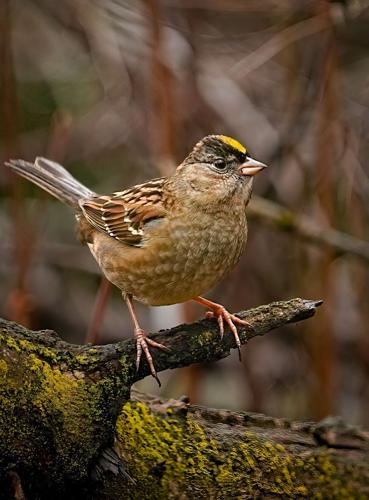
The golden-crowned sparrow is classified as “rare or very local” in southwestern Idaho during winter.
According to the Birds of Idaho Field Checklist (2007), the white-throated, golden-crowned, Harris’s and swamp sparrow are all classified as “rare or very local” in the southwestern part of the state in winter. The American tree sparrow is “uncommon or local.” The idea behind “local” is that a bird might not be that rare, if you know exactly where to look.
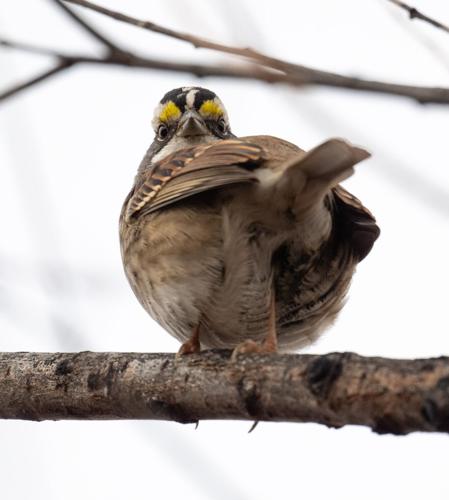
It seems there is at least one white-throated sparrow in Hulls Gulch and/or Kathryn Albertson Park every winter. I’d call it the most common of our rare and very local sparrows. Checking eBird for sightings between December and February over the past 10 years, I see dozens of reports across the Treasure Valley. Interestingly, every checklist I looked at tallied just a single bird.

It seems there is at least one white-throated sparrow in Hulls Gulch and/or Kathryn Albertson Park every winter. They may be found mingling with other sparrows or dark-eyed juncos.
Although the white-throats I’ve found have also been single birds, they’re not anti-social. They often hang with more common white-crowned sparrows, song sparrows and/or dark-eyed juncos. They like prowling around on the ground, in cover, and can be hard to see or photograph well. Although they are superficially similar to white-crowns (same genus, Zonotrichia), the white throat pops, and there is usually conspicuous yellow in the lores.
This sparrow should be more common here in winter. They breed across the entire Boreal Forest of Canada, so there are enormous numbers of birds nesting straight north of Idaho. According to Partners in Flight, there are 160 million white-throats, one of the most common species in North America. But they migrate mostly east of the Continental Divide to winter widely across the southern U.S. They also winter along the California coast, but birds mostly avoid crossing the Intermountain West. One wonders why?
A couple of golden-crowned sparrows have been hanging around Hulls Gulch and Kathryn Albertson Park this winter, although these reports have not yet shown up on the eBird species map. The number of sightings of this sparrow in winter over the last 10 years only number around a dozen.
Golden-crowns breed in the Pacific Northwest, far into Alaska, and winter along the Pacific Coast. Although they migrate across eastern Washington and Oregon, they don’t venture into southern Idaho very often. As with white-throated sparrows, all the reports are of single birds. The difference between species that flock and don’t flock is fascinating. That’s a good topic for a future column.
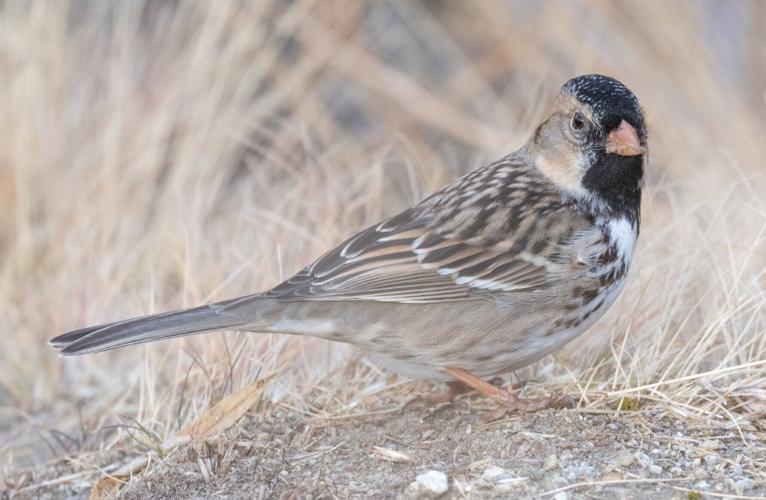
Harris’s sparrow is just a beautiful bird. It’s a bit more common than golden-crowned, with a few dozen reports in the Treasure Valley over the last 10 years between December and February. This sparrow is a prairie bird, breeding in the tundra of the Arctic, migrating mostly through the Great Plains, and wintering in the prairies of Nebraska, Kansas, Oklahoma and Texas. Their migratory path barely reaches into eastern Montana and Wyoming, so Idaho is way off the beaten path. Very interesting.

Harris’s sparrow is just beautiful. This bird occasionally shows up in pairs during winter.
Unlike the other wintering sparrows covered so far, Harris’s occasionally shows up in twos. Several of us saw two birds near the Foothills Learning Center in November, although, oddly, these reports are also not yet showing up in the eBird map for this species. There is also one report of three birds from 2017.
The swamp sparrow is another species whose records amount to one or two dozen birds over the last 10 years around the Treasure Valley. But I suspect they are being overlooked because they are pretty similar to our resident song sparrow. Note that they are unstreaked below and show a distinctive reddish hue in the wings and in the cap.
The swamp sparrow also breeds across the Boreal Forest, nearly as far west as the white-throated sparrow. But like the latter species, they migrate east of the Continental Divide and don’t get into the Intermountain West in numbers any time of the year.

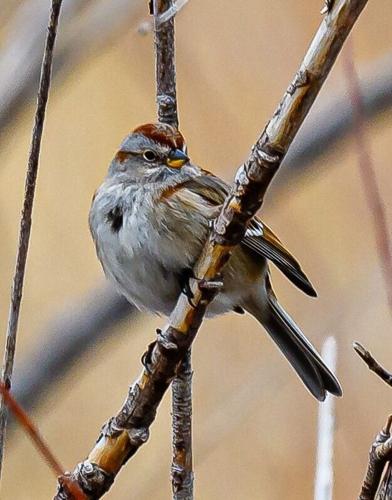
All of Idaho is within the winter range of the American tree sparrow, but it’s still seen relatively rarely in winter.
The last rare sparrow for now is the American tree sparrow. This species has an enormous breeding range across northern Canada and winters across most of the northern half of the U.S. All of Idaho is within the winter range. And although there are many more sightings of this sparrow than of the previous four species, it’s still seen relatively rarely in winter.
Also, unlike the previous species, tree sparrows are apt to be found in flocks. My own sightings have typically been of groups along the edges of fields outside of town where they forage on grass and weed seeds along fence lines. Thus, they are quite unlike the lone golden-crowned or white-throated sparrow in heavy cover along a foothills drainage. A quick check of eBird checklists shows this to be the case around here, with as many as 16 being seen in one flock in February 2022.
Big, showy birds are easy to like. I never tire of seeing Vlad the Impaler, the reliable great blue heron in Kathryn Albertson Park. But for me, it’s the little birds, and especially the sparrows, that are the most fun. They can be challenging to find, but they really aren’t that hard to identify — if you can get a look!



(0) comments
Welcome to the discussion.
Log In