

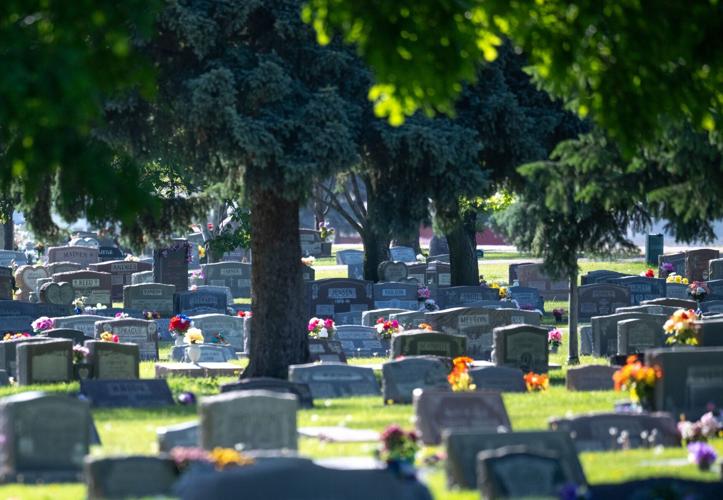

We recently spent a morning birding with friends at Canyon Hill Cemetery in Caldwell. It was cloudy and breezy, with golden leaves swirling around — a classic November day. It may surprise you to hear that cemeteries are great places to go birding.
Cemeteries offer physical and philosophical environments in a nice mix. They typically have many big old trees, which I love just for themselves. While the surrounding landscape may be increasingly dominated by houses, cemeteries are spared the tree cutting and bulldozing that ruins the land. Pines, spruces, firs and other conifers grow into huge shaggy beasts preferred by many species of birds. The biggest oaks and maples anywhere are safe among the headstones, benches and quiet lanes.
Because the habitat is often unlike the surrounding area, they also serve as oases. Like a palm grove in the desert, birds flying over the landscape can see that patch of special habitat. They may choose to drop in for a rest, also likely hoping for food or water. In winter, the old-growth conifers mimic montane forests, often attracting species like red-crossbills, mountain chickadees and red-breasted nuthatches.
Another word for this sort of oasis is “vagrant trap.” This means such spots are good places to look for vagrants — species otherwise rare in the area. It’s easy to imagine how a bird would stop to rest there rather than in the surrounding matrix, whether rare or common.
Birders often look especially for owls who love the dense cover of old conifers. Northern saw-whet owls, western screech-owls and great horned owls are often found there. Other predators like red-tailed hawks, Swainson’s hawks, American kestrels and merlins like the high perches with expanses of open ground in between them. This gives them a good view, and a head start on prey.
The expansive green lawns among the headstones are perfect for American robins, mourning doves, dark-eyed juncos, white-crowned sparrows and other species that forage on the ground. Flycatchers find the structure appealing as well, sallying out from low tree branches to grab insects in the open areas.
Cemeteries are also such thought-provoking places. Every headstone is the opening line of a book, starting the mostly untold story of the person being memorialized. While seeing people who died young is always sad, it’s a sea of wonder, leading me to ponder what life was like for each of them. Birthdays, Thanksgivings, Fourth of Julys and daily lives unwinding to far beyond the horizon. Yes, they each are gone, but you can feel the love extending to this day, in countless directions, among family and friends. Even when the birding is slow, there is plenty to think about.
One thing I wish cemeteries would do, much as the city of Boise has done in places like Kathryn Albertson Park, is to plant patches of native shrubs and let some of the lawn grow up into fields of flowers. This is probably against the fundamental notion of a properly groomed cemetery. But, wow, would birds love it!
Maybe I’ll get involved with the International Cemetery, Cremation and Funeral Association, with an eye on changing their policies and best practices. Their next conference is at the Mandalay Bay Casino in Las Vegas. That’s certainly the perfect place for quiet contemplation and thoughtful discussion of the cemetery mission.
The cemetery we visit most often is Canyon Hill. When I first heard this name, I tried to imagine what the incongruous description was trying to portray. In fact, it’s a pretty good name.
The cemetery is not on a hill so much as a classic basalt table, with steep tumbled rock walls on two sides. Below the drop-off, the Boise River flood plain stretches far to the east and the river itself borders the north side. This provides a large variety of habitats in proximity. In fact, I don’t know of another place of any kind — cemetery or otherwise — around here with such variety.
Another favorite of ours is Dry Creek Cemetery in Boise. This, too, has an edge of native habitat bumping up against extensive green lawns. There are many old conifers to search for owls, and we often find wild turkeys wandering around.
Morris Hill cemetery, also in Boise, has been a good spot in recent years for rare sapsuckers. Huge, old deciduous trees and a typical quantity of big conifers are always worth a look. There are many other cemeteries in the Treasure Valley worth visiting from time to time.
Rural cemeteries present a little different situation because they are often integrated into the surrounding landscape so thoroughly that they don’t present very different habitats. We always walk around the Citizens Cemetery when we visit Silver City. Birds from the enveloping forest are sometimes easier to see in the more open spaces among the markers.
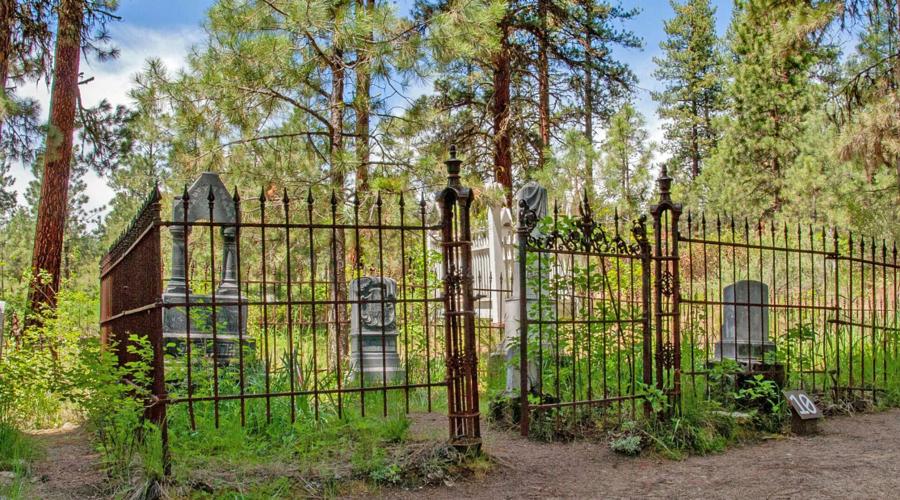
Pioneer Cemetery in Idaho City is fantastic. It is thoroughly woven into the forest, with enough stories and fascinating grave sites to occupy your mind for hours. Imagine having to fence your plot so wild animals don’t dig you up!
One of the cemeteries that most obviously serves as an oasis is outside Bruneau. It’s a cluster of mostly large deciduous trees in a landscape of fields and weeds. If Bruneau were closer, I’d visit a lot to see what birds have stopped in. My wife, Pat, got us involved in Find a Grave (findagrave.com/) a few years ago. This is where people can go to have others find graves of family or friends who are buried far away. For example, we found a grave of someone in Dry Creek whose interested relatives are in Massachusetts. Pat takes a couple of pictures of the site and uploads it to the Find a Grave website. This quest goes well with birding and adds yet more depth to the cemetery experience.
Cemeteries are incredibly peaceful. You don’t have the runners, mountain bikers or even walkers that populate trails and parks. Unless you hit a day when the staff is mowing, weed whacking or leaf blowing, it’s like being in a library. You don’t have the comforting scent of old books, but the fragrance of pine needles and oak leaves is nice enough.
Some fresh flowers, cut by people you don’t know for people you don’t know, are oddly comforting. It brings to my mind the words of Shakespeare: “And this our life, exempt from public haunt, finds tongues in trees, books in the running brooks, sermons in stones, and good in everything.”



(0) comments
Welcome to the discussion.
Log In