



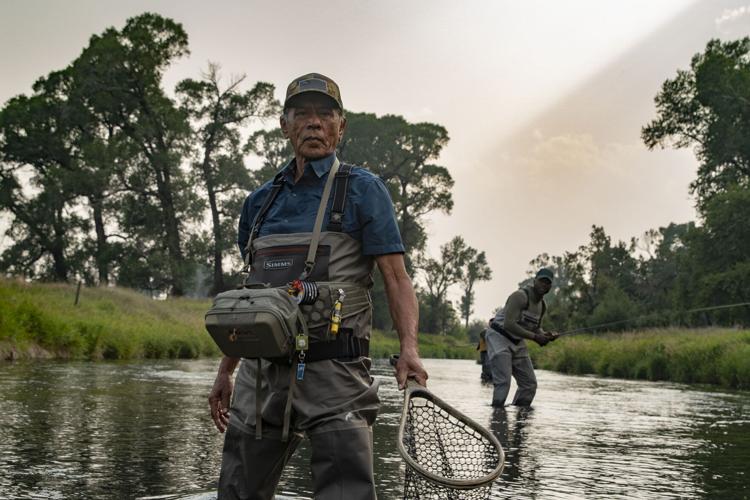


Preeminent Montana fly fishing film “A River Runs Through It” closes with an elderly Norman McLean casting into the Gallatin River — a stand-in for the Blackfoot River in northwest Montana.
When we first see a fisherman in “Mending the Line,” a film premiering in Bozeman on June 8, he is standing in roughly the same spot on the river. Fly fishing, in both films, is cathartic for their subjects. In connecting with rivers, they connect with themselves.
“Mending the Line” is a composite story, wrapping in bits of truth surrounding combat veterans and organizations like Warriors and Quiet Waters that support them in the transition back to civilian life.
“This movie in particular is really special,” said director Joshua Caldwell in a call with the Chronicle. “It’s a storyline that’s ripped from truth, even though it’s not based on any particular true story. But it’s happening.”
“Mending the Line” opens with a group of Marines who take enemy fire on their last patrol. They don’t all survive. The story follows their commander, John Colter, played by Sinqua Walls of “White Men Can’t Jump,” to a VA hospital in Livingston. He’s trying to recover and return to active duty, and though his body may be healing, he hasn’t attended to his mental wounds.
After group therapy takes a sour turn, his doctor (Patricia Heaton of “Everybody Loves Raymond”), sets him up with a surly old vet (Brian Cox of “Succession”) to learn to fly fish.
“Mending the Line” was written by Stephen Camelio, a Bozeman resident who reached out to talk about the film on May 1. Camelio, who is not a member of Writers Guild of America, said he stands in solidarity with Hollywood screenwriters, and politely declined an interview after the strike started on May 2.
The film was inspired by Camelio seeking the river’s solace to deal with his Army veteran father’s cancer diagnosis due to exposure to Agent Orange and subsequent death.
“As every fly fisherman knows, there are few things as therapeutic as standing in cool, moving water accompanied only by the rhythm of a fly rod and the possibility of a rising fish,” Camelio stated in press notes for the film.
Fly fishing has the ability to quell some of the stories that play on repeat in the heads of those suffering with grief or post-traumatic stress disorder.
“It requires you to be completely present in the actions of what you’re doing in that moment and there’s just no time to be thinking about anything else,” Caldwell said.
Colter isn’t the only one grieving in “Mending the Line.” There’s also Lucy (Perry Mattfeld of Netflix’s “In the Dark”) a librarian who recently lost her fiancée and is trying to find a path through her own grief while supporting the woman who would have been her mother-in-law.
“While ‘Mending the Line’ is very personal to me. … I have come to realize it is no longer my story,” Camelio stated. “Everyone involved with the film has turned it into a universal tale of resilience and redemption, and in doing so they’ve created a moving example of how to start the healing process much like I did on the water many years ago.”
Caldwell gravitated toward Camelio’s script because of his own love for fly fishing, picked up in 2017 after moving to upstate New York. The director pointed to his Instagram page as evidence. It features “fish with some movies thrown in,” he said.
“Mending the Line” was shot in August 2021 around Bozeman and Livingston, using Bozeman’s old hospital as a location and studio space before it was torn down. For atmosphere, Montana did much of the work, with locations highlighting the majesty of our mountains and rivers — especially the Yellowstone River and Paradise Valley.
“You almost feel like you don’t have a big enough and wide enough lens to capture it,” Caldwell said.
Local connections run deep. A bamboo rod named “Super Max” in the film was custom made for the film by Tom Morgan Rodsmiths. Its reel was provided by Bozeman Reel Company. SIMMS stepped in with waders and clothing for the fishing scenes and RO provided the drift boat. The fly shop is Angler’s West in Emigrant. And fish for the film — Yellowstone cutthroat and mountain whitefish on the Yellowstone and brown trout on the Gallatin — were wrangled by Joe Urbani, a Bozeman fisheries biologist who also worked on “A River Runs Through It.” Urbani was supported this time by his sons Colter and Dylan. No fish were harmed.
Ultimately, Caldwell wants the film to raise awareness for organizations like Warriors and Quiet Waters.
“Look, we made a film,” he said. “I’m very proud of the film. I hope it connects to people. But I’m just a storyteller. I’m not doing this for real. There are real groups and real organizations and real people that are doing this on a daily basis. They’re changing people’s lives.”
The Bozeman Film Society presents an exclusive premiere of Montana-made feature film “Mending the Line” (Rated R, 122 minutes) on Thursday, June 8, in the Emerson Center. The benefit for the Warriors & Quiet Waters Foundation begins in the ballroom at 6 p.m. with a no-host social, raffles, and booths with WQW, Yellow Sally, Urbani Fisheries, the American Legion, Tom Morgan Rodsmiths, and more. The film will screen at 7 p.m. in the Emerson’s Crawford Theater and will be followed by a panel discussion with screenwriter and producer Stephen Camelio, Warriors & Quiet Waters Foundation CEO Brian Gilman, and fisheries biologist Joe Urbani. Tickets are $12-$20 (plus fees) at the door or online at www.bozemanfilmsociety.org.

(0) comments
Welcome to the discussion.
Log In