

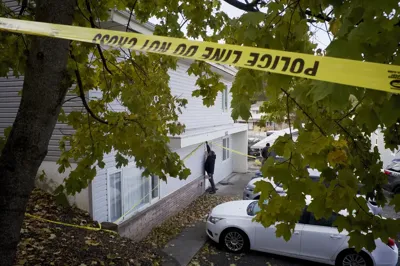
The families of four University of Idaho students slain in Moscow have said for years they are haunted by any photos depicting the murder scene.
For some true crime online content creators, the families' wishes to keep private the last moments of the lives of Madison Mogen, Kaylee Goncalves, Xana Kernodle and Ethan Chapin appear irrelevant.
"I don't mind being the source and leaking stuff … People have pictures of victims unredacted, of wounds unredacted … We have them," a YouTuber said in a video posted Monday. "We are waiting to see if we can get more (photos) before we be the leakers of it."
The YouTuber's name is Logan, who hosts a show called "BronxTails True Crime" on the video platform. Her channel has more than 9,000 subscribers.
Her introduction videos open with an electronic rap song that is edited to photos of Mogen, Goncalves, Kernodle and Chapin and the home where they were killed. The photos pulsate to the beat of the music.
"Stay tuned," she told her followers as they cheered her on in the live comments. "It's coming."
The YouTuber's comments came shortly before the Latah County Prosecutor's Office issued a joint statement with the Idaho State Police and Moscow Police Department Tuesday, condemning any release of photos that depict the bodies of the four UI students.
"We collectively are deeply troubled to hear of this potential release … Providing sensitive unredacted crime scene material for public dissemination is an unwarranted invasion of the victims' privacy and demonstrates a profound lack of integrity and professionalism," the statement says. "Those entrusted with access to such material must safeguard it, and violating that trust and any professional and ethical duties required by such position of trust is unconscionable."
All four students were found stabbed to death in an off-campus home Nov. 13, 2022. Investigators eventually zeroed in on Bryan Kohberger, a then-28-year-old Washington State University graduate student, through DNA found at the scene. He pleaded guilty to the murders in July 2025.
Tuesday's statement from the prosecutor's office states the unredacted photos that may soon be released from true crime creators came from "an unknown source."
"We recognize the public's legitimate interest in transparency and accountability. The dissemination of these photographs does not serve that interest," the office said. "These unredacted images should not be published, posted, shared, or otherwise distributed. Further dissemination would serve no legitimate public purpose and would only compound the harm to the victims' families and the broader community."
The only photos of the victims' bodies online as of Tuesday appear to be redacted images released in August 2025 in a batch of public records to an Idaho news outlet.
The families were not notified prior to that release, seeing them online the same day they were published, the Chapin family previously said in court records.
The release of some crime scene photos was a partial reason for last year's passage of a new Idaho law that prevents photos of decedents from going public.
The law amended Idaho's Public Records Act to exempt from release "any photographs or images of a decedent taken as part of a coroner death investigation or law enforcement investigation regardless of whether such investigation is active or not."
Other photos the BronxTails channel discusses depict blood on the floor. Before showing the photos, the host gives a trigger warning and laughs. She starts to speculate on what a small white object in the photo could be. She also speculates about small, barely visible stains in other photos.
In another photo she shares, a large empty Coors Light box sits on one of the victims' beds. The host then claims the police purposefully "threw" the box on top of the bed and later accuses police of destroying evidence. She offered no source or evidence to back up her claims.
Moscow Police Chief Anthony Dahlinger did not respond to a request for comment Tuesday.
"People see a video or see something out of context, and it looks one way to them, but it may not be the facts at all," said Danielle Slakoff, a criminal justice professor at California State University, Sacramento. Slakoff specializes in studying true crime and recently published a comprehensive study interviewing well-known crime victims' family members.
The study showed true crime media is often sensationalized, retraumatizing and exploitive of the victims' families and their pain.
"I think people have been emboldened to speculate because it's a way to drive attention to their pages," Slakoff said. "Sometimes the loudest and most negative voices get the most attention."
Slakoff is a supporter of keeping the photos of the victims' bodies out of the public eye. When photos like that are released, she said, it becomes a ripple effect.
For one, Slakoff said, it brings the crime back into focus and makes true crime consumers feel like they know the family personally. That can lead to more invasive behavior like reaching out or approaching them on the street, she said. It can also place more eyes on the killer.
"Sensationalizing the tragedy can possibly make a hero status out of the perpetrator," Slakoff said.
The families, too, must face the worst day of their lives all over again.
Ethan Chapin's mother, Stacy Chapin, posted the agencies' joint news release on her Instagram story Tuesday afternoon.
"For the love of WHATEVER … Stop with the photos," she wrote. "They have absolutely NOTHING to do with transparency and are so incredibly hurtful. Rest in peace, beautiful kids."
The potential release is all but surprising to Slakoff, who believes true crime creators care more about themselves and their followers than they do the victims.
"I feel really horribly for the families, what they are bracing themselves for," Slakoff said. "It says a lot about how we treat victims and their families. When we talk about true crime, we are talking about the commodification of murder."

(0) comments
Welcome to the discussion.
Log In