

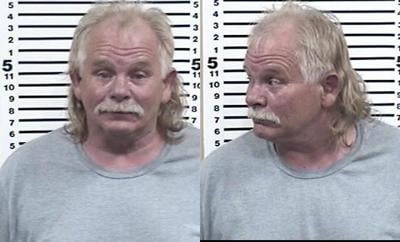

After two years, the trial of a Chubbuck man charged in the death of a man in 2022 has begun and is now in its fifth day where he faces 10 years to life in prison.
Randy Larkin, 60, was arrested in July 2022 and charged with first-degree murder, with a grand jury indicting him for the murder of Morey Pelton, 36. In October 2022, Bonneville County Prosecutor Randy Neal announced he would not seek the death penalty against Larkin.
This means that if found guilty, Larkin could face a minimum of 10 years to life in prison.
Pelton’s body was found at the Lane Clark Rest Area along U.S. Highway 26 between Ririe and Swan Valley on May 13, 2022. The Bonneville County Sheriff’s Office believes that Pelton was shot and killed during the night of May 12, 2022 or the early hours of May 13.
In October, Gerald Hamlin, 61, of Puyallup, Wash., was sentenced in connection with Pelton’s death, and during his sentencing, Neal gave more details about Pelton’s death. He said Pelton had sustained a gunshot wound to the neck, and the bullet had made its way into his chest.
Hamlin was arrested on Feb. 8 after a grand jury indicted him for first-degree murder, accessory by withholding or concealing knowledge of a felony from a peace officer, judge or jury, and concealment/destruction of evidence. However, a plea agreement dismissed the first-degree murder charge.
He was sentenced to 10 years, with the court retaining jurisdiction for a year. Part of the agreement details that he will help during Larkin’s trial.
Hamlin and William “Billy” Burton, a person of interest in the murder of Pelton, were listed on the state’s witness list. Earlier in the year, Hamlin’s attorney had filed an objection to consolidate Hamlin and Larkin’s cases together. It stated that Burton and Hamlin provided statements that they did not know Larkin was planning on using violence against Pelton.
A motion filed by Neal on Oct. 14 detailed 25 pieces of evidence that will be used in Larkin’s trial. The first alleges that Larkin was dealing drugs in the Swan Valley area. During Hamlin’s sentencing, Hamlin’s attorney said the destruction of evidence charge pertained to Hamlin’s involvement in bringing drugs to Larkin.
Neal’s motion goes on to state that Pelton and Larkin were engaged in a drug transaction, and a dispute occurred. The drugs in the transaction were allegedly brought in by Hamlin, consisting of two ounces of methamphetamine from Washington state.
The motion states that Larkin said he only wanted to beat up Pelton but brought a firearm. It is alleged that he stated, “I ought just to shoot the little (expletive).” A motion filed by Larkin’s attorney, Allen H. Browning, and Dave Leroy on Nov. 12 stated that Larkin had reasonable belief that Pelton was carrying a handgun the day of the shooting.
That motion states that Larkin and Pelton had known each other for several years. During a discussion, Pelton allegedly told Larkin that he always carried a gun and had one on him when he was in the car. Pelton showed Larkin where he stored the gun in the space between the driver’s seat and the center console.
The motion goes on to state numerous witnesses knew that Pelton carried a gun with him. It states that Pelton’s father, in his initial interview with law enforcement, stated that his son always carried a gun.
It also states that photographs taken by police showed “loose live bullets” from a handgun in the pocket by the passenger side door.
“The defendant reasonably believed that the man he was going to speak with concerning a debt owed was armed. That’s why he brought a gun to his visit with Morey. Failing to allow Mr. Larkin to tell the jury what he reasonably believed would be to deny him his defense in this case,” the motion states.
Larkin’s attorneys filed a motion on Monday to support the inclusion of the previous motion in the trial to help the court understand his client’s state of mind during the incident. “In a case in which the defendant has been charged with murder, and no weapon was found at the scene of the death, the defendant’s state of mind is central to the defense of the accused,” that motion says.
“In this case, Defendant Larkin actually believed, as he will testify, that Morey Pelton was armed and that when Mr. Pelton began to charge him, Larkin’s life was in peril. It is not necessary that Mr. Pelton actually, at the time he was shot, had a gun in his possession. The state of mind of Mr. Larkin at the time of the shooting is central to this defense.”
The motion states that witness Chris Hanson, who was interviewed on May 14, 2022, told his probation officer that Pelton always carried a gun. If the court allows the evidence of the gun possession, it will call on Hanson to testify. This goes for the three witnesses Larkin planned to call on to tell the court of Pelton’s alleged reputation for violence and two of them who knew that Pelton carried a gun.
Larkin’s attorneys argue in the motion that the knowledge of both Larkin and other members of the community that Pelton carried a gun was pivotal to his defense and claim of self-defense.
“It is important that Randy Larkin be allowed to tell the jury (1) that he believed Morey Pelton owned a gun, (2) that he believed Morey Pelton always kept a gun immediately beside his right hand when in his car, and (3) that he is not making up a story; that his belief was reasonable because other people who knew Morey had that same knowledge,” the motion states.
This was cited by Larkin’s attorneys under Idaho Criminal Jury Instruction 1517, which states that self-defense instruction with one charged with homicide makes the defendant’s state of mind central to the defense. “You should determine what an ordinary and reasonable person might have concluded from all the facts and circumstances which the evidence shows existed at that time.”
The attorneys argue that the knowledge of Pelton’s gun, alleged reputation for violence, and Larkin “could tell the decedent (Pelton) was high and the decedent (Pelton) was angry and by everything the defendant knew had a gun next to his right hand in his car was absolutely relevant to the defendant’s claim of self-defense.”
Neal filed a response to this motion stating that it should be inadmissible because the motion filed by Larkin’s attorneys does not state a time, date or circumstance of the interactions that are alleged to have happened with Pelton and Larkin.
“If the Defendant has supporting evidence that Pelton ‘always carried a gun’ and ‘always kept it next to him when in his car,’ it has not been provided,” Neal wrote in the response. “As to other persons in the community having knowledge of this fact, this evidence is inadmissible because it does not relate to the Defendant’s state of mind at the time of the homicide, since only that knowledge the Defendant personally held would be relevant.”
A motion to amend the indictment was also filed on Monday to include an alternative theory that the murder was committed in the perpetration of a robbery or in an attempt to perpetrate a robbery. The state’s motion for the change stated that it allows them to do this prior to the prosecution being rested.
The state’s motion to explain the amended change states that Hamlin had provided testimony during direct and cross-examination on the way to the rest stop.
“Randy Larkin stated that his purpose for going to the rest area was to beat up Morey Pelton and to take his drugs and money,” the motion stated. “This provided notice to the defendant that the crime of robbery was in play.”
Larkin’s attorneys filed a motion of opposition to the amendment change, stating that the addition of the robbery component introduces a new charge on which Larkin has not been arraigned.
“Robbery was not initially part of the charges and its introduction that the defendant is now facing two distinct charges, one for robbery and one for homicide, each requiring independent proof, as well as separate,” the opposition motion stated. “The Defendant was not given notice of the State’s intent to seek robbery charges until the 5th (fifth) day of trial in this matter even though that information was available to the State in September of 2024.”
Larkin’s trial is expected to last two weeks, according to electronic court records.


(0) comments
Welcome to the discussion.
Log In