

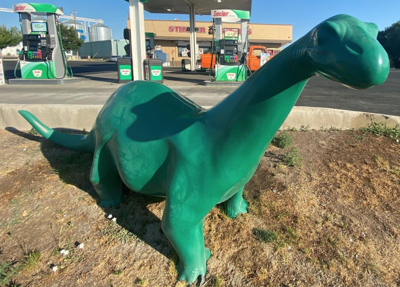
There’s a dinosaur standing in the dirt out front of the Sinclair gas station on Shoshone Street in Twin Falls.
It’s a statue, of course — a replica of Sinclair’s friendly mascot, a Brontosaurus named DINO who rose to popularity in the 1930s, even to the point of making an appearance at the Chicago World’s Fair in 1933.
While the real-life Brontosaurus that munched on plants and ate stones during the Jurassic times was a mighty beast, with some measuring longer than 20 yards on a football field and weighing between 31 and 38 tons, according to Britannica, DINO is not at all scary. The fright comes when you pull up to one of the pumps behind him: $3.99.
It’s not just Sinclair. The price on Friday was $3.98 at the Maverik station down the road, $3.99 at Chevron at Blue Lakes Boulevard and Filer Avenue, $3.98 at Phillips 66 on Addison Avenue.
The number was even higher in some spots outside of Twin Falls this week — including $4.19 at Travelers’ Oasis off Interstate 84 in Jerome County, $4.29 at Base Camp in Ketchum, and $4.34 at the Fairfield Sinclair in Camas County. Gas prices in Pocatello on Sunday were mostly over $4 per gallon and a few cents cheaper in Blackfoot and Idaho Falls.
For the first time in 2023, the Gem State’s average price for a gallon of regular gasoline crested the $4 mark last week, and it only climbed higher this week, adding four cents as of Friday as the price for crude oil surged to its highest level since November at more than $83 a barrel.
At $4.04, Idahoans are paying the ninth-highest price in the United States — including, on average, $4 in Twin Falls County, $3.98 in Jerome County and $4.15 in Blaine County, according to AAA Idaho.
California ($5.06) and Washington ($4.94) have it the worst, according to the fuel-pricing website GasBuddy.
Why are prices going up, what’s the forecast heading into Labor Day, and is there any chance that $3 gas could again become a reality?
The Times-News took those questions, among others, to one of the country’s foremost experts on gas pricing, Patrick De Haan, GasBuddy’s head of petroleum analysis, and here’s what he told us:
What are the factors driving prices higher again, not only in Idaho but across the country?
“Oil is certainly one of them. We have to watch the price of oil. It’s not always the complete story but, at least this time around, the price of oil is certainly one of the factors. Oil prices are up for six straight weeks. Part of that is due to the fact that, well, really, the bulk of it, is that Saudi Arabia announced in June when oil hit $65 (a barrel) — keep in mind, the Saudis have a lot of bills to pay now; they’re throwing hundreds of millions at the PGA, they’re trying to go after Lionel Messi, who’s next? … They need expensive oil. They need $80 oil to be able to avoid budget issues, and so they’ve cut production to try to inspire oil prices to rise. Which has worked in the last couple of weeks. They’ve also been able, now, to convince the Russians to go along with them and when you have the world’s second and third largest oil producers, combined, to cut production in the middle of the summer and in the middle of an economic outlook that’s been improving, you know, it’s putting pressure on oil. …
”Then another catalyst was certainly heat. Extreme temperatures can wreak havoc on refineries, whether the SunCor refinery in Colorado after a cold spell, catching fire, or if it’s extremely hot temperatures which has been the case in Texas and Louisiana. There’s a lot of refineries in Texas and Louisiana, by the way — something just shy of half of the nation’s refining capacity in those two states. Whenever you see extreme temperatures in areas where there’s a lot of refineries, you have a risk of issues developing and that’s been the case. There’s been some unexpected outages at some of those refineries. Keep in mind, too, the physics of it, right? Thermal expansion. When liquids heat up so much, they expand, which essentially reduces the usable capacity at refineries. … When half of the nation’s refining capacity is seeing limitations because of the extreme heat, you’re not producing as much gasoline. Combined with some of those unexpected outages which can be related to various equipment failures. … Refineries are delicate. They operate on everything working just right: Sensors, computer systems, etc. So outages can happen and sometimes it’s heat-related and sometimes it’s not.
”That, coupled with oil, is part and parcel why we’ve seen prices going up. Demand is high, higher in the summer. That certainly acts to exacerbate the outages.”
Many of the Western states — including Idaho and our neighbors in Utah and Nevada — are regularly paying more per gallon than states in the Northeast and the South, for example. Why? Is it simply a combination of supply and demand, taxes and refining costs? Or is there more at play?
“The problem is that you’re all tied together. Idaho, you’re reliant on refineries in Wyoming and especially Colorado, and ever since the SunCor refinery, the market has been pretty tight. Any outage affects the areas that those pipelines serve the most and you really don’t have any ability to really improve the situation because you’re landlocked (in Idaho). So, when refinery outages happen, there’s a massive disruption between the balance of supply and demand and it tilts that delicate balance and that’s what drives prices up so quickly. … (And) there are very limited options to bring in additional fuels.
”That’s how economics work, right? Gasoline demand is inelastic; it’s not like people stop consuming it when prices start going up. So prices naturally go up until they find a spot where demand starts to drop to better balance the market, but we’ve had a lot of refining issues this summer and we’ve had less spare capacity …
”No oil company wants to invest in refineries. In California, they’ve been trying to chase oil refineries out of the state — or at least been trying to do so by the regulatory process, the taxes, the requirements, the permitting. There’s been more and more pressure on refineries, and that translates into what you pay at the pump. A major refinery in Texas, in Houston — and this is Texas, where they’re much more friendly with the oil industry — the LyondellBasell refinery in Houston was going to shut down at the end of this year and now they’ve extended it a little bit (to 2025). But refineries are very expensive to upkeep, to stay with the times. We’re talking about billion-dollar investments. It’s not cheap — and refining, aside from last year and this year, when refining has been suddenly profitable — refining has very much been a boom-bust investment. There’s great times and there’s really bad times. The problem now is, even though the last year and a half have been better for refineries, you don’t just sink a billion dollars into a refinery right now.
”Bottom line: Why do prices go up so quickly? Because we have less spare capacity. Because we have more regulations. There’s fewer refineries. And there’s been more problems due to some of the high temperatures. There’s only so much you can do. Refineries are outside, exposed to the elements. There’s only so much resilience that you can have in these systems — which is not a whole lot. … There’s been some outages, I think, in Wyoming this year at refineries. And Salt Lake City, as well. When there’s an outage at a refinery that serves your region, you’re going to feel it.”
What’s the forecast for Idaho leading up to Labor Day and into the fall months?
“There might be some downward pressure, yeah. There should be some downward pressure on prices once we get outside the summer. The concern, though, is that a hurricane, a major hurricane, again going back to Texas and Louisiana, because we have so much capacity there. If there’s a hurricane that takes aim for Texas or Louisiana, that may delay the onset of lower prices.
”I think that prices, typically as we get toward the end of summer, prices are moderating because demand is starting to weaken. We also change back to cheaper winter gasoline on Sept. 16; that should provide some price relief. But the wild cards. I mean, OPEC. Saudi Arabia just extended their production cut into September and they kind of had a thinly guised threat that they could further accelerate their cut, or go above and beyond their already announced production cut. And of course they’re going to do that and try to spook the market and to push oil higher. Hard to know if they’re going to act on that threat. I doubt they will.
”But hurricane season and OPEC are the wild cards that could prevent the normal seasonal decline in prices. Just be aware of that. A major hurricane in the Gulf Coast would be bad news.”
How can we best understand the link between the West Texas Intermediate, now over $82 a barrel, and the price of a gallon of gas down the street? Is it simply because of the amount of crude needed to make gasoline?
“That’s really it. Fifty-five percent of what’s in gasoline is crude oil, so crude oil is the largest component in the price of gasoline. That relationship is not always direct; there can be times when the price of oil’s going up and the price of gasoline’s going down. … People often forget that nobody’s filling up with crude oil, right? The issue, generally, is when there’s a kink at the nation’s refineries, it actually puts downward pressure on oil, because there’s going to be less demand for oil if a refinery goes offline. At the same time, that’s also going to mean there’s less gasoline being produced. So, theoretically, it’s pretty common that you can see the price of oil going down but the price of gasoline is high.
”A lot of people like to make that comparison to 2008 … when oil hit $150, gas hit $4. Well, why last year, when oil was hitting $120, did gas hit $5? Because refineries are the wild card. And if there’s not enough refineries, or if there’s issues at refineries, you can have all the cheap oil in the world but if nobody refines it, theoretically, the value of gasoline could be much higher.”
”We’re all tired of paying more to fill the tank. Is there any pathway to get back to $3 per gallon in Idaho — or are there just too many obstacles?
“We could. If things go well this winter. … Like I mentioned, you’re landlocked. That can be bad when you need supply from other regions. But if refineries don’t have any issues this fall, that could be good news. Because that gasoline, also then, can’t find a way out of that market. By the way, that’s also why, there was a brief window when that SunCor refinery came back online, Colorado was seeing some prices below $3 early this summer.”
What tools are available for us to find the lowest prices — whether through GasBuddy or other ways?
“An educated consumer is always a consumer that spends less. Everyone shops around for big-screen TVs, for insurance, for cars. But the mindset’s different when it comes to gas, because people say, ‘Oh, it’s only 10 or 20 cents.’ It’s only 10 or 20 cents multiplied by 20 or 30 gallons of fill-up, multiplied by 52 times a year that you’re filling your tank. People don’t realize that there’s hundreds of dollars at play, even saving 10 or 20 cents. You’re not always going to come out ahead, but make sure that, before you fill your tank, be aware of what the prices are in your town or where you’re going to need to fill up. Whether it’s GasBuddy or Google or Waze, people should be checking around. It only takes 10 or 15 seconds. Shop around. Make sure you’re aware of what a good price is and what a bad price is.
”Loyalty programs are basically everywhere now, and stations offer you 5 to 10 cents a gallon off if you pay with a loyalty program. So, I’d say, sign up for a free loyalty program. The other thing that costs people money is, Americans are creatures of habit. They just go to the station they always go to. Maybe the coffee’s good or they like the service — and that’s fine. But make sure that station you always go to has a good gas price, too. …
”GasBuddy has pay card, as well. It’s similar to a debit product; it has a pin number, it’s tied to your checking account. And retailers, though the GasBuddy app, offer savings up to 25 cents a gallon, as well. Sometimes there’s credit cards that will have a bigger rebate than what we can give, too. …
”Loyalty programs. Shop around. If it’s not our pay card, there’s credit cards that offer rebates and rewards. There’s programs that Shell Fuel Rewards. If you’re on a road trip, be aware of state lines. That’s a big one, as well.”

(1) comment
Thanks to Obiden....what a great president....POS.
Welcome to the discussion.
Log In