

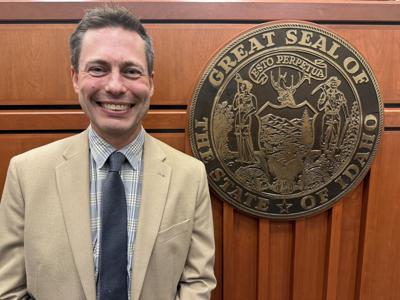
POCATELLO — For Jason Scott, the road to the Idaho Supreme Court started on Main Street, behind the counter of his family's hardware store.
Gov. Brad Little announced last week that he had appointed Scott, a 4th Judicial District judge based in Ada County, to the state's highest court.
Scott will fill the seat left open by the retirement of Chief Justice Richard Bevan, effective Oct. 30. The Idaho Supreme Court has already selected Justice Robyn Brody to succeed Bevan as chief justice.
"Judge Scott has dedicated his career to the law and to serving the people of Idaho," Little said in a news release announcing the appointment. "I am confident he will bring thoughtful judgment, a strong work ethic, and a deep commitment to the rule of law to the Idaho Supreme Court."
Scott said his Pocatello roots run deep. The year he was born, his parents bought a hardware store on Main Street called Pocatello Hardware.
Over the years, the business evolved into Scott Skis Sports, selling skis and other sporting goods.
"That was kind of our family identity," Scott said.
He worked there throughout his childhood and college years, until his parents sold the store while he was in law school.
His parents were also avid tennis players, a sport Scott said he picked up growing up in the city, and he has stayed loyal to his hometown ever since.
"It's a great place," Scott said. "It took me a long time, actually, after moving away, before I wanted to come back."
Scott's path to law began in an unexpected place — the classroom. His father was on the faculty at Idaho State's College of Business, and Scott enrolled at ISU intending to become an accountant, drawn to what he called a nationally recognized accounting program that at times led the nation in CPA exam passage rates.
About three years in, he decided he did not want to prepare tax returns for a living and set his sights on law school instead, hoping a law degree would open more doors.
That search led him to Duke University School of Law, a decision Scott said was shaped as much by basketball as academics.
"I loved college basketball, and I wanted to go to a place that had a high-end law school and a high-end college basketball program," Scott said. "When I got admitted to Duke, that was kind of the end. I couldn't do better than that."
Scott earned his law degree in 1997, then clerked for a U.S. district judge, an experience he credits with sparking his interest in the bench.
"I was drawn to the idea of being the neutral who sorts out what the outcome is that the law directs, given what the facts are," Scott said.
He returned to Idaho rather than pursuing opportunities in larger West Coast cities, spending about 15 years at the Boise law firm Hawley Troxell, including seven as a partner, focusing primarily on civil litigation with an emphasis on business disputes, according to the governor's release.
Scott applied for district judge openings four times before he was appointed to the 4th Judicial District in February 2014, in a process he described as sudden — an interview one day, a phone call the next and the oath of office the day after that.
He now also serves as the presiding district judge in Valley County.
Over 12 years on the bench, one case in particular stands out to Scott as among the most consequential of his career.
Scott oversaw a five-day, live-streamed trial interpreting the medical exceptions written into Idaho's abortion laws after the U.S. Supreme Court overturned Roe v. Wade, a case that drew national attention, including coverage in the New York Times.
"That was one of those things that you feel is destined to have a higher court look at what I did someday," Scott said.
Neither side ultimately appealed his ruling.
"It wound up being, I went up feeling good about the outcome in the sense that it was the end of the line in my court, rather than fodder for an appeal," Scott said.
Scott also ruled on a contentious open meetings lawsuit between the Idaho attorney general and the State Board of Education over the University of Idaho's proposed acquisition of the University of Phoenix, a decision the Idaho Supreme Court later reversed.
"You're not going to get everything right in the eyes of an appellate court," Scott said.
Scott said he had long hoped for an appointment to a higher court but had largely given up on the possibility in recent years, believing his district judgeship, a job he said he never regretted for a second, would be the end of the line for his career.
"For twelve years, I've given my all to serving the people of Idaho as a district judge," Scott said. "I'm grateful to Governor Little for entrusting me with the opportunity to continue in public service as a justice of the Idaho Supreme Court."
As he prepares to join his four future colleagues on the state's highest court, Scott said he is looking forward to working through difficult cases as a group rather than alone.
For Pocatello students considering a legal career, Scott said an expensive undergraduate degree is not a prerequisite for a good law school, and he noted that law schools do not require a specific undergraduate major.
"There are many paths to go into law school," Scott said.
Reflecting on the appointment itself, Scott said the honor speaks for itself.
"I'm confident that I did not somehow get this because of connections," Scott said. "It feels to me like the fact that I've done well at the job I have was recognized in this instance, and that is gratifying."


(0) comments
Welcome to the discussion.
Log In