

Latinos in Idaho are disproportionately impacted by COVID-19, in case counts and hospitalizations. The worrisome trend has its roots in a swirl of socioeconomic factors and also, experts say, in a lack of good information making its way into the state’s Hispanic communities.
The confluence of social and economic factors, as well as the information problem, has experts worried as the coronavirus pandemic continues its march through the state.
SOCIAL AND ECONOMIC FACTORS
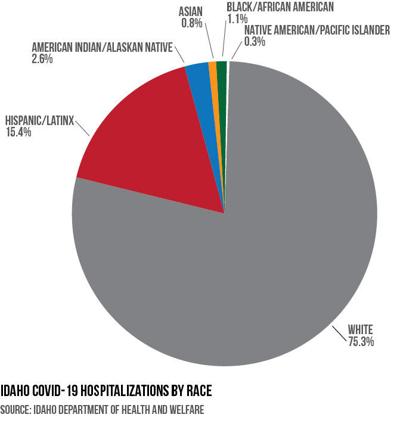
According to Idaho Department of Health and Welfare data provided to the Idaho Press on Nov. 30, Latinos make up over 15.4 percent of Idahoans who have been hospitalized due to COVID-19, but make up only 12.8 percent of the state’s population. The rate Latinos have been hospitalized is 20 percent higher than would be expected if there were an even distribution of hospitalizations across the state’s demographics. Since the start of the COVID-19 pandemic in March, 3,948 Idahoans have been hospitalized with the disease; 608 are Latino.
Kristin Bennett, a researcher at the Rensselaer Polytechnic Institute said factors including “access to health care, economic disparities, community resources and the physical environment” may be reasons why Latinos are disproportionately impacted by the virus.

Such disparities existed long before COVID-19 arrived in the United States; the pandemic has simply cast a light on them, Bennett wrote in an email to the Idaho Press.
Plus, she said, some groups might be more likely than others to hold jobs that cannot be done remotely. If that’s the case, members of those demographics are more at risk to catch COVID-19.
“Alternatively they may be more likely to lose their jobs, and then the consequence of that may exacerbate other health (risks), access to community resources,” Bennett wrote.
When looking at the disproportionate impact of the virus on Latinos, people should consider that Idaho Latinos are discouraged from seeking medical help if they are undocumented, said Dr. Edward Savala, a physician in Caldwell. As of 2016, an estimated 28,000 immigrants from Mexico in Idaho do not have documentation, according to the Pew Research Center.
“When I go into a doctor’s office, (office staff) ask for multiple forms of identification, and there are enough undocumented workers here that they still worry about having to give information,” Savala said. “I have had patients that have used more than one name when they see me.”
Mari Ramos, the Family Community Resource Center coordinator for the Nampa School District and a member of the Hispanic/Latino COVID-19 Task Force in Nampa, said one of the main factors in why Latinos are disproportionately impacted by the virus than other groups is because of the structure of family units in Latino families.
“I do think that our Hispanic families not only have multi-generations in the same household, they also host gatherings of their family a lot more often and it is much more difficult for them to stay away and isolate,” Ramos said in an email. “There is also a hesitancy to miss work or do anything to jeopardize their jobs.”
Reluctance to see a doctor and the resulting delay in care could be a factor in the higher death rate for Latinos than for white residents, according to Bennett. Nationwide, Latinos are dying from COVID-19 at a rate of 78 per 100,000 population, in cases where race is known, compared with 59 per 100,000 for white residents, according to the COVID-19 Tracking Project. Nationwide, other compounding factors include air pollution and crowded health care systems, Bennett said.
MISINFORMATION
Even nine months into the COVID-19 pandemic, there is not enough information about the disease making it into Latino communities, Savala said.
There is a lack of trusted, professional sources in Idaho who can answer questions about COVID-19, who are available to Latino communities, he said.
JJ Saldaña, community resource development specialist with the Idaho Commission on Hispanic Affairs, said a lot of Latinos in Idaho rely on social media to get their information about the virus.
A combination of a lack of information and the falsehoods circling online, in addition to underlying health conditions, lower income and worry around immigration status that Latinos face, has put the community in a difficult position, Savala said.
Saldaña said Spanish radio stations across Idaho have heard from the Latino Spanish-speaking community who say they didn’t know where to get information and didn’t know who to trust.
Ramos disagrees that information is not getting out to Latino families, she said she has heard the misconception that masks don’t help prevent the spread of the virus, but she has also heard that from non-Latino, English-speaking families.
“I think for the most part the official sources of information are giving out the same information in Spanish and in English throughout different platforms,” she said in an email.
OTHER DEMOGRAPHIC FINDINGS
Idaho’s demographics have some other interesting factors. Men, who account for 50.1 percent of the state’s population, have been hospitalized at a slightly higher rate than women during the pandemic for COVID-19, making up 51.1 percent of all hospitalizations in Idaho. And white people have had a lower rate of hospitalization than expected; 75.8 percent of all hospitalizations were white people, while they make up 81.6 percent of Idaho’s population.
Hospitalizations are an important piece of understanding how deadly the COVID-19 pandemic is in communities. In Idaho as of Nov. 30 there had been 960 COVID-19 related deaths tallied by the Idaho Department of Health and Welfare. That is a rate of 53.7 deaths per 100,000 population, with 53 percent of deaths occurring in people over 80 years old and 57 percent of all deaths being men. In Idaho, Latinos make up more than 11 percent of total deaths in cases where race is known.

(0) comments
Welcome to the discussion.
Log In