


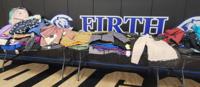
Even as the turbines are arriving and being installed, Clearway Energy Group, the owners of Cedar Creek Wind, and Wanzek, their construction company, have taken time from their rush to finish the wind farm to personally buy coats and backpacks to brighten kids’ lives.
They brought coats of many colors and sizes and some backpacks for students in the Firth School District. For The Village in Blackfoot, an organization that supports foster and adopted kids, they donated 250 backpacks.
Currently they are “passing the hat” at their meetings and buying canned goods for the Heart 2 Hand Bingham Food Pantry in Shelley. And, there are plans to continue this kind of good neighbor generosity through a foundation after they are up and running.
The Cedar Creek Wind Farm is where the huge blades and massive tower parts that you see on the roads are headed to. These turbine parts are being assembled and installed on 2,600 acres of private land east of Goshen in the Taylor Creek area.
The project started in 2008 with a plan that kept expanding. Development phases with more and more turbines were added over the next decade, until eventually, 129 turbines were being planned. However, at the same time the industry’s technology has been advancing. Now there are thinner blades that can produce significantly more power with the same or less infrastructure costs, and that is revolutionizing wind farm designs.
In 2019, rPlus Energies bought the wind farm-to-be, redesigned it, was awarded a power purchasing agreement with PacifiCorp, and then sold it to Clearway Energy Group in 2021. Clearway finalized the 25-year purchasing agreement and started construction in 2022. The new plan is for just one phase of 47 turbines, each of which will be only 550 feet tall, 60 feet shorter than was earlier planned. Construction is planned to be completed by the end of the year with operations starting early in 2024.
Cedar Creek Wind farm will produce 152 megawatts of power, which is enough power to keep 41,000 homes humming with electricity for a year. It will have more power capacity than the Goshen North Wind Farm in Bonneville County, which had been the state’s largest wind farm at 124.5 megawatt capacity. This is an example of how the industry has changed. Cedar Creek will produce more energy with 47 turbines on 2,600 acres versus Goshen North with its 83 turbines on 11,000 acres.
Another way the wind farm will benefit their neighbors, once they are operating, is courtesy of the Idaho legislature. In 2007 they instituted a 3 percent energy tax on wind and geothermal energy’s gross revenues (solar energy is taxed at 3.5 percent). This tax is gathered by the state but then redistributed back to the county and all of the taxing districts which the farm is a part of.
For example, last year Bingham County received $95,880.62 for the few turbines in the county that are a part of the Wolverine Creek Energy Wind Farm. This was distributed to the six taxing districts that the property is located in. The County received $58,155 and the Firth School District added $17,396 to its revenues, with the Shelley/Firth Fire District, North Bingham Library District, Ambulance District and the Mosquito Abatement District also receiving various lesser wind farm tax revenues. If you are wondering who decided the amounts, the state legislature did. The tax revenues are distributed according to each district’s tax levy rate.
For perspective, Power County, home of two larger wind farms, received tax revenues of $296,669 from Power County Wind Park and $518,017 from Rockland Wind Park. Both of these reimbursements were divided between nine taxing districts, including the county, according to their individual levy rates.
Not that it is a competition with Power County, but there is a third wind farm in the works for Bingham County, the Arco Wind project that will span the border of Bonneville and Bingham counties, similar to the Wolverine Creek Farm. This 27,000-acre farm will have 39 turbines in Bingham County and 59 in Bonneville County. Both counties have issued the required conditional use permits and North Renew Energy is currently refining their design and choosing equipment manufacturers. They hope to break ground in 2024.
Thus, there appears to be three ways Cedar Creek Wind Farm is or will be helping Bingham County. First, through their unmandated, ongoing generosity with the nearby communities. Then, besides generating needed power for our society’s increasing electricity demands, they are also benefiting the county, schools, libraries, ambulances, and fire departments through extra tax revenues.
The losers here seem to be the mosquitos, since the abatement districts will now be able to spray more.


(0) comments
Welcome to the discussion.
Log In