

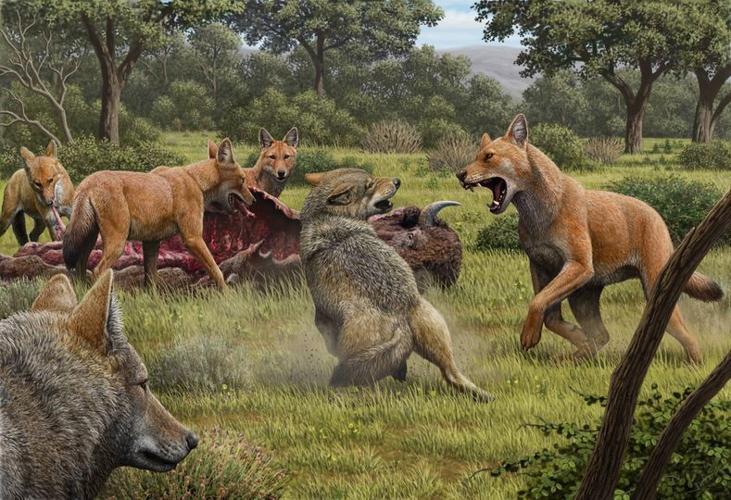
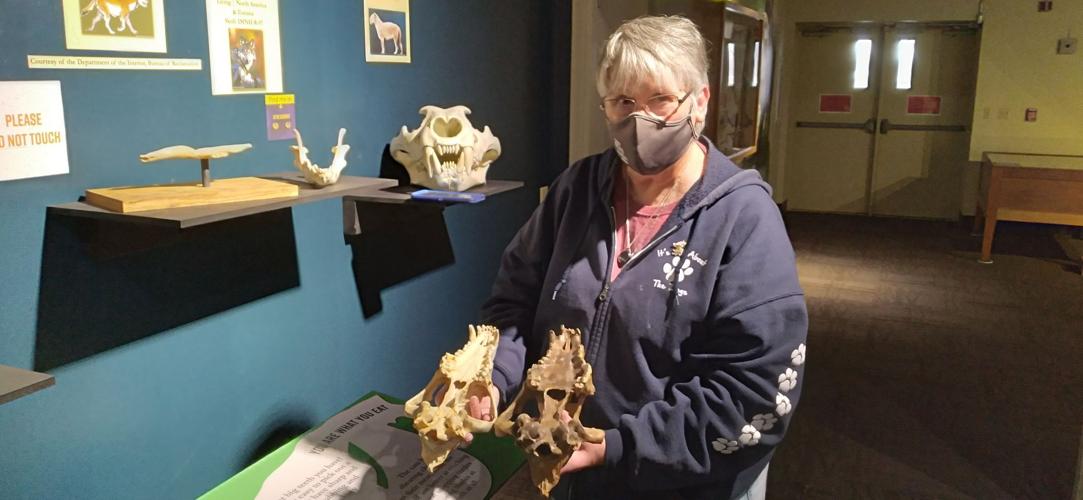

POCATELLO — The two fossilized dire wolf skulls have mostly remained in storage at the local Idaho Museum of Natural History since they were unearthed in the 1940s from American Falls Reservoir.
Thanks to new technology, they’ve finally spilled their secrets, thereby changing scientists’ long-held beliefs about the lineage of the menacing mammal from the last Ice Age.
Mary Thompson, affiliate curator at the Idaho State University-based museum, was among about 30 coauthors on an international dire wolf research paper, published in the January edition of “Nature.” The groundbreaking study included analysis of DNA from her museum’s pair of dire wolf fossils.
The most intact of the two fossils, left by an adult dire wolf, is now on display at the natural history museum as part of its new “Skulls” exhibit.
The “Nature” publication was met with global fanfare and has been shared widely on social media, due in large part to significant public interest in dire wolves spurred by their role in the popular HBO series “Game of Thrones.” Thompson explained that the team of researchers initially planned to publish the study in a different journal in conjunction with the final episode of “Game of Thrones” in May of 2019. That journal ultimately declined to publish the paper, however, leaving the researchers to seek another publication.
“Dire wolves are kind of glitzy. A lot of us were getting questions: Are dire wolves real? They are real,” Thompson said.
The DNA study reached an unexpected conclusion with broad ramifications for science: Dire wolves and gray wolves — long assumed to be close relatives — evolved separately from one another. Leif Tapanila, director of the Idaho Museum of Natural History, believes the dire wolf study may represent just the “tip of the iceberg” regarding false connections between species made solely upon appearance and morphology. Tapanila even sees potential for DNA research to debunk assumptions about the evolution of man.
“I expect to see in the next decade or two many more revelations about the complexity of life based on DNA,” Tapanila said.
In the case of the recent study in “Nature,” Tapanila said it’s provided strong evidence that dire wolves and gray wolves resulted from convergent evolution, meaning they evolved separately but similar conditions led them to take on similar forms. Dire wolves apparently originated in North America while gray wolves, which appear to simply be smaller versions of dire wolves, trace back to Europe and Asia.
“You would think that the dire wolf and the gray wolf based on the appearance of their fossils is a slam dunk that they’re related to each other. ... What else might we be getting wrong based on the just the skeleton itself and not looking at the biochemistry of those animals?” Tapanila asked.
Australian researcher Kieren Mitchell and Angela Perri, an American scientist working in Germany, were the paper’s main authors. The team arrived in Pocatello in 2016 to take DNA samples, flaking a small piece of each fossil’s petrous bone, located inside the back of the skull. They also evaluated dire wolf fossils from other locations, including in the Midwest.
Tapanila shared the story of the dire wolf study with the Idaho Legislature’s powerful Joint Finance Appropriations Committee on Tuesday, making the case that investments in museums and collections make future scientific discoveries possible, as new technology becomes available.
“We keep (collections) safe for future generations because you never know how they’re going to be used in the future and what new information can be spun off of them,” Tapanila said.
Thompson has found hundreds of Pleistocene mammal fossils in American Falls Reservoir throughout the years. She’s unearthed fossil camels, saber-tooth cats, short-faced bears, giant sloths, giant bison, mastodons, mammoths and fossilized trackways.
In Thompson’s view, the Southeast Idaho reservoir ranks among the top 10 locations for finding Ice Age specimens. She acknowledges that the La Brea Tar Pits of Los Angeles are the nation’s best source of fossils from the period. However, the tar tends to complicate DNA analysis of La Brea fossils.
Researchers have come to recognize that DNA is especially well preserved in American Falls Reservoir fossils, and the museum has seen a significant increase in requests from researchers seeking samples for DNA evaluation in recent months.
The dire wolf study raises new questions for scientists to tackle. For example, why did dire wolves go extinct between 10,000 and 12,000 years ago while gray wolves survived?
“It’s an important reminder that you can get new information from old things and be totally surprised,” Tapanila said. “This is a global story. The things we have in our collection are really important and can lead to groundbreaking research that is of interest globally.”

(0) comments
Welcome to the discussion.
Log In