

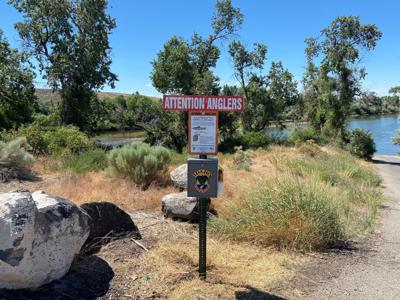
Anglers fishing along the Snake River south of Shelley are being asked to help with a study by nipping a chunk of fin from every rainbow trout they catch, slipping it in an envelope and leaving it at a kiosk.
The Idaho Fish and Game study is to determine how many rainbows are wild or of hatchery origin along the stretch of river between Shelley and just above American Falls Reservoir.
“We’re focusing on whether it’s hatchery or wild fish that are being caught,” said Ryan Hillyard, fisheries biologist with Fish and Game’s Southeast Region. “It makes sense to use the anglers that are actually catching the fish to do the work and get the information.”
Fish and Game posted four fin kiosks located at McTucker boat ramp (north of American Falls Reservoir), Porterville boat ramp, Cherry Plant boat ramp and Shelley boat ramp (south of Gem Lake).
The kiosks have envelopes and instructions on how to process a fin sample. Hillyard suggests anglers take a few envelopes with them, especially if they are planning to release the fish after catching them.
“You take a knife and cut a sliver off any fin,” Hillyard said. “It won’t impact the fish. We say no bigger than a hole punch. Something about a quarter of an inch at the most. You take a little chunk off the fin and put it into the envelope. Nail clippers would work too.”
Rainbow trout can be identified by heavy spots on the head and white fin tips.
Hillyard said his crew will gather all the fin clips “probably toward the end of fall when fishing slows down” and do a chromosomal test to determine if they are wild or hatchery.
“Regular fish will be diploid and a hatchery fish will be triploid because they are sterile,” he said. “We only stock sterile fish because they are triploids. We can tell that from a chromosomal sample, how many chromosomes they have.”
Learning what the rainbow trout population consists of along this stretch of the river will help Fish and Game develop a strategy for stocking the river in the future.
“If a lot of them are hatchery, we’ll know that the hatchery fish are surviving and we can continue stocking,” Hillyard said. “We haven’t determined what the management strategy will be until we find out this information. We want to find out what our hatchery percentage is in the population.”
If it turns out that most of the fish are wild rainbows, he said the strategy could be to encourage the wild population.
“We could manage more for wild fish if they are surviving better than our hatchery stock,” Hillyard said. “We could do different things to encourage wild fish survival looking at rearing habitat. It will be interesting to figure that out. It will impact the way our stocking strategies go.”
Hillyard said he’s guessing the four different sites will produce different results in the study.
“We could see that some of the hatchery stock is more prevalent in the lower section because they are coming up out of the reservoir when it’s warmer in the reservoir up into the tributary,” he said. “Maybe it might differ at the different kiosks that we have. It might give us an idea of where to focus our stocking.”
While fin clip studies have been done in other areas of the state, particularly with wild versus hatchery salmon, this is the first time a study of this type has been done along the Snake River in eastern Idaho, Hillyard said.

(0) comments
Welcome to the discussion.
Log In