





Lili Hill
BLACKFOOT — Lili Hill isn’t your typical teenager.
Yes, there are other 17-year-olds enthralled by the performing arts — dancing, singing, acting and playing stringed instruments. And yes, a portion of those children bring home straight A’s on every report card.
And there’s certainly a percentage of that subset who do so while staying quietly humble and putting the people around them first before satisfying their own wishes and desires.
To do so through constant dizziness, bouts of nausea, debilitating headaches and numbness in her arms and legs is a feat Blackfoot teen Lili Hill completes virtually every single day of her life as someone living with Chiari malformation and Ehlers-Danlos syndrome.
But soon she may not have to — and a close mentor and fellow performer is asking for the public’s help in giving her the chance at a life-altering operation overseas.
A life built on stages

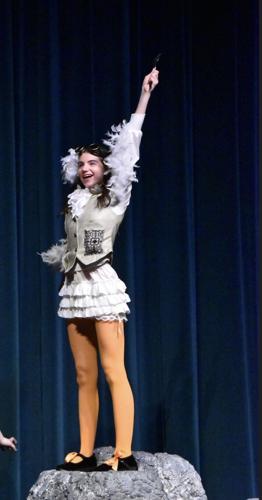
Lili Hill pictured while performing during a musical.
Jennifer Hill will tell you her daughter came into the performing arts the way most kids come into a family sport — by watching her older brothers do it first and deciding she wanted in.
“Her older brothers were involved in musicals and so was my husband,” Jennifer said. “We just started doing it as a family. And she just loved it, probably the most of all my kids.”
That was at age 6. Since then, Lili — the fifth of seven children and a junior at Blackfoot High School — has been in 29 musicals.
She has competed with the Blackfoot High School Fillies dance team, trained with the Blackfoot School of Ballet, and performed with the Blackfoot Community Players and the Blackfoot High School Drama Company. She plays violin and ukulele, takes voice lessons and helps choreograph the very shows she performs in.
She also tried basketball and soccer. They didn’t stick.
Jake Spjute, the Blackfoot Performing Arts Center director and Lili’s drama teacher, has known the Hill family for years — long enough to have shared a stage with Lili before she ever stepped into his classroom. He has watched Lili grow from a shy grade-schooler who used the stage to find her voice into a competitor who has competed at IHSSA drama competitions at both the district and state level.
The performing arts, though, are only part of the picture.
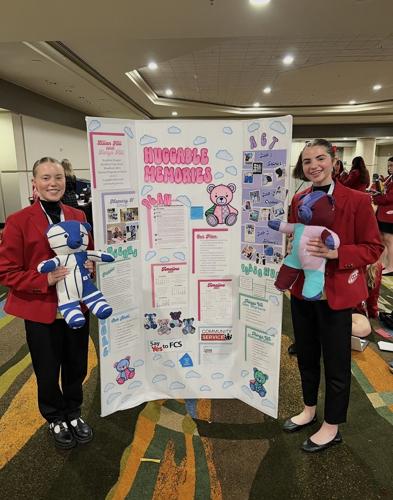
Through Family, Career and Community Leaders of America, or FCCLA, Lili has built a service project that has earned her a national stage of a different kind. She sews memory bears from the clothing of people who have died, handcrafting keepsakes for grieving families who want to hold onto something tangible. The project has placed at the Idaho state competition two years running and carried her to nationals both times. This year, she finished fifth in the nation.
“She’s not just on the dance team,” Spjute said. “She’s pretty much always the best one. She excels at so many different things.”
Jennifer laughed recalling how Lili had earned enough college credits since eighth grade that she could have graduated two years early.
“She decided to stay,” Jennifer said, “because she loves the arts so much.”
What she carries
What almost no one in the audience ever knows — what Lili herself rarely volunteers — is what it costs her to get there.

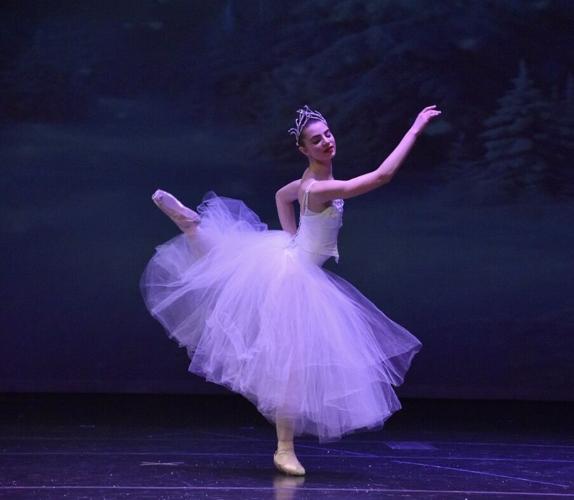
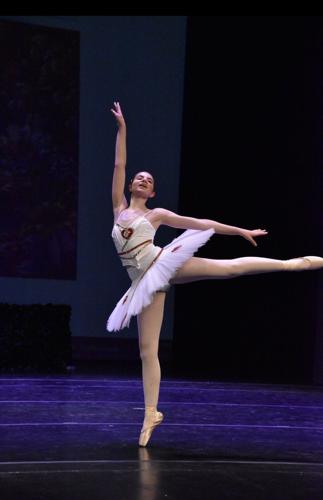
Lili Hill pictured during a ballet performance.
Lili has Chiari malformation, a condition in which part of the brain, the cerebellum, extends down into the spinal canal. It causes chronic headaches, dizziness, nausea and, in Lili’s case, episodes where her legs simply stop responding mid-dance. Her coach calls a halt to practice. Lili gets back up anyway, waiting for her nerves to refire.
Symptoms have shadowed her since she was 5. But it wasn’t until seventh grade that a scan revealed the full extent — her cerebellar tonsils had descended 11 millimeters into her spinal cord, more than double the five-millimeter threshold that typically triggers surgery. She was in the middle of her dance season. She refused to quit.
She finished the year. Then, the summer before her freshman year, she had the surgery.
“They opened up her skull, went inside her brain, used a form of heat to shrink the cerebellum and squeeze it back up into where it’s supposed to belong and put a patch over her brain,” Jennifer said. “It’s supposed to grow back and cover it and keep her brain up where it’s supposed to be.”
It didn’t.
The headaches came back. The body pain didn’t leave. Doctors dug further and found Ehlers-Danlos syndrome — a connective tissue disorder that affects Lili’s joints, tissues and nerve endings across her entire body.
A recent MRI confirmed that Chiari has returned. Her cerebellar tonsils are back down into her spine.
Running offstage to be sick — then going right back on
Lili does not tell people when she is hurting. That is perhaps the most remarkable and quietly troubling detail about her situation.
“She never complains,” Spjute said. “You would never, ever suspect she deals with something like this.”
Jennifer put it more plainly.
“She doesn’t know a life without being busy and having a headache,” she said. “So when she does perform, she will literally run off stage and just throw up because she’s so dizzy and then she’ll go back on and continue performing.”
She’s never thrown up on stage, Jennifer noted — as if that were the bar being cleared.
Spjute, who has coached, directed and watched Lili perform through all of it, was more somber.
“If she didn’t live in such pain,” he said, “she’d probably be an Olympian by now.”
A fork in the road
The path American medicine offers from here is a spinal fusion — a procedure that would fuse Lili’s C1 and C2 vertebrae to her skull, permanently eliminating her ability to turn her head.
For anyone, that is a serious limitation. For a dancer and performer who one day wants to be a mother, Jennifer said it is simply not a road they are willing to take.
“How am I going to be a mom if I can never move my head again?” Lili has asked.
The neck brace she was issued — a preview of what the fusion would mean — has already been pushed aside. It doesn’t help. And the family does not believe the surgery would, either.
“The spinal fusion doesn’t actually fix the problem,” Jennifer said. “It just keeps her head in place.”
Spjute added: “She’d basically have to turn to look around like Batman.”
Then Jennifer found something different. The Chiari Institute of Barcelona — a specialized center with decades of experience treating the condition — performs a procedure called filum terminale sectioning. Surgeons access the spine through the tailbone and sever the filum terminale, a slender strand of tissue that runs the length of the spinal cord. Researchers have found that releasing that tension can relieve the upward pressure pulling the brain downward.
Everyone the family has spoken to who has had the surgery describes the same thing, Jennifer said. Life-changing.
The estimated cost for Lili to receive the procedure in Barcelona is $35,000.
A community asked to step in
The Hill family was not going to ask for help. That is the part Spjute wants people to understand.
“They would probably just try to do it by themselves,” he said. “Because that’s the type of people they are.”
Jennifer had mentioned in passing that she would mortgage the house if it meant getting Lili out of pain. That was all Spjute needed to hear.
“I was like, no, I don’t like that,” he said. “So I just did what I could on my end.”
He started a GoFundMe. The Hills said yes. Spjute made a point of clarifying that the family never came to him for help — the decision to act was his.
“I wanted to engage the community,” he said. “I thought we should try and give them some help.”
As of Friday afternoon, 38 donors have contributed $2,925 toward the $35,000 goal. Those who want to give can find the campaign at gofundme.com/f/hope-for-lili-surgery-in-spain.
The girl they are rallying around
Ask anyone close to Lili what she is like and they reach for the same words: humble, kind, hardworking, always thinking about someone else.

Lili Hill pictured during with her Family, Career and Community Leaders of America, or FCCLA, service project board.
Jennifer described a girl who was shy as a child — who used the stage to come out of her shell — and who still carries a quiet introversion beneath the confidence performing has built. She gravitates toward the underdog in any room and helps before being asked. It’s no coincidence that the project she chose to take to a national stage is one built entirely around easing someone else’s grief — staying up to sew bears from the clothes of strangers’ loved ones while carrying pain most people around her don’t even know exists.
Spjute said she is, in every setting he has ever seen her, exactly the same person.
“If I was in that position, I’d be like, everyone leave me,” he said. “But she’s just — yeah. She’s a really, really good human.”
Lili turns 18 this year. She is finishing her junior year, taking college courses she could have completed years ago if she hadn’t chosen to stay for the art. There are 29 musicals behind her. There are, if this surgery works, many more ahead.
“The sky’s the limit,” Spjute said. “We have no idea where this young girl from Blackfoot would be.”
He paused.
“President of the United States. Anything, really.”




(0) comments
Welcome to the discussion.
Log In