

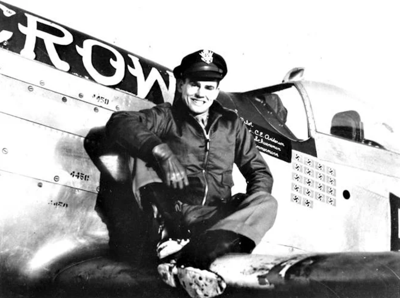
The last living triple ace, now more than 100 years old, will visit Lewiston during the fifth iteration of the Radials and Rivers Fly-In on Saturday.
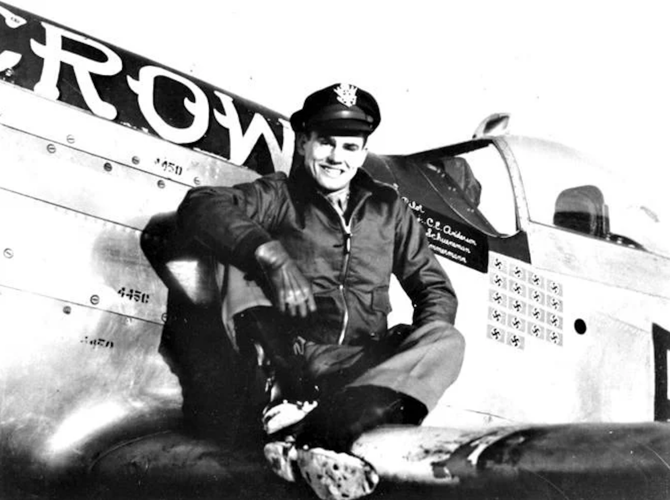
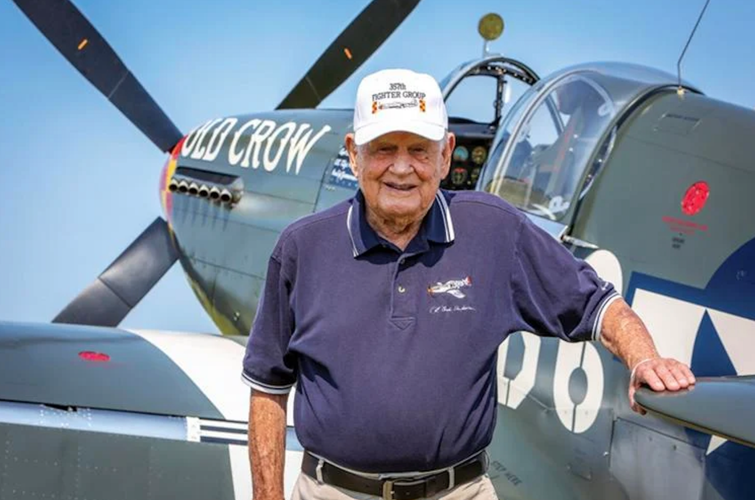
Clarence “Bud” Anderson, a newly minted brigadier general and celebrated World War II fighter pilot, will make his second appearance at the event that features a mixture of antique aircraft and military planes. Also making a return visit will be a restored P-51 Mustang painted to replicate Anderson’s Old Crow, one of the planes he flew in the European Theater.

Bud Anderson stands next to a P-51B Mustang painted in the Old Crow design like one of his planes in World War II. Anderson, a triple ace, is the guest of honor at the Radials and Rivers Fly-In on Saturday.
“It was a wonderful airplane,” Anderson said of the P-51 during a phone interview. “It probably saved the air war in Europe and affected the European war in a major respect.”
Before the plane was introduced, American fighter pilots were unable to fly at high altitudes nor accompany and protect allied bombers on long-range trips deep behind enemy lines. As a result, the bombers suffered high losses when attacked by the German Luftwaffe.
The P-51 changed that. It could fly up to 500 mph, climb to high altitudes and make it from England to Germany and back on a single fueling. But Anderson said it wasn’t the aircraft alone that helped turn the tide. A decision by Gen. James “Jimmy” Doolittle played a massive role.
“He was my hero,” Anderson said. “He came in and turned things around and let the fighter pilots fight and, as a matter of fact, that allowed us to defeat the Luftwaffe.”
Prior to Doolittle, American brass ordered fighter pilots escorting bombers to stick close to the big birds. That meant they were unable to pursue German fighter pilots.
“He said go for ’em, leave the bombers and destroy them anyway you can,” Anderson said. “We gained air superiority by killing their fighter pilots.”
Anderson shot down 16 German planes on his own and shared another kill with three other pilots, earning him the title of triple ace. The ace title is given when a fighter pilot achieves five kills. At 101, he is the only living triple ace.
The event, at Hillcrest Aviation, runs from 7 a.m. to 6 p.m. Saturday. Anderson will participate in a round-table discussion during intermission of the fly-in, scheduled for noon to 2 p.m. With him will be Jonna Doolittle Hoppes, the granddaughter of Jimmy Doolittle.
While Doolittle’s call allowing American pilots to pursue attacking Luftwaffe planes was instrumental, he is best known for the daring attack he led on Japan following that country’s surprise bombing at Pearl Harbor.
Doolittle, then a lieutenant colonel, and his crew known as the Raiders, flew 16 B-25 bombers from an aircraft carrier in the Pacific and attacked military and industrial sites in Japan in April 1942. Knowing they wouldn’t have enough fuel to return, they planned to crash land in China. One man died after bailing out and four of eight men captured by Japanese forces were executed.
The raid, the first engagement with the enemy following Pearl Harbor, was celebrated by the American public and proved an embarrassment to Japanese military leaders. As a result, they relocated some of their forces to the island nation in a defensive maneuver. Doolittle was promoted to general and awarded the Congressional Medal of Honor, which he initially attempted to decline.
“He believed in the team. His accomplishments were on the shoulders of a team,” Hoppes said in a phone interview. “When awarded the Medal of Honor, he accepted on behalf of every single one of the Raiders and he never considered it his medal. He considered it their medal.”
She has dedicated her working life to preserving her grandfather’s history and authored “Calculated Risk: The Extraordinary Life of Jimmy Doolittle,” a book about her grandfather. But her efforts quickly morphed into something larger. At speaking engagements, veterans would frequently share their war experiences with her.
She said their stories, the things they did, were just as important as Doolittle’s.
“My whole mission changed,” she said. “It became the goal of getting history and recording as many stories as I could and getting people to realize how important those stories are to our history and our freedom.
“My message is every story, every person who has contributed, they are a thread in the fabric that make up this country,” Hoppes added. “They are why we are free and have options, and I think his story is a springboard to all those stories and how important they are. It is about Bud Anderson. It’s about everybody who has put on the uniform or served in other ways.”
Hoppes second book, “Just Doing My Job: Stories of Service from World War II,” is part of that effort.

(0) comments
Welcome to the discussion.
Log In