

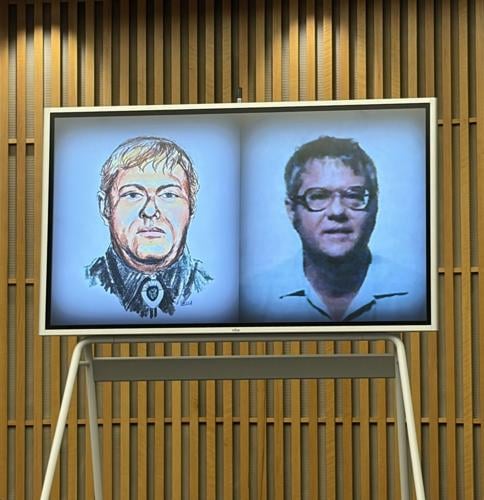
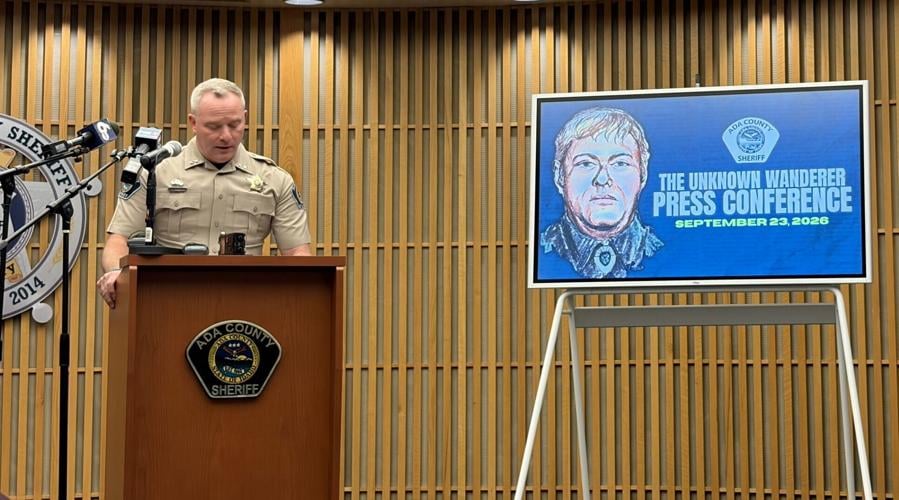
BOISE — A notorious cold case out of a Boise church has been solved with ties to a string of murders in the 1980s.
On Dec. 3, 1982, a man later deemed the “Unknown Wanderer” was found dead inside Sacred Heart Catholic Church. His cause of death was ruled as cyanide poisoning.
Police had limited evidence to go off of. The man did not appear to be from Boise, with suntanned skin in the middle of winter.
Items found on his person included a set of 30 keys, an envelope holding $1,900 cash and a suicide note signed with a fake name. The cash was intended to cover his burial expenses, according to the note.
For 40-plus years, the man’s identity remained a mystery — until Wednesday morning.
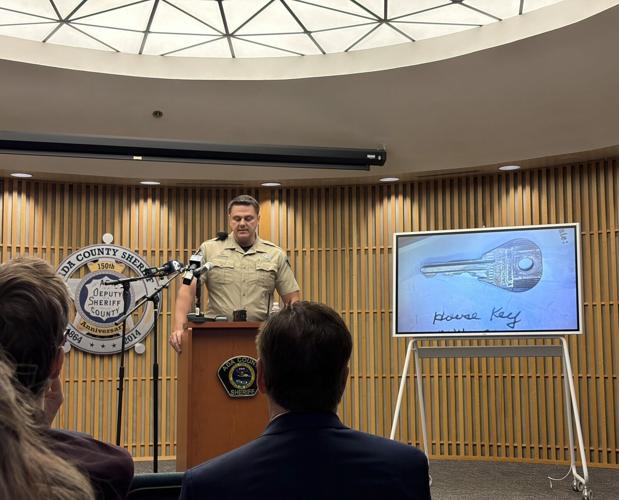
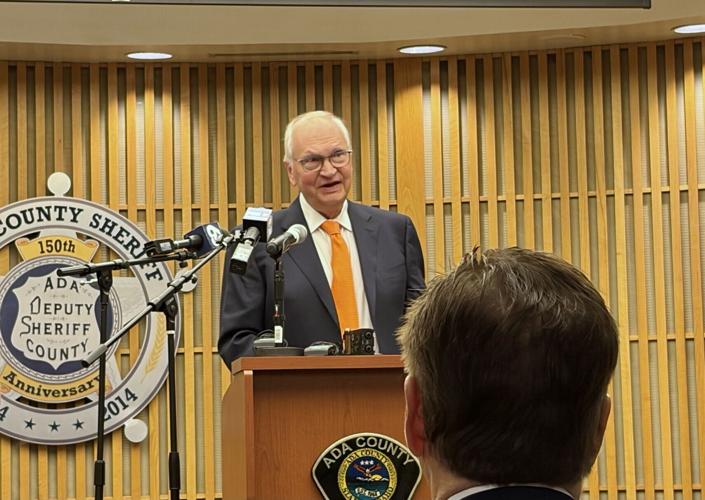
“This case was an example of good citizens and experts in their field coming together to assist law enforcement in finding answers,” Ada County Sheriff’s Office Det. Tim Cooper said.
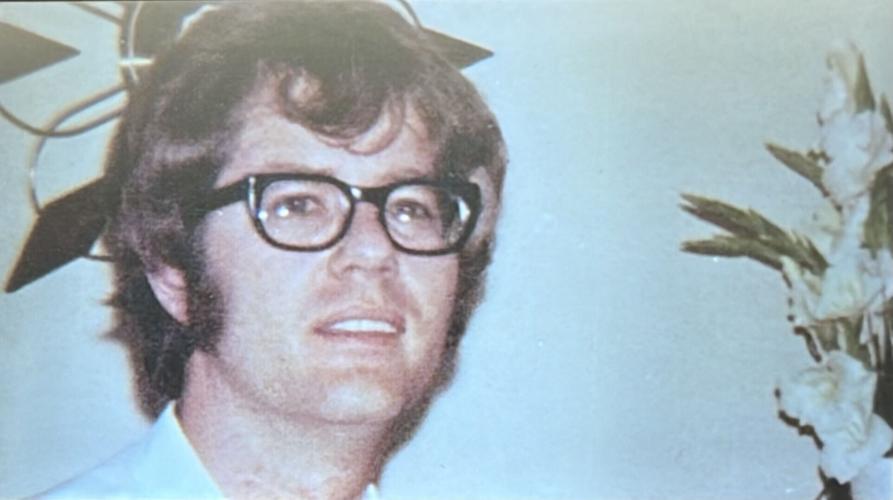
At the Ada County Sheriff's Office, a breakthrough in the case was announced. The man has been identified as Florida resident and Los Angeles native Mathew Francis Betkouski.
ABOUT BETKOUSKI
His grandfather served on the Los Angeles City Council for nearly 18 years according to city records, and his father worked for the Los Angeles Department of Water and Power. Betkouski himself was a well-educated chemist with a Ph.D.
“This is a case that involves mental illness, and there were many who tried to get Dr. Betkouski help during his life — and I mean — they really tried,” Cooper said. “His mental illness throughout his life was complicated.”
In spite of his intelligence, Betkouski suffered from mental health issues. According to Cooper, Betkouski hit his head in a 1968 fall and later experienced a traumatic brain injury in a second 1974 fall. He was hospitalized after the second fall and put into an induced coma due to his injuries. The damage ultimately exacerbated his prior mental health issues.

Mathew Francis Betkouski has not been officially declared a suspect in the Chicago Tylenol murders, but has not been ruled out.
In 1975, Betkouski worked at a flavors and fragrances company in the Jacksonville, Florida, area.
“After about three years, concerns mounted after coworkers reported Dr. Betkouski discussing the perfect crime and how cyanide could be used as a less messy means of taking one's life,” Cooper said. “Dr. Betkouski was observed talking to himself on occasions and had fears that he was being tracked.”
Betkouski spent two and a half months in 1978 receiving treatment at the UCLA Neuropsychiatric Institute in Los Angeles, but did not see improvement. His journal entries at this time provided a window into his state of mind.
“Dr. Betkouski wrote about the possibility of trying to manage schizophrenia and depression, the possibility to experience feelings of euphoria brought on by imaginary thoughts of violence,” Cooper said.
He later continued treatment in Florida and may have received treatment at other locations as well.
Betkouski later moved to New Mexico and worked at Lockheed Martin’s White Sands Test Facility. He was fired in 1982 after he allegedly caused a disturbance trying to buy pills or capsules at a pharmacy in the Las Cruces area. His arrest led to the discovery of stolen materials from the Lockheed Martin lab at his home.
“A fellow scientist from the White Sands Test Facility recalled that before he was terminated, Dr. Betkouski made a comment about how poison could be introduced into over-the-counter capsules if a person wished to do so,” Cooper said.
CRACKING THE CASE
Cooper took the lead in Ada County’s investigation beginning in 2018 after he stopped to grab gas station coffee. A member of the Sacred Heart congregation expressed interest in the case.
“His modesty is not telling the whole story,” Sheriff Matthew Clifford said about Cooper. “...That's usually indicative of how Detective Cooper solves crimes. He stumbles upon something and then starts drawing little red threads in his brain and connects the dots.”
A breakthrough was discovered with the help of local key experts who analyzed markings. A key that was later identified as Betkouski’s house key led the investigation to Jacksonville, Florida. Through further research, law enforcement was able to narrow the residence to the Mills Court community and got hold of Betkouski’s brother.
His brother said Betkouski went missing and was presumed dead, though he was never formally reported as a missing person. A DNA test with a sample from his brother and the Unknown Wanderer’s wallet confirmed that the body was Betkouski’s.
The brothers’ childhood home was well-preserved and investigators were able to search Betkouski’s room where he periodically stayed in the '70s and '80s. Inside his desk was a map of Chicago and a small bottle of homemade cyanide.
THE TYLENOL MURDERS
A series of deaths in 1982 Chicago were found to have a common source. Tylenol bottles from various distributors were tampered with and cyanide-laced pills led to the deaths of seven individuals in late September and October, according to the Chicago Tribune.
The initial deaths were connected to five separate bottles, and more contaminated pills were discovered during the investigation in six different stores. The incident inspired modern-day tamper-proof packaging and seals for over-the-counter medicine.
The Ada County Sheriff's Office opted to neither rule out nor confirm Betkouski as a suspect in the Tylenol murders, leaving the determination up to Chicago law enforcement’s ongoing investigation.
Park Dietz, a high-profile forensic psychiatrist, consulted on the original Tylenol murders investigation.
“I became very interested because this was, in my view, the most important unsolved crime in my lifetime: the Chicago Tylenol murders,” Dietz said Wednesday. “It's an extraordinary thing to have been around at the beginning in 1982, and now today in 2026, to see very likely closure that the identity of the Tylenol killer from 1982 can be shared.”

Forensic psychiatrist Park Dietz consulted with police during the Chicago Tylenol murders and has now been working with the Ada County Sheriff’s Office.
Dietz said that Betkouski’s interest in cyanide, access to materials and comments all aligned with a typical perpetrator. He identified Betkouski as a possible “set-and-run killer.”
“Not a very good name, but there are really three ways to do that,” he said. “One is an arson fire of an occupied building. Another is poisoning multiple people simultaneously. Another is explosives. The cases I knew about at that time, and this has remained true in my experience, have all been by people who had in common paranoia.”
Betkouski was described as a paranoid loner, an issue that became worse after his head injury, Dietz said. Betkouski began sleeping with a pistol under his pillow and believed the government was spying on him.
“Imagine what it's like to be inside the mind of a person that fearful, believing these terrible things are happening,” Dietz said. “When one couples that with his belief, as he indicated in a letter, that scenes of violence could produce euphoria which would cure him of his mental illness, we can understand a motive.”
Tragedies in his life were also detrimental to his mental state, including the death of his father shortly after he was fired from Lockheed Martin.
“The death of his mother, losing his job, a divorce, the death of his father, and an embarrassing event in which he introduced at a trade conference an invention of his, and the press reported it as a flop, a failure. That was on the very day his father died in 1982,” Dietz said. “It is not long thereafter that all of these proximal behaviors of his disappearance, the Chicago homicides, and his suicide occurred.”
The question for locals remains, why Boise? Sheriff Clifford said one theory is that Betkouski arrived in town via the Boise Depot and went straight to Sacred Heart Catholic Church, one of the nearest churches. However, investigators do not know how much time Betkouski spent in Boise and are continuing to seek information.
“I'm not going to beat around the bush with everybody, but this isn't over,” Clifford said. “And what you've heard today could take months or even years to fully work through as it's processed and investigated further. So we ask for your patience as that continues.”
Information on Betkouski or his visit to Boise can be shared with the Ada County Sheriff's Office at acsotips@adacounty.id.gov.

(0) comments
Welcome to the discussion.
Log In