

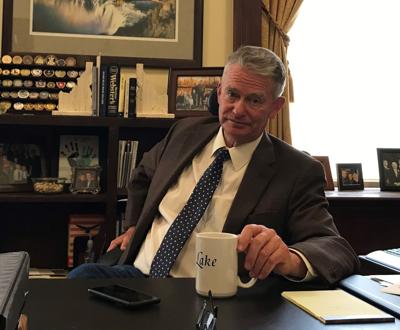
BOISE — Idaho Gov. Brad Little is the new chairman of the Western Governors Association, taking over from Oregon Gov. Kate Brown, and he’s planning to position the group of governors from 22 western states and territories to have maximum input into the next federal Farm Bill, which Congress will take up in the coming year.
“Rather than be recipients, we want to be authors,” Little told the Idaho Press.
He noted that the Western Governors Association always has the secretaries of Interior, Agriculture, and Energy and the EPA administrator address its meetings, as it did this past week, along with the Commerce secretary.
“If Brad Little calls them, it’s one thing,” Little said. “But if Brad Little’s standing shoulder to shoulder with Jared Polis and Kate Brown, it makes a difference.”
Polis is the Democratic governor of Colorado and the WGA’s newly installed vice-chair; Brown, the outgoing chair, is the Democratic governor of Oregon.
As the new chairman of the group, which includes 12 Republicans governors and 10 Democrats, Little announced his chairman’s initiative at the group’s annual meeting this past week, which was held virtually; it’ll focus on “Working Lands, Working Communities.”
The initiative will “examine the interdependent relationship between western communities and federal resource managers,” Little told his fellow governors, “and the role that local communities play in successful land planning and management processes.”
That will include identifying “barriers to better management,” he said, including “all things fire: Prevention, including prescribed fire; suppression, both traditional and new; and restoration.”
“We will also explore tools and innovations for rural communities to adapt to changing economic, environmental and technological conditions, as well as ways to expand markets and support active management in western working lands,” Little said. “We will use this information to shape policy and develop statutory and regulatory recommendations that promote sustainable western communities and lands.”
Brown’s initiative during her chairmanship focused on a western “Electric Vehicles Roadmap Initiative.” She told the group that electric vehicle design, manufacturing, sales and infrastructure “all represent an incredible economic opportunity across the West.”
Little said, “The result is pragmatic and meaningful recommendations that will help ensure our transportation infrastructure keeps up with innovations and advancements in the electrical vehicle space.”
He’s launching his own initiative with an Idaho Falls workshop set for Aug. 4-5, and he invited all the governors to attend.
Little said he’s long had an interest in forest health, even before he got into politics, when as a rancher from a timber town — Emmett — he got involved in the changing ways forest health was addressed in Idaho, from the old style of “just get out the cut and log” to the more modern focus of logging in ways that enhance forest health, conservation, wildlife habitat and more.
“Now the timber industry, even the loggers, agree that it’s only sustainable if the public accepts it,” Little said. “The conservation community are pretty big advocates of good forest health projects.”
Little said his ancestors used prescribed fire early on, burning after their sheep herds came out of the mountains.
“It wouldn’t be great range the next year, but it’d be spectacular in two years,” he said. Native American tribes did the same before the arrival of Europeans, he said.
Interacting with other governors through WGA, Little said, has taught him “that we have a lot more in common than we have” differences.
“Everybody wants thriving rural communities, everybody wants healthy watersheds,” he said. “The one thing that’s absolutely uniting is that these catastrophic wildfires and the effects of drought are no good for anybody.”
Among the changes Little hopes to see in wildfire management is increased use of unmanned aerial vehicles, or drones. North Dakota has a big UAV research facility, he said, and there’s promise in flying drones when it’s too smoky or too dark to fly traditional firefighting aircraft like planes and helicopters.
At big wildfires, he said, “they close the airspace,” so with drones, “you can fly all the time. You know where the hot spots are, you can find some of those things that are risking firefighters’ lives early.”
This past week, Little and Montana’s governor were snubbed by the Biden Administration when it held a wildfire season briefing with eight western governors, but didn’t invite Idaho’s or Montana’s.
“This administration is different,” Little told the Idaho Press. “They’re still trying to figure out how their intergovernmental affairs is going to work with the states. If they reach out to us, we always get back to ‘em.”
He said he was “really surprised” Idaho was excluded from the briefing.
Asked if his harsh criticism of the Biden Administration over immigration and the situation on the nation’s southern border with Mexico this week might have played into the decision, Little said, “That’s their call. I do that with legislators all the time. I’m critical of what they say, and then I roll up my sleeves and work with ‘em the next day.”
“I hope they don’t say, ‘Well, because Brad Little says we’re doing the wrong thing, we’re not going to do the right thing,’” he said. “I think if you gave the administration sodium pentothal, they’d say they have a problem down there.” Sodium pentothal is a barbiturate drug sometimes called “truth serum.”
Little told the Western Governors meeting, “Collegiality and meaningful bipartisanship through WGA is a breath of fresh air in today’s climate. We face unique challenges out here in the West that the East Coast states and Washington, D.C. just can’t fully understand. It is our job as western governors to advocate for states’ rights, and where we can, approach the issues of shared importance with a united front.”


(0) comments
Welcome to the discussion.
Log In