



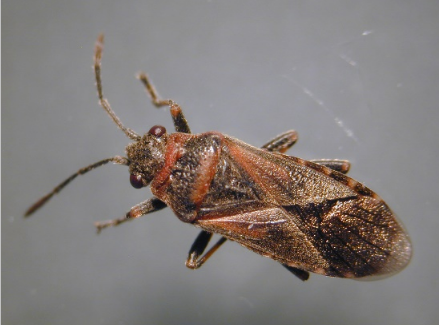

Have you noticed that we have far fewer boxelder bugs these days in Southern Idaho? The reduced boxelder bug population can be partially attributed to the rise in a competitor species. This is the elm seed bug. It is in the same order of insect, hemipteran, which stands for half wing. This order of insects includes the true bugs, and about half of them are beneficial and half are considered pest species.
Other members of this order include: Lygus bugs, plant bugs, stink bugs and bed bugs. They all have a distinctive half wing forming a triangle on the back or scutellum. This triangle is particularly unique for the elm seed bug. Their triangular scutellum (skew- TELL-um) is enclosed within a rusty-colored rectangular mark. Further identification markings include the edge of the body slightly extending beyond the wings. This extended margin is marked in a series of five narrow white bands on a dark colored background.
Elm seed bugs have piercing sucking mouthparts. They feed mainly on elms and do very little damage to other plant species. They are considered a nuisance pest during July/August when adult bugs congregate on homes and buildings (especially structures adjacent to elm trees) and subsequently but accidentally crawl into homes. These insects give off a pheromone that attracts surrounding mates to the area. They do not bite nor sting nor feed on stored foods nor damage structures, but do (like many true bugs) emit odors that some people find unpleasant.
In the fall, elm seed bugs look for safe and warm overwintering shelters. If you experience them congregating or invading your home, I suggest removing these bugs by vacuuming as needed. Due to their odor, I suggest using a shop-vac (so as not to contaminate the household vacuum with their scent). To capture the insects without crushing and releasing the odor, secure a nylon stocking onto the shop-vac hose inside the canister.
You will also need to bug-proof your home by caulking and weather-stripping doors and windows. I do not recommend using insecticides in or near the home. Insecticides are usually less effective than vacuuming and weather stripping. Repeated applications would also be necessary as new waves of the insects arrive. Removing volunteer or established elm trees from around the structure and property can be considered, but is only minimally effective due to the number of elm trees in our area. Cleaning up leaf debris and fallen elm seeds from around structures is effective.
Reed Findlay — University of Idaho, extension educator, Bannock/Bingham counties. Graduated from BYU 1990, M.S. Agronomy. His background is alfalfa, wheat, barley, apples, and beekeeping. He teaches the Idaho Master Gardener lecture series and teaches the Spanish sessions at the UI Potato School. He also has a background in entomology and insect control.

(0) comments
Welcome to the discussion.
Log In