

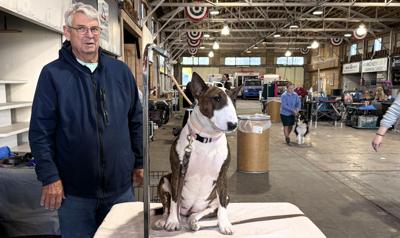
BLACKFOOT — Unlike traditional major sporting events, dog shows don’t have dedicated seasons — they take place across the nation and around the world year-round. Multiple competitors from all walks of life meet in one place.
Some have only one dog, while others may have 15. Last week, Blackfoot hosted its own dog show, organized by the Pocatello Kennel Club and Eagle Rock Kennel Club.
Twelve years ago, Nampa resident Mary Jo, a new bull terrier owner at the time, was called on by her breeder to try something new — entering the dog in a competition in Sacramento, California. Sure enough, the dog won first place, and Jo has been competing alongside her husband Rick ever since.
“That got me hooked. I thought, ‘Oh, I could do this. It’s not that hard,’” Jo said.
Fast-forward to the recent show, held at the Blackfoot Fairgrounds June 11-14. The Jos have since retired two dogs and currently have two competing. Both are bull terriers: one that is colored named Roma and an all-white one named Brea.
According to the Bull Terrier Compass, bull terriers are classified as either “white” or “colored.” While a white bull terrier can appear to be completely white, it always carries a color, even if no markings are visible. On a white bull terrier, markings of color are permissible on the head only.
On the first day of the four-day show, both Roma and Brea competed in conformation. According to the American Kennel Club, the official term for dog shows is conformation — as in, the act of conforming or producing conformity. While a dog show may look like a beauty pageant, it’s not. Dogs are not being compared to each other; they’re being measured by how closely they conform to the standard of their particular breed.
“Besides conformation, they also do trick dog — they have their trick dog titles. They do fetch, which is another AKC title. Scent work, Barn Hunt — there are different titles that you can get on your dog,” she said.
What may surprise many is that show dogs are not perfectly behaved around the clock. At home, Roma and Brea are just dogs, prone to zoomies and more interested in fun than formality.
“When they start off, they pretty much know nothing. Teaching them how to walk on a leash, teaching them how to stack, teaching them how to bait, teaching them how not to run in circles — it just takes practice,” she said.
Roma and Brea are certainly no strangers to the shows. Both dogs have been competing since they were 4 months old. Roma has accumulated about 20 to 25 shows, while Brea has competed in around 15.
According to the AKC, dog show groups categorize breeds based on their historical jobs and original purposes rather than appearance. The AKC divides more than 200 recognized breeds into seven distinct groups, and understanding that structure helps clarify how judging progresses — from group placements toward the coveted Best in Show.
Behind the scenes, Rick plays a quiet but essential role. He handles the driving, helps set up and break down the grooming area, and steps in as a handler when both dogs win and Mary Jo can’t show them simultaneously.
“He drives me where I need to go, helps me set up and take down our grooming, and he also shows when both dogs win because I can’t show both at the same time,” she said.
At the Blackfoot show, years of training and hard work paid off. Brea captured a Group 4 and an owner-handler Group 2. Roma dominated, taking owner-handler Groups 1, 2, 3 and 4, along with a regular Group 4.
“I had an amazing, amazing show,” she said. “I am over the moon.”


(0) comments
Welcome to the discussion.
Log In