

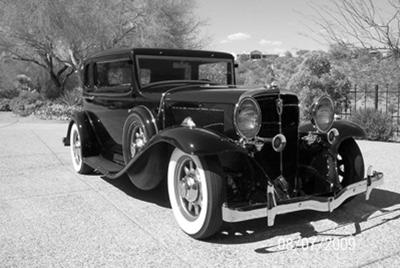

A Studebaker Dictator like Lynn Draper’s.
Submitted photo
By Bill Ryan
I’m looking at a clipping from the June 11, 1964, edition of the Idaho State Journal. It tells the story about a Pocatello man, Lynn Draper, planning to drive his 1932 Studebaker to the New York World Fair. I keep wondering how Lynn did.
I hope he took an extra fan belt and maybe a new generator — today they are called alternators. Modern tires are steel-belted — Lynn’s tires had cotton instead. His spares were always in sight, standing in a well in each front fender. Side spares were sportier, cheaper cars had a spare attached to the rear of the body.
If he wanted to stop or turn, Lynn had to keep his driver’s window down. His arm went out to warn others of his intentions. This was before turn signals were developed. If it rained, his single windshield wiper slowed to a crawl on climbing a hill. Electric wipers came later.
When not on the open highway, Lynn had an intimate relationship with his car’s transmission. It was controlled by a slightly bent rod sticking up from the floor, with a knob on the end. The transmission shifted the power from the engine to the rear wheels. Matching the clutch to shifting the gears in the transmission depended on the driver’s skill. An automatic transmission does all of this for you, but usually to the front wheels.
Studebaker produced three price levels — the Dictator (like Lynn’s), the Commander and the President. This worked until the media applied the word “dictator” to nasty men in Europe. “Champion” then became the new model. My copy of the Encyclopedia of American Cars shows Lynn’s vehicle was a six cylinder and had 132-inch wheelbase.
Lynn planned to leave in June. As one who has driven across mid-America in uncooled cars, I can testify about the blessing of air conditioning. Lynn had to tough it out under a blazing sun, but so did everyone else. He could only open the vents and crank down the windows as he drove at top speeds of maybe 60 to 65 miles an hour. Anyone who knows how he did might get in touch with me.
Pocatello native Bill Ryan is a retired UPI editor who was earlier with Idaho State University. He lives in the Dallas suburb of Richardson, Texas, and can be reached at wryan1807@aol.com.


(0) comments
Welcome to the discussion.
Log In