


There was a time when early summer was the season that football coaches worked on their golf games.
Their players were all at home, hopefully staying out of trouble and maybe even getting in some workouts on their own, but for a month or two, at least, there was no requirement for supervision.
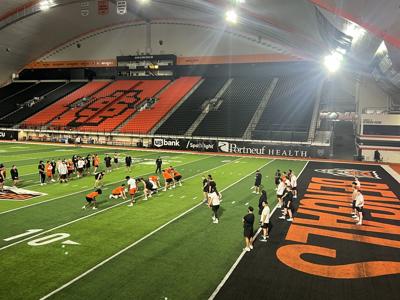
Those days are long gone now, and if you needed any evidence of that, drop by the ICCU Dome on the Idaho State campus just about any weekday morning from now until the end of July.
There you’ll find about 100 ISU football players running “skellys” — seven-on-seven offensive drills against their defensive teammates; engaging in sprints; or doing caterpillar drills, a funny-looking exercise where players crawl underneath their teammates who have bridged their bodies in a single-file line. All with coaches and training staff looking on.
The NCAA now allows teams to conduct noncontact drills or work in the weight room for eight hours a week over an eight-week period during the summer. Idaho State’s football team began its summer drills the week after Memorial Day and will continue them, with a short break for the Fourth of July holiday weekend, until the end of July. Then the Bengals will begin “fall camp” — a somewhat misleading term given fall is still officially two months away — on July 28 to begin preparations for the Aug. 29 season opener against VMI.
With the season running through the end of November — and hopefully into December with the FCS playoffs — followed by “spring ball” and then summer workouts, college football has morphed into a full-time job.
“It’s been like that for me since high school,” said Tre Shorty, a sophomore defensive back from the Phoenix area. “My mom always told me to get up and take care of business. If I could see her wake up and work a job at 6 a.m., I can get up and do something I love. It’s nothing to me.”
Shorty, who played in all 12 games for ISU last season as a true freshman, said the summer workouts tell him a lot about his teammates.
“I just feel like the workouts are where we figure out who’s gonna go — who’s gonna go yard for us,” said Shorty, who expects to line up at the nickel back position this fall. “Who’s going to really be there when we need them. Also, this is where we figure out our schemes, how we’re going to adjust to different coverages and different schemes. How do I like to play with this corner vs. what do I like to call with this corner on my side?”
Idaho State has traditionally been known as an offense-driven program, outscoring other teams when it’s been successful, rather than stoning them defensively. With an inexperienced receiver corps and some question marks on the offensive line this year, however, the Bengals may be relying more heavily on their defense this season. It’s a challenge Shorty believes he and his teammates are ready for.
“I just see a bunch of people that are willing to do their job and take one for the team,” Shorty said of the Bengal defense. “I know if I look in the box, they (the defensive linemen) are going to stick to their gap. If I look to the left of me, I know my safety is going to be in his spot — I know he’s not going to be selfish. And I know my corner is going to be in his spot, he’s not going to be selfish. I feel like we’re all here just for the team and nobody is here just to get their own. That’s what I like about our defense.”
The point of emphasis for the ISU defense, at least in Shorty’s mind, is takeaways.
“We know the offense is going to score — they’re the Throwin’ Idahoans, 40 points a game, 500 passing yards,” he said. “So, the biggest key for us is takeaways, getting the ball back and putting the ball in the offense’s hands and allowing them to run up the score.”
Titan Saxton, a transfer safety from Utah State University, has had an opportunity to get acclimated to the ISU program after participating in spring drills. Saxton, who played in 10 games for the FBS Aggies last year, doesn’t find a great deal of difference between the Mountain West USU program and the FCS Bengals.
“The work is still the same,” said Saxton, who will be a junior this fall. “The standard here is to be exceptional and to bring your best every single day. So there’s really nothing different. We’re focused here on what we’ve gotta do.”
Saxton, a former Utah all-state player at Sky View High School in Smithfield, fits in comfortably in the Pocatello culture. A returned missionary, he’s married and enjoying spending time with his wife, as well as his new teammates.
“It really is awesome,” said Saxton of summer in southeastern Idaho. “The great outdoors, there’s great hiking, a lot of cool water spots — so summers in Pocatello are super nice and fun. I love it here. It’s been awesome.”
Like Shorty, Saxton is sold on the potential of his defensive teammates.
“I see that we can be exceptional,” he said. “We’re ferocious, we run to the ball, we play nasty, we try to get the ball. We got a lot of good turnovers in the spring, and that’s against our offense, which is exceptional. So I see a defense with great potential. Coach (Grant) Duff is going to put us in situations to make plays and change the game.”
Over on the other side of the line of scrimmage, senior Julian Mason finds himself the standard-bearer for a wide receiver room that has been decimated by graduation and the transfer portal — after producing six All-Big Sky Conference receivers over the past three seasons.
Mason, the leading returning receiver with 12 catches, has eagerly assumed the new leadership role.
“It’s upholding the standard — especially in my room, the offensive room,” said Mason, a Tacoma, Washington, native. “It’s holding the standard that Coach Hawk and Coach Pit have set now over the past four years,” he said, referring to head coach Cody Hawkins and assistant head coach Jeff Pitman. “It’s holding that standard and holding guys accountable, including myself.”
After losing all-conference receivers Tsion Nunnally, Mike Shulikov and Damien Morgan from last season, Hawkins has brought in a passel of new receivers — Division I, Division II and junior college transfers. Spring football and the summer drills are part of the process of identifying who from that group of newcomers will be the next featured receivers in Hawkins’ pass-friendly offense.
“We’re putting in the work to figure that out,” said Mason when asked who the next stars in the receiver room would be. “We all have a really good bond in this receiver room, especially the new transfers coming in. Everyone has really done a great job upholding the standard.”
Mason is excited about sharing the receiver room with one familiar face — Chedon James, who led the nation with 102 catches at ISU in 2023 before transferring. James is back for his senior season, and Mason couldn’t be happier.
“I’m just excited about all of them,” said Mason of the new receivers, “but especially Chedon. We both came in our first year together and for us to have our senior together, man, it’s such a blessing. It’s so good to have a familiar face.”
For Mason, who’s provided depth behind all those outstanding Bengal receivers over his career, this season is the opportunity to step into the limelight as a featured receiver at 5-foot-10.
“Just taking the next step — how can I be the guy, how can I carry on what ... all those guys did,” said Mason when asked what his focus is this offseason. “I’m not 6-4, 6-5 like them, so how can I make myself a threat out there.”
“I like to compare myself to Steve Smith Sr.,” he said of the former receiver who played 16 seasons in the NFL at 5-foot-9. “Really just using that attitude, that want-to and that tenacity. I’m going to get it no matter what.”

(0) comments
Welcome to the discussion.
Log In