



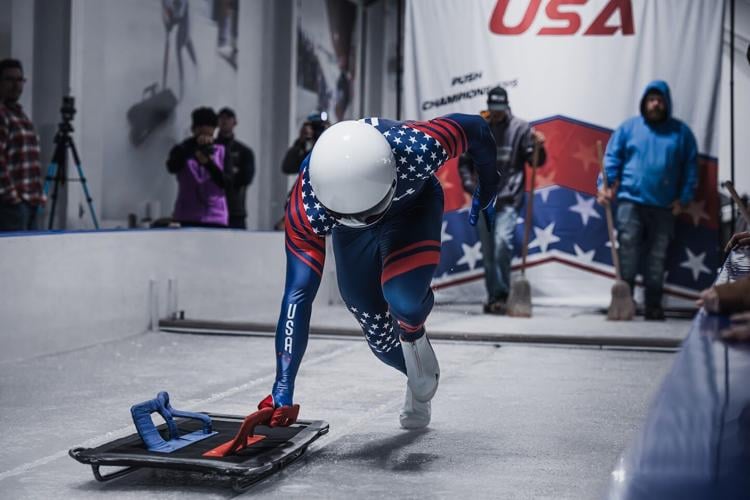

There is a level of intense concentration and calm as Pocatello native Andy Whittier tears down a frozen track accelerating to speeds of over 80 mph with his face centimeters from the ice.
Attentiveness is paramount for these sliding sentinels as they bank at breakneck speeds, carving around corners using slight movements of their shoulders, legs and toes to steer. There is only a helmet and spandex suit protecting the athletes as they risk literal life and limb for a chance at Olympic glory.
The sport of skeleton is perhaps one of the most adrenaline inducing and death-defying spectacles to behold. Athletes competing in the exhibitions begin by rushing from the starting position to gain momentum before launching themselves head-first onto a small sled.
It’s a sport Whittier began participating in only five years ago and since then he has found incredible success. He’s a member of Team USA with his sights set on Olympic gold. He won the North American Cup and is currently the third ranked skeleton racer in the U.S. and 31st in the world.
With a level of fearlessness and a strong desire to continue his athletic career after his time with the Idaho State University football program, Whittier entered skeleton as a total unknown when he competed at an open tryout for the U.S. Bobsled and Skeleton Federation nearly four years ago.
“You come in as a rookie and the goal is to make Team USA and secure one of our racing spots that we have amongst the three circuits,” Whittier said. “It’s not a sport that you just pick up overnight. There’s a lot of training as far as physically and mentally that goes into it to prepare your body for going 80 plus miles an hour down the ice. (It’s about) honing those skills over the last three and a half years, getting a couple race opportunities over the two previous years, and then finally taking the full step commitment to moving to Lake Placid, moving up in rank and qualifying for housing at our Olympic Training Center. Those were really the committing steps it took to put me into the position that I am now.”

Andy Whittier
While the average sports enthusiast might assume that these athletes would be paid for their efforts, they are entirely self-funded, relying on sponsorships and working summer or remote jobs in the offseason.
Whittier has dedicated long hours of training and commitment to ascend to the higher echelons of competitive skeleton, working the program like a full-time job. Upon moving to Lake Placid, Whittier realized just how involved the training would be, fully utilizing plyometrics, sprinting and recovery in a consistent way that was eye opening for the athlete.
“It’s a very powerful, aggressive sport off the start line,” Whittier said. “You’re in a track start. When you get that green light, you give it all you’ve got for about 30 meters, running on ice and eventually going over the crest, going downhill and then you jump on your sled.”
The sled itself is made of steel and plastic and is approximately half the size of the rider’s frame. The conditioning the athletes go through helps them find an equilibrium in how they approach their run, factoring things like the speed and consistency of their launch along with their form.
“After that, you have to be calm,” Whittier said. “I like to relate it to golf. You have to be really calm during your swing, so everything’s nice and fluid and everything flows really well. That’s kind of what the sport turns into, from chaos and explosion at the line to as smooth as you can be in a golf swing down the tracks. You’re flowing in and out of curves. Your face is only an inch off the ice. You want to be hugged onto the sled, but also relaxed at the same time, keeping your eyes up but keeping your shoulders down, seeing where you’re going, seeing your entrance, figuring out, ‘This is the line I’m on, this is the amount of pressure it’s going to take to match this curve so I can fall with it and gain speed’ and keeping that simple composure doing 80 plus miles an hour an inch off the ice.”
Last year Whittier competed in the U.S. Push Championships with his fellow teammates who are talented and successful skeleton athletes in their own right. Whittier found it humbling to be counted among them.
“For this year, coming in with all that training over the summer, knowing that I had to really show up for myself to be ahead of those guys was pretty awesome to end up taking first overall, especially with the load of athletes that we have in our program,” Whittier said. “We have a lot of top tier athletes from around the nation competing. Being able to be a part of that mix and then be at the top of that was just something special. It’s really kicked off my year. It was definitely the first objective on my 2024 and 2025 season goals. To hit that (goal) really set the standard and made sure my trajectory was going down the right path.”
Whittier continued, “Those are definitely the two big highlights for the season — winning the U.S. championships and then the North American overall cup title. As far as individual races go, getting my first extended podium in Whistler, Canada, with a fifth-place finish. (I had) three first place finishes in Park City, Utah, and one second place and then coming back to Lake Placid and really going against some high-level sliders here was really awesome.”

Andy Whittier jumps off the line as he begins his run during a recent skeleton race.
Regarding his skeleton racing victories, Whittier discussed his last competition in Park City. In Whittier’s mind, he is racing nameless, faceless opponents and assesses that anyone can be beat, regardless of the day.
“One of my teammates informed me that we do back-to-back races,” Whittier said. “The first day I ended up taking second against the bronze medalist in the 2022 games. On the second day, I was able to beat him, so I took first and he took second. That was probably one of the biggest highlights of my season, that I can slide with some of the best of them.”
Whittier is wasting no time in his career, recently finishing in 16th place at his first European Cup in Lillehammer, Norway.
“As far as the future for me, I’m a potential 2026 Olympic hopeful, aiming at 2030 and 2034 when it’s back on our home ice in Park City to kind of wrap up the career if we’re looking at the big picture,” Whittier said. “As far as growing the sport, just getting it out there, telling people we exist and letting people know that this fun adrenaline (inducing) thing is just down the road from Pocatello. Park City is always welcoming and free to spectators. Come watch bobsled and skeleton. Come try it out too. We let spectators do it. That’s the fun part.”
For Whittier, his dedication to the dangerous sport comes from his own desire to compete and to never flinch in the face of adversity or a challenge. The rush he feels encapsulates everything that draws him to competitive sports.
“That’s how I personally feel on a sled right now,” Whittier said. “It brings me that same type of joy that I once felt on the football field that I now feel on the ice.”

(0) comments
Welcome to the discussion.
Log In