



This is where the story starts: As a kid, Mitch Gueller and his younger brother Tanner loved sports.
In the backyard at home, Mitch, almost three years older, would terrorize his brother in games of one-of-one.
“It was usually me getting punished by Mitch, and then him taunting me and then starting a fight and him whupping me in a fight, too,” Tanner remembered, “and then me going in and telling on him, of course. Him begging me not to go tell mom, you know, the typical stuff.”
On the fields and courts in and around Chehalis, Washington, where they grew up, the brothers more often teamed up, and it didn’t matter the sport or the season. Baseball, basketball, football — the Gueller brothers were always playing something.
But they loved football the most.
No, wait. Maybe that’s too early.
Maybe this is where the story starts: In fall 2014, with his minor-league baseball season over, Mitch Gueller took a trip to Pocatello to visit Tanner, a freshman quarterback at Idaho State.
Late one night, Tanner and his roommate, freshman wide receiver Hagen Graves, took Mitch to Holt Arena.
With the whole place to themselves, they showed him the locker room and the offices and everything else, and then took him out on the field and played catch for hours — three kids in an empty stadium, none of them quite sure yet what they were going to be.
Hang on, though. Maybe that’s still too early.
Maybe this is where the story starts: In early May 2016, Mitch Gueller was released by the Philadelphia Phillies.
His five-year professional baseball career, begun in 2012 as a hotshot prospect — top-60 in that year’s MLB Draft — was ending in Lakewood, New Jersey.
When you’re cut in the minor leagues, there’s no ceremony. One minute, you’re one of thousands in the minors — maybe anonymous, but at least, along with of all of your peers, striving for something and imagining that one day you’ll see your name in lights.
The next, you’re not, and that dream is dead.
Tanner, then a junior and recently done with spring practice at ISU, flew out to New Jersey and the brothers pointed Mitch’s truck west, away from that dream and towards another one.
“(Tanner just mentioned), ‘Hey, I talked to coach (Mike) Kramer, our head coach at the time, and he said you have a spot on the team if you want to do that,’” Mitch said. “I just told him I would think about it. Really it was more to get over the fact that I had spent five years chasing a dream and been told no. Which, it’s something that you have to get over, and I took a week, maybe, and then I was like, yeah, let’s do this thing. That’s kind of how I ended up here, really.”
No, wait. That’s not the right moment either.
First off, as you might have guessed from his nonplussed answer about a pretty big life change — seeing his pro baseball career end and then deciding, within a week, to go play Division-I college football — Mitch Gueller isn’t really into big, dramatic moments.
Getting selected in the first round of the MLB Draft?
“I was pitching pretty well in my senior year, and the buzz kind of grew, and I was fortunate to get drafted.”
Catching a 97-yard touchdown pass from his little brother, the longest in Idaho State history, in his sophomore year?
“It was pretty cool.”
Even breaking ISU’s all-time receiving record, which he’s in line to do sometime in the next few weeks, with 2,733 yards to Rodrick Rumble’s 2,863 going into Saturday’s game against Portland State?
“I think, first of all, it’s just an honor to be on that list with all the great receivers in Idaho State history,” Gueller said.
“To say that I would look back on it and think, I mean, I don’t know — I don’t really think I’m going to think about it like that. ... I’ve never really thought about getting a record or anything like that, it’s just, I’m lucky that I’m in that position.”
The receiving record — in fact, the whole crazy story of Mitch Gueller — is due in part to that attitude.
Think about the maturity it would take to watch your dream die — four years in high school, realizing you might be drafted, five years in the minor leagues, all that work, taken away in an instant — and being able to move on from it in a week.
Understand that, and Mitch Gueller’s journey from pitcher to wide receiver, from New Jersey to Pocatello, from failed minor leaguer to ISU record holder, should start making a little more sense.

Idaho State wide receiver Mitch Gueller jumps over the tackle of Weber State’s Jayden Palauni on his way to a nice reception during their game last season at Holt Arena.
* * *
When he first came to Pocatello that summer of 2016 to give football a shot, Mitch Gueller hadn’t played football in five years. He hadn’t been a wide receiver in seven.
Plus, minor-league pitchers are usually a little underserved in terms of workouts that translate well to football. The footwork is different, and Gueller said he flatly just fell down a lot during summer workouts.
“I’m not saying a pitcher’s not athletic, but, you know, there’s a certain demand to being a wide receiver, athletically,” Gueller said. “A lot more running and cutting and stuff that you don’t do as a pitcher. It’s kind of just running poles when you’re a pitcher.”
But, just a few months after pitching to future major leaguers like Victor Robles and Brendan Rodgers as a member of the Lakewood Blue Claws, Gueller was already turning heads on the practice fields at Pocatello.
After a particularly good play in 7-on-7 drills that first summer, running back James Madison came up to the still-skeptical Tanner to tell him that his brother was going to be good right away.
Mitch had 36 catches for 509 yards and three touchdowns that year.
“Baseball is such a mental sport that I was able to approach my work here a little bit differently than some guys that come in right away,” Gueller said. “I felt like I just needed to work my butt off and try to establish myself and get my name in the mix, where maybe some of the coaches would look at me a little bit too and consider me as somebody who could get out there and play.”
The next year is when he really broke out, recording 36 catches again but this time having them go for 809 yards and eight scores.
In ISU’s Oct. 21 game against Portland State, he authored half of one of the greatest plays in Bengals history.
With Idaho State in second-and-1 on its own 3-yard line, he released to the outside and ran a go route down the right sideline, reached up to snag Tanner’s pass with his right hand and sprinted 97 yards for the touchdown as the defensive back fell away behind him.
“He caught it with his right hand, and it never touched his left hand running the whole way down the field,” ISU head coach Rob Phenicie said. “At about the opposite 30-yard line down here he turned and looked at (cornerbacks coach Kam) Yancy while he was running into the end zone. That’s one Mitch Gueller play that will stand out, probably stand for a long time in Idaho State history.”
It also illustrates that Gueller’s success at Idaho State wasn’t simply the product of maturity and hard work — the man was born to be a wide receiver.
At 6-foot-3, he has all the tools — height, speed, physicality, incredible hand-eye coordination.
It’s not surprising that Gueller was able to go from baseball to dominating Division I cornerbacks in a year.
What’s surprising is that he also had a good enough arm to give baseball a try first.
“I remember the first 7-on-7, it was just like a jump ball, and he just mossed a little corner,” Hagen Graves said. “I was like, okay, not many guys are doing that here. That was probably the first time I was like, yeah, this guy can play. ... It took him a little bit to kind of get his feet underneath him, just the football movements, but you could tell right away that he was a freak athlete.”
* * *
Tanner and Mitch were hanging out at their parents’ house in Wyoming late one night this winter when Tanner decided to impress his big brother.
On the TV, Peyton Manning was analyzing and breaking down coverages on ESPN.
Tanner started to show off his knowledge, gained from being a three-year starter at ISU.
This is what I’d do here, this is where I’d set the protection, this is how I’d attack this coverage.
Until Mitch stopped him in his tracks.
“He said something like, ‘Well, couldn’t you just do this?’ And it was like, the whole time, well, you’re a receiver, why would you ever pay any mind to that, how did you know that?” Tanner said. “And so that really impressed me, that’s something I’ll remember for a long time, over winter break, just being like, wow, I didn’t expect you to even have any inkling of an idea of what protection we’d be doing.”
Both Phenicie and Graves said that wanting to know everything that went on with ISU’s offense was another of Mitch’s calling cards.
He asked about the offensive line’s responsibilities as much as he did the intricacies of route running.
Phenicie likes to break down defenses in granular detail, and players typically need at least some experience to be able to pick everything up in meetings.
But during his first year, aside from jumping over unfortunate cornerbacks in drills, Gueller had already progressed to mastering Phenicie’s “400-level” coverage breakdowns.
“I guess I’ve always kind of been analytical in a way,” Mitch said. “Just trying to understand concepts. Even in school, just trying to understand why things work the way they do. I want to see the big picture, how it all ties together and works. In football, to understand that, you kind of have to know what everybody else is doing to really get that clear picture of what’s going on.”
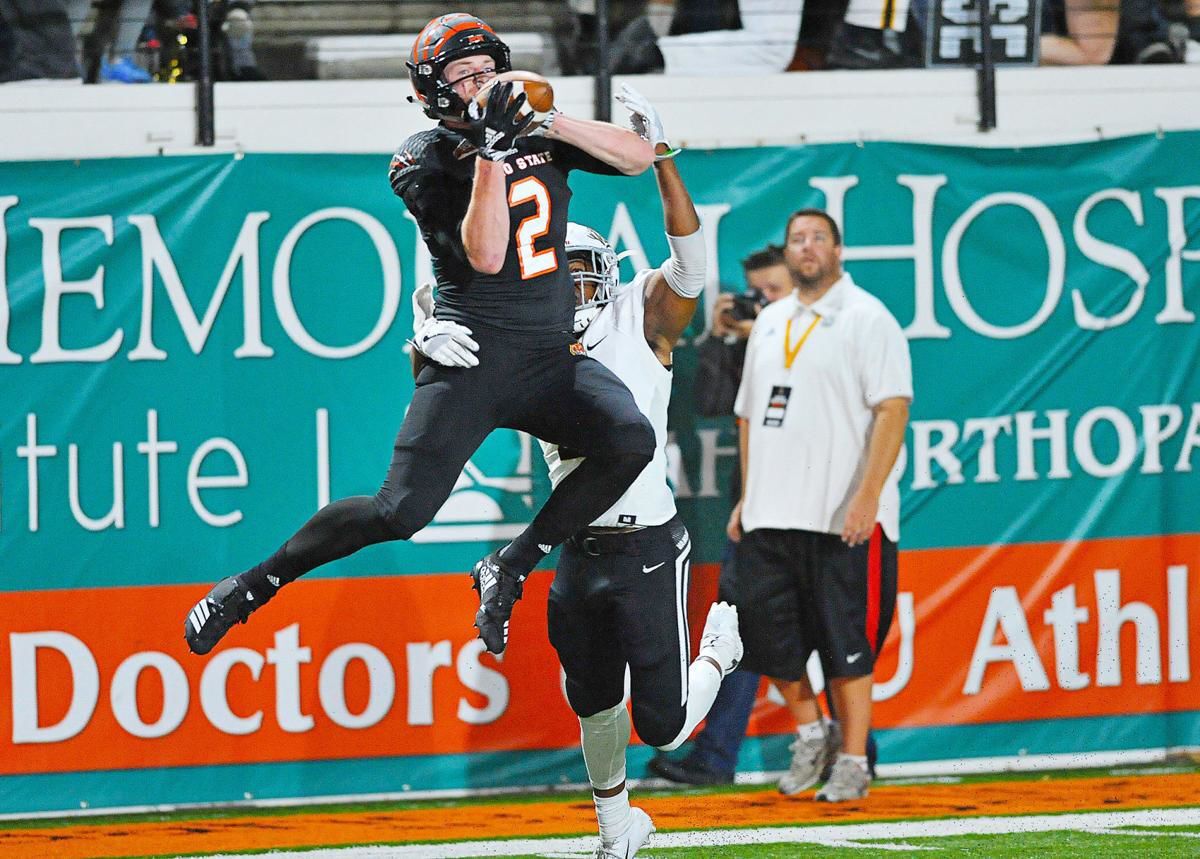
Idaho State wide receiver Mitch Gueller (2) catches a pass as he’s defended by an Idaho player during their game last season at Holt Arena.
* * *
The secret of Mitch Gueller’s success is that there was no big moment that put him on the path to being the most productive wide receiver in ISU history.
And what would be surprising to everyone else — this guy went from first-round draft pick to minor-league failure to college football star! — really wasn’t surprising to Gueller.
He got over his failure, chased another dream, put his head down and worked hard.
And all the pieces — the uncommon maturity, the jaw-dropping athletic tools, the analytical mind — just happened to come together perfectly to make an Idaho State icon.
“I didn’t know what tomorrow held when I first got here,” Gueller said. “I’ve been extremely fortunate to be put in this position, and to achieve the things that we have as a team has just been awesome. We’re not done yet, so we still have to keep grinding and keep going. I guess I’ll look back on it when it’s all said and done and consider it then, I guess.”

(0) comments
Welcome to the discussion.
Log In