

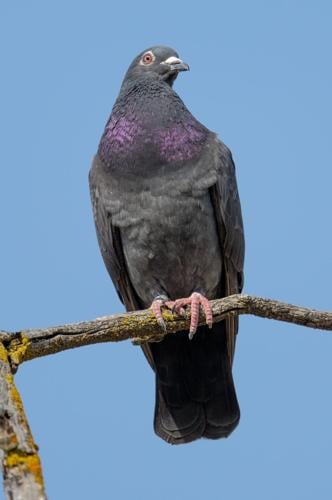
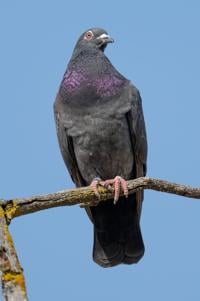
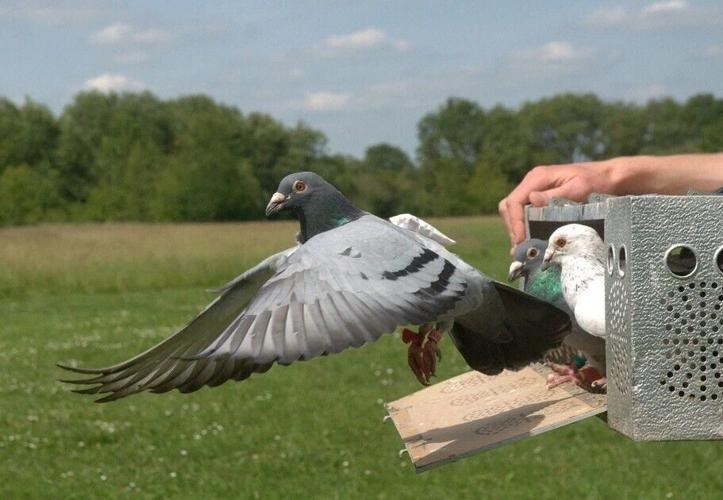


We were birding in one of our favorite places — Hulls Gulch — a few days ago when I got quite a surprise. I came around one corner for the umpteenth time, and was surprised to see a fairly large, black bird perched on an open branch. I knew immediately what it was. But despite thousands of mornings on foothills trails since 1992, I had never before seen that species, that way.
It was a rock pigeon in a tree.
The first thing that struck me was that this was a gorgeous bird. It was nearly black, with a few white bits and some classic pigeon iridescence. What was so odd was that it was perched on a tree branch, in the woods. I had never seen a pigeon in that sort of place before … ever, anywhere.
When I got home and looked more closely at my photos, I saw that the bird was banded. It obviously belonged to somebody, and that probably explains its atypical behavior.
Rock pigeons love cliffs. That’s one reason they’ve done so well in countless cities around the world. Buildings of all sorts mimic cliffs of all sorts. In Hulls Gulch, a few are frequently found on the cliffs and banks above the pond across from the Foothills Learning Center. But they just don’t get out into the surrounding woods like countless other species. That’s why this bird caught me so off guard.
Some other introduced species that follow humans also don’t get out very far from us and our facilities. Rock doves, European starlings, house sparrows and Eurasian collared-doves are similar in this respect. As soon as you get away from the human footprint, these camp followers mostly can’t be found. This is probably a very good thing.
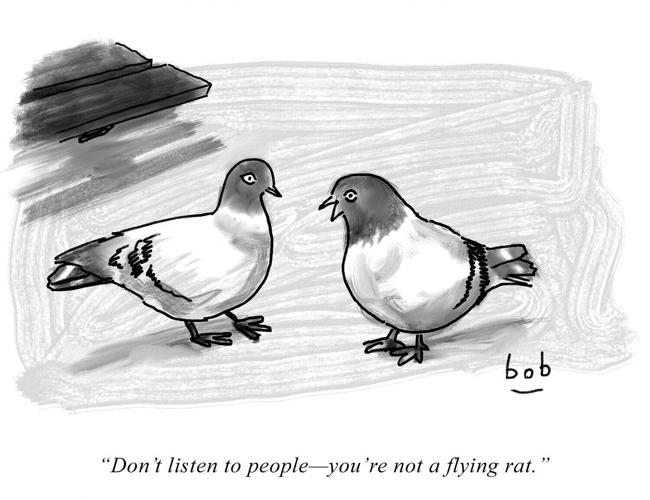
Rock pigeons get no respect. They are looked down upon and even despised. One of their nicknames is “rats with wings,” a term coined by New York City Parks Commissioner Thomas Hoving in the 1960s. Humans like success in themselves, but not so much in other species. The reference to rats has a sparkling new relevance in the Boise area right now. And in defense of pigeons, I’ll take one of them over a rat every day.
In addition to their fondness for tall urban buildings, they’re obviously very tolerant of people, more so even than mallards and Canada geese. I doubt any bird has appeared in more single-panel cartoons, either eating popcorn from someone on a park bench or pooping on a statue. The captions tend to be funny, philosophical, or both.
So, what’s up with pigeons?
Formerly the rock dove, the rock pigeon (Columba livia) is native to Europe, North Africa and much of central and southern Asia. It was introduced into North America in the early 17th century. There were a few reasons for this. Pigeons were historically raised as a source of meat, just like chickens, ducks and many other species. There was also a traditional component. European immigrants liked to have familiar domestic animals around them. With all the risks and unknowns of a new continent, those animals must have been very comforting.
Pigeons were also valued for their strong homing instincts and were used to carry messages. Other common names were mail pigeon, messenger and carrier pigeon. Flights as long as 1,100 miles have been documented for birds in competitive homing pigeon races. Check out the American Racing Pigeon Union (https://www.pigeon.org/) for more on this fascinating hobby. If you want to play, prepare to spend hundreds to thousands of dollars for birds with the best genes.
Pigeons also have been bred to emphasize other behaviors and plumages. I missed the Pigeon Show at the Western Idaho Fair, but I won’t miss it next year! For a quick look at some varieties out there, visit the American Pigeon Museum and Library (I’m not making that up). Do scroll through their Pigeon Breed Gallery. Amazing!
Returning to wild pigeons, you can see the current range of the species at eBird under Explore and Species Maps.
The map nicely distinguishes between historical and current sightings. You will see the species is widespread but not everywhere. They have not occupied the Amazon Basin, central Africa or most of the higher latitudes. Curiously, it occupies Iceland but not Greenland.
Pigeons are relatively intelligent. They can learn to recognize patterns, remember visual information and distinguish between different objects. You can find some old films and images of pigeons performing in carnivals and on street corners. Like many species of birds, pigeons make use of the earth’s magnetic field and the position of the sun. They can see colors, including ultraviolet. All of these skills certainly contribute to their homing ability.
Rock doves are monogamous and pair for life. As with most or all species in the Columbidae family (pigeons and doves), the female almost invariably lays two eggs per nesting attempt. They typically raise two or three broods per year, but as many as five have been documented. So, the total production of a pair can be relatively high.
One curious feature of the pigeon and dove family is that they produce pigeon “milk” for their young. Also called crop milk, this is a nutritious, milk-like substance produced in the crop — the food-storage pouch in a bird’s throat. An additional oddity is that both females and males produce it.
Crop milk is rich in nutrients, containing substantial amounts of protein and fat, which allows chicks to grow rapidly. Some species also supplement the milk with partially digested food as the chicks get older.
Rock doves have increased from 0 to an estimated 16,000,000 individuals in the U.S. and Canada. This is about the same as the population sizes of western tanagers and blue jays. Since 1966, their population has declined at 0.6% per year rangewide. This is not especially steep, but the trend is significant.
Don’t worry, the pigeon population is increasing at 2.1% per year in Idaho over the same time period. One wonders if there is not a simple correlation with our human population growth. This proposal could be rather easily examined by looking at trends in all 50 states.
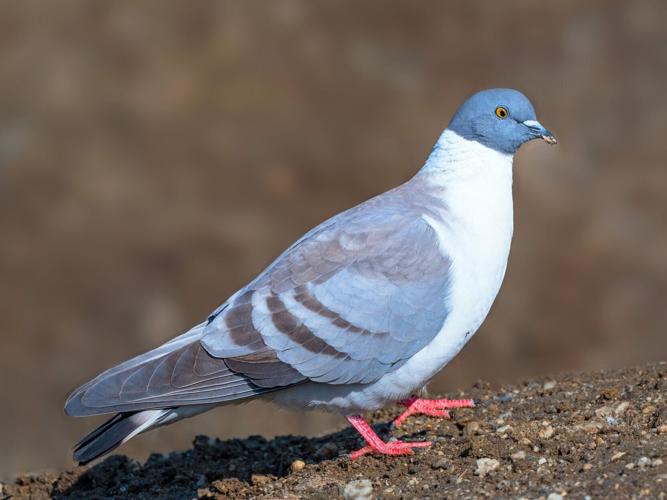
There are 34 other species in the genus which is another clue to the adaptability of the group. If you want to go on a Columba quest, let me recommend both the snow pigeon and the speckled pigeon.
Closer to home, take a moment to actually look at pigeons the next time you get a chance. And while you’re at it, consider what French film director, Claude Chabrol, observed: “You have to accept the fact that sometimes you are the pigeon, and sometimes you are the statue.” Something to ponder while you sip your cappuccino.



(0) comments
Welcome to the discussion.
Log In