


At the recent iCAST Show, I met with Whitewater, which offers nice fishing apparel. In talking, they found out that I was from Idaho, and they said, "Then you know Chris Weber, a premier fishing guide on Lake Cascade." I didn’t.
One thing led to another, and I soon lined up a fishing trip with Chris. In the meantime, my wife Katy met Lauren Groshong and Corissa Cassity with CONCORD COLLECTIVE at a business breakfast at the Unbound Library in Meridian and told me that they could design me a good website.
Back to the fishing trip and Chris. Katy got tied up preparing her classroom on D-Day, so Lauren and Corissa went so they could do photography, YouTube, etc. We had a unique and awesome day of fishing. I will later explain why I included the word unique.
Chris is a good fisherman, and I learned a lot from him. We started with trout/kokanee. I titled this article OLD SKOOL MEETS NEW SCHOOL because of the latest technology that Chris uses. I’m super old school. For 41 years I’ve had a little 12-foot Jon boat with an electric motor (Yes, in those 41 years I’ve had other boats, but I’ve still got the Jon boat). I finally got a little Honda 2.3 gas motor 9 years ago. No depth finder…nada.
I’ve heard of fish scopes but never fished with one. As soon as we got to our first trout spot, Chris threw on his Garmin LiveScope. Amazing. He explained to me how trout hang out in the thermocline. If you’re not familiar with that term, here’s the deal. The water on top of the lake is oxygenated due to the wind and waves and, of course, warmed due to the sun. Down deep, the water is colder and not very oxygenated.
There is literally a line between the two layers of water called the thermocline. Trout, coho and kokanee hang out in this zone. What shocked me was how tight this line is. When people tell you they’re catching trout at 30 feet, they don’t mean 20-40 feet. They’re literally at 30 ft., plus/minus maybe 9 inches. The bandwidth of trout showed as a solid line on his Garmin LiveScope. To fish the most productively, you need to be right at 30 ft or maybe 1- 3 ft. above. They’re looking up and will see your lure. They won’t see it if it’s below them. Period. That’s why downriggers and meters on your reel are so helpful. I met the Bullet Weights company at iCAST and will be using their weights to get to the desired depth.
This explains why my buddy Dave was killing the kokanee last week and me… not so much. He had a downrigger and was running at 30 ft. I was periodically hitting bottom at
48 feet, so I was too low most of the day. Again, it shocked me how tight their spread was. So on trout and kokanee you need to be in their zone.
The crappie had (I didn’t look at the screen for sure, so don’t quote me) but probably an 8-10 foot spread. Which gels with my experience. When I get into crappie, I’ll be catching them from 20 ft up to barely below the surface. At first I thought the ones that hit 3 ft. below the surface had just followed my jig up from down deeper, but then once in a while when I unhooked one and had the jig lying over the side I’d get a hit, so I knew they were also feeding up that high. So the moral of the story is, crappie don’t hang together that tight in the thermocline.
What makes the Garmin LiveScope really cool is that you could see your lure dropping down and if a fish swam over to look at it. Or picked it up in its mouth. Or if you were 2 feet above them and needed to drop down some. I’m thinking that you could also experiment with different movements to see which ones entice them the most. So with all of the above said, I learned a lot more about their habits.
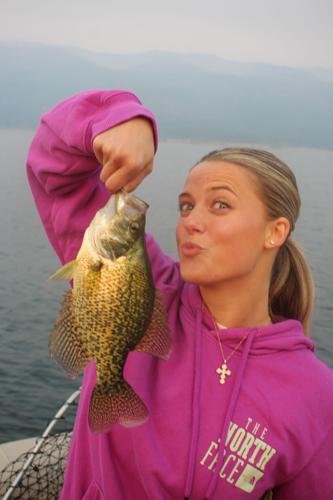
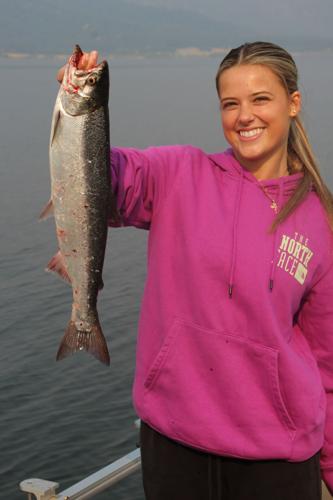
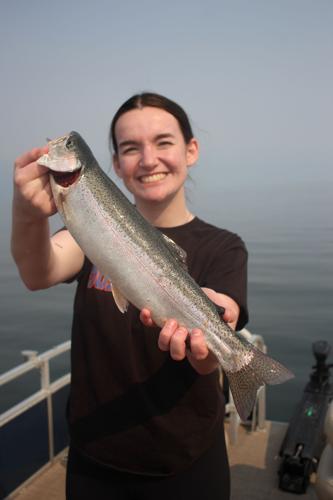
Now let’s get into how the fishing was. Let’s start off with the bad news first. Lauren and Corissa smoked me. Corissa caught the biggest coho I’ve ever seen in Idaho and was all smiles. And I’m supposed to be the crappie king, and Lauren caught the biggest crappie! And they both caught more yellow perch than me, which we will talk about next week.
At the beginning of the article, I said that it was a unique trip. Here’s why I say this. We only fished for 5 hours. So we didn’t want to spend 3 hours limiting out on one species before jumping to the next. So we fished for one species for 1-2 hours and then jumped to the next. Here’s what made the trip unique. We caught huge fish in every species.
We started out on trout and kokanee. We caught a handful of nice trout. I didn’t measure them, but they were probably 22-23 inches. Then I think we caught one kokanee, and then Corissa caught a hog of a coho.
We then jumped over to fish for crappie. Cascade has some nice crappie (And did I mention that Lauren caught the biggest one). Every crappie was nice. Then we targeted perch, which is what Lake Cascade is nationally known for. Next week we will cover the perch fishing.

(0) comments
Welcome to the discussion.
Log In