

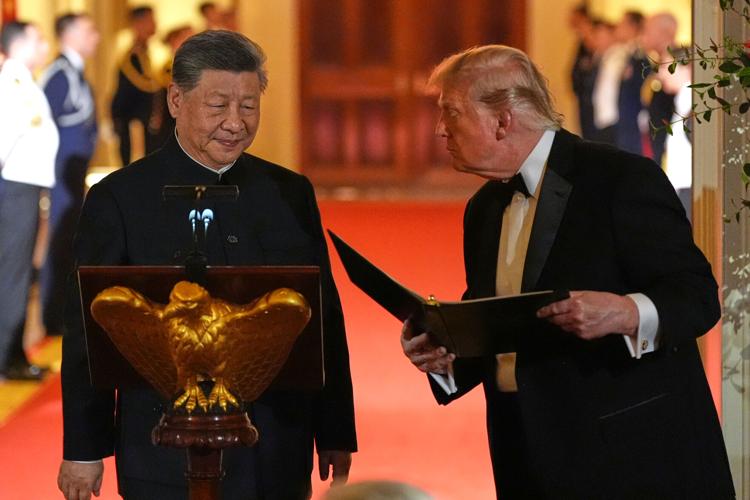
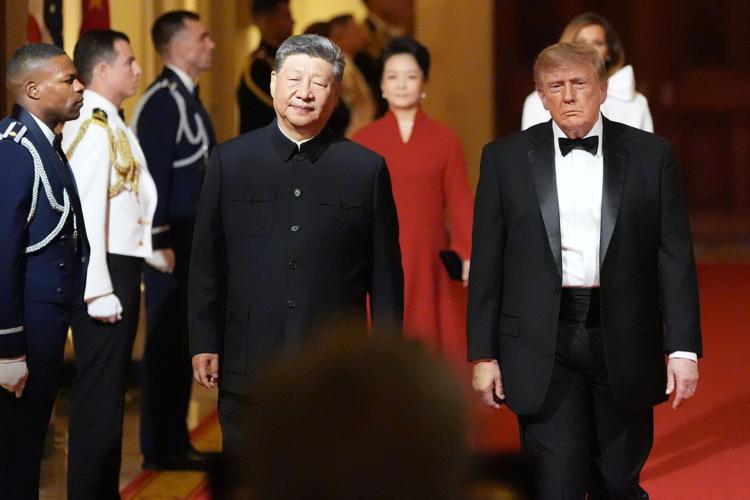
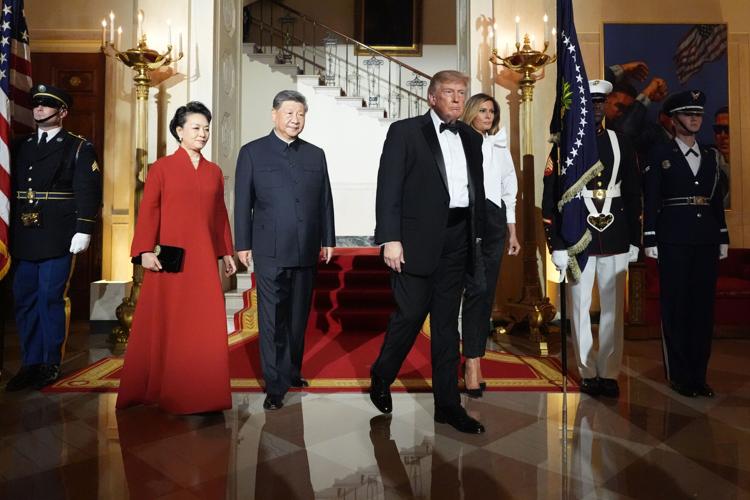
President Donald Trump is taking Chinese President Xi Jinping to visit the National Archives on Friday, showing off the sacred texts of U.S. democracy to the leader of the world’s most powerful communist country to cap off a three-day state visit criticized for being heavy on pomp and light on substance.
While Trump warmly welcomed Xi to Washington, outside the White House, protests against Xi continued almost nonstop Thursday. The demonstrators represented a range of causes, from calls for religious autonomy and greater freedoms in Tibet, Hong Kong and the ethnic region of Xinjiang to demands to keep China out of self-governed Taiwan.
Here's the latest:
Iran has suggested a deal to reopen the Strait of Hormuz in 7 days
Iran has offered to reopen the Strait of Hormuz and resume talks on its nuclear program in seven days if the United States lifts its naval blockade, waives sanctions on Iranian oil sales and observes a ceasefire that would include Lebanon.
Iran’s Foreign Minister Abbas Araghchi detailed the proposal in a private gathering Thursday on the sidelines of the U.N. General Assembly in New York, according to one attendee.
Trita Parsi, executive vice president of the Quincy Institute think tank, who attended, said Araghchi suggested that a speedy agreement would help President Trump ahead of November’s midterm elections.
There was no immediate comment from Iran’s U.N. mission or other Iranian officials.
Ukraine’s Zelenskyy says he urged Trump to enlist China’s help in ending Russia’s invasion
Ukrainian President Volodymyr Zelenskyy told reporters Friday he hasn’t yet received feedback from the White House about Trump’s talks with Chinese President Xi Jinping but expects to learn the outcome.
Zelenskyy, who’s keen to muster more international support for Ukraine’s defense, was in the United States this week on a trip coinciding with the U.N. General Assembly. He met with Trump on Tuesday.
NATO countries have called China a “decisive enabler” of Russian President Vladimir Putin’s invasion.
Xi’s day will begin at the White House
There, President Trump and first lady Melania Trump will host the Chinese leader and his wife, Peng Liyuan, for tea.
Macron says a U.S. diesel ban would inflict economic damage across the world
On Thursday, French President Emmanuel Macron said in an interview with French broadcasters that the diesel ban would damage economies across the world, including the U.S.
“This decision would be bad, not just for the rest of the world, but for the American economy, too,” Macron said. “I can tell you one thing: it wouldn’t be a good decision for his country and its economy.”
The European Union has increasingly turned to the U.S. for diesel since Russia’s full-scale invasion of Ukraine in 2022 and the outbreak of the Iran war in February. The support Trump expressed this week for banning diesel exports to drive down U.S. prices worries the bloc, which would have to find alternative sources of the fuel.
Japan’s Takaichi says her country and the U.S. are allies
Japan’s Prime Minister Sanae Takaichi, asked about Trump’s remark during his talks with China’s Xi Jinping that their countries were “allies” during World War II, said Japan and the United States are close allies of mutual trust today.
“Japan and the United States waged war but we have since firmly reconciled, deepened our relationship and now we trust each other as strongly bonded allies,” Takaichi said.
Japan worries about closer U.S.-China ties at a time Tokyo struggles to mend worsening ties with Beijing. Takaichi’s comment last year that a potential Chinese military action against Taiwan could justify Japanese involvement outraged Beijing, spilling over to trade.
Protesters of Xi’s policies push for change in earshot of White House visit with Trump
Trump warmly welcomed Chinese leader Xi Jinping with a personal airport greeting, a tour of his new helipad and a candlelit dinner. But outside the White House, protests against Xi continued almost nonstop Thursday during his state visit.
The demonstrators represented a range of causes, from calls for religious autonomy and greater freedoms in Tibet, Hong Kong and the ethnic region of Xinjiang to demands to keep China out of self-governed Taiwan.
Protests against visiting Chinese leaders are nothing new — in 2006, a woman heckled Xi’s predecessor Hu Jintao at a White House welcome ceremony — but Xi has become the focus of attacks for his tough approach to tightening control over Xinjiang, Hong Kong and other regions and the Chinese military’s growing threats to Taiwan, which he says must come under Chinese rule.
Crowds gathered behind a fence along Lafayette Park, waving flags and holding signs. Loudspeakers carried their voices across the park to the White House’s North Portico, where an honor guard and a red carpet awaited guests attending the state dinner.
Xi is wrapping his visit to Washington with a peek at the Constitution and Bill of Rights
Trump is taking Chinese President Xi Jinping to visit the National Archives on Friday, showing off the sacred texts of U.S. democracy to the leader of the world’s most powerful communist country to cap off a three-day state visit criticized for being heavy on pomp and light on substance.
Xi is expected to depart Washington after touring the nation’s vault of records, where the Declaration of Independence, the Constitution and the Bill of Rights are held. The two leaders have made a show of working to preserve harmony between the world’s two largest economies, though there were no major breakthroughs on issues such as trade or the safety of artificial intelligence.
The visit comes as the U.S. celebrates the 250th anniversary of its founding, and Trump said Thursday that he wanted to show Xi “some of the greatest treasures of that proud history.”
The U.S. president also said he wanted to show Xi artifacts about the relationship between the two countries.

(0) comments
Welcome to the discussion.
Log In