

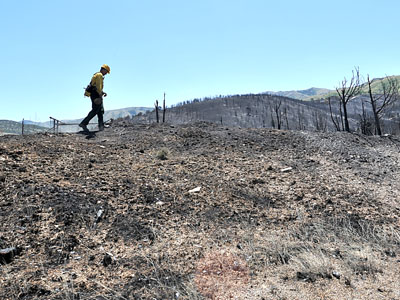
The peak of summer may not be the best time to reseed burned areas in Southeast Idaho, but various agencies are providing land and homeowners with valuable information for revegetating the fragile earth when cooler weather arrives.
At a recent meeting with homeowners who were impacted by the Charlotte Fire, various agencies gave updates on how homeowners can prepare to rebuild. Key ingredients include knowing what and when to plant and how landscaping can reduce fire danger around homes.
Danny Mann, the wildland fire education coordinator for Three Rivers Resource Conservation and Development, said for more than a decade grant funding helped the council provide “fire wise” information to homeowners.
“Our focus is to help people on the private side,” Mann said. “There are a lot of cooperative projects with the BLM or Forest Service. ... We offer free home evaluations. We go to the home and walk the property around the home with the land owner and give them fire wise suggestions on the preventative side. We’re trying to help those people be for the wildfire gets their home.”
While funding may only allow for evaluations with existing homes, Mann said educational resources are available online for homeowners rebuilding.
Fire wise information can be found online at www.3riversrcd.org.
The City of Pocatello set up a website listing links and brochures to help in the effort. The website is www.pocatello.us/se/charlottefire.htm.
Hannah Sanger, the environmental educator for the City of Pocatello, said a concern now is erosion on or near people’s property.
“We have a lot of steep slopes,” Sanger said. “(Knowing) what you can do with existing vegetation to slow the water down, so it has time to sink in, so it doesn’t wash out into someone else’s basement or creek.”
David Schmidt, the Assistant State Conservationist with the Natural Resources Conservation Service in East Idaho, recently shared with Mink Creek and Gibson Jack homeowners about the task of finding resources to aid in revegetating the area.
“We don’t have a fund source right now to do this kinds of work,” Schmidt said to homeowners about a week ago. “We have to wait and see if there are additional funds out there from other disasters that have occurred that they didn’t use all their money or new money comes along in the federal system.”
With much of the affected Charlotte Fire area being on private land, Schmidt said that is where the NRCS can step in. He said the USDA offers an Emergency Watershed Protection Program to lands impaired by “flood, fire, drought, windstorm or other natural occurrences,” according to the NRCS website.
Following the Charlotte Fire, an initial report was sent to Washington, D.C., then was followed by a damage report that was being edited last week.
“The purpose of this is to try to stabilize the site and help with not only erosion on a given point, but what happens to the materials that leaves the burn area and will it take out roads and culverts,” Schmidt said.
He said engineers, biologists and vegetation specialist surveyed the area.
“The plan we put together looks at soils, slopes, water,” Schmidt said. “We divided up, there are six different basins that the water comes off up there. We tried to identify where the culverts were. Can these culverts handle the amount of water that may come off these sites?”
Sarah Wheeler, public affairs specialist for the Bureau of Land Management, said of the more than 1,000 acres destroyed between 200 and 250 acres was on BLM land.
Wheeler said a plan was submitted for approval and based on funding will see what work can be done on the land.
Comparing to the Drive Inn Fire last year, Wheeler said similar factors are being considered with the Charlotte Fire reseeding effort such as the steep slopes. The project could include replanting native vegetation, drill seeding and adding straw bails to minimize water movement.
She said the seeding process could include hearty shrubs as bitterbrush, since the area is also a known winter habitat for wildlife.
While jurisdictional issues are a concern, Wheeler said people can still ask questions.
“If the public has questions on fire wise or don’t understand a pamphlet or find a contact, every one is here to help everyone,” she said. “We are all willing to help as much as we can.”

(0) comments
Welcome to the discussion.
Log In