

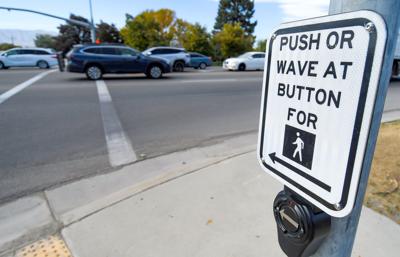
The Utah Department of Transportation is installing radar-enabled crosswalk buttons throughout Utah, including five in Cache Valley and four in Tremonton.
According to a press release, the new buttons make the pedestrian experience safer and more accessible, helping people with varying disabilities safely, confidently and independently cross streets.
Accessible pedestrian signal technology utilizes movement or activation via an app to direct pedestrians through an audio feature with statements like “wait” and “walk sign is on.”
The intersections UDOT has installed radar-enabled crosswalks so far are on US 89/91 at Hyde Park Ln in Hyde Park and 2500 N in North Logan, on 400 N at 100 E and 200 E in Logan and at 1700 S Main St in Providence
An additional four are planned for the valley in the future.
In Tremonton, there are new accessible pedestrian signals on Main Street at 1000 W, Tremont St and 300 E, and at 1400 S SR-82.
“I’m glad UDOT added the touchless crosswalk buttons,” Kris Johnson, a wheelchair-bound Provo citizen who visits the Provo Rehabilitation Center, said in the press statement. “It’s made crossing the street much safer for me and several other residents at the care center.”
UDOT has installed over 1,000 buttons at nearly 250 intersections and plans to install APS technology at every signalized intersection on state routes by 2033.
“This new crosswalk technology benefits everyone by facilitating safe and independent movement through pedestrian networks regardless of age or ability,” said Mike Blanchette, UDOT traffic engineer. “The app and touchless buttons are key components of an accessible, inclusive transportation system.”
Currently, APS technology exists on all state-managed streets in Cedar City and Moab and is expanding to Salt Lake City, Ogden, Provo and Logan.
UDOT is encouraging the public to participate in the installation process by flagging areas to prioritize. Citizens can submit an online form to notify UDOT of the need for APS technology at a crosswalk.
An online map shows existing and planned APS buttons.
Citizens can use the PedApp to activate a button. The app also provides pedestrians with live, supplemental information at crosswalks, such as the amount of walking time remaining or the street name and direction they’re heading. Sight-limited pedestrians can enable a feature that helps them locate the button.
According to the press release, equipment costs approximately $7,000 per intersection. UDOT has allocated $800,000 per year to the purchase and deployment of APS buttons.
UDOT is among the first in the nation to implement widespread use of accessible pedestrian signal technology at crosswalks, according to the press release.
According to an accessible pedestrian signals best practices guide developed under the sponsorship of the National Cooperative Highway Research Program, audible signals at pedestrian crossings may have appeared as early as 1920 but were not included in U.S. standards and regulations until 2000.
The American Council of the Blind Pedestrian Safety Handbook on APS says former APS models like the “overhead cuckoo-chirp” type signals are no longer the recommended standard because research revealed they were confusing and led to incorrect decisions.

(0) comments
Welcome to the discussion.
Log In