

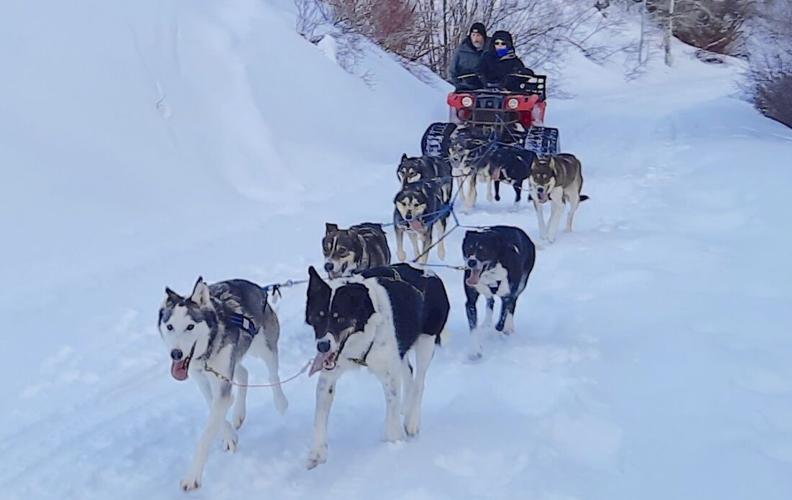

An exuberant canine chorus serenades Susan Wilson as she harnesses her sled dogs during a training run in the Caribou National Forest off Mink Creek Road.
“They’re so excited, but once we’re off, they’re silent,” Wilson said during a brief lull. “All you hear are the runners skimming across the snow. A lot of times, we’re the only ones out here. It’s soul-soothing and magical to be out with them.”
Wilson of Pocatello will select her six best dogs to compete this weekend in the oldest sled dog race in the Lower 48 — the American Dog Derby, established in 1917 and held in Ashton. On Friday and Saturday, they will race in the derby’s 12-mile class. Last year, they placed second.
“When I started, other mushers gave me advice,” said Wilson, 64, a pharmacist at Portneuf Medical Center in Pocatello. “They told me, ‘Everyone who mushes loses their team at some point,’ and ‘You either cross the finish line with a great time or a great story.’ And they were right. You never know what will happen.”
Wilson and her team have been chased by a bull, survived a head-on collision at a race, and lost each other for 24 hours.
Not merely a winter pastime, mushing is a lifestyle Wilson has embraced for more than a decade. A frequent speaker at schools, she said she hopes her tales from the trail entertain, educate and teach life lessons.
She said, “For me, it’s part of a musher’s responsibility to spread correct information about the sport and to encourage new participation. I love everything about it — the relationship with my team, caring for my dogs every day, the solitude and beauty of the trail, the sense of accomplishment, and the self-confidence you can’t help but develop.”
Wilson started running the Ashton race in 2010 after someone at work told her about it.
“I had a longtime fascination with the Iditarod and watched the derby for the first time in 2009,” she said. “It looked so easy to me. It’s a good thing I was so ignorant because I naively thought it would be simple to learn.”
Wilson gleaned advice from www.sleddogcentral.com and found a mentor, Jon Bunderson in Soda Springs, who advised her about buying dogs including her lead dog Raoul. An Alaskan husky, he had competed three times in the Iditarod and made up for Wilson’s inexperience.
“Raoul was wise and taught me and the other dogs,” she said. “If the dogs didn’t do something right, he’d correct them. They tend to learn better from a dog than a person.”
Unfortunately, seizures claimed Raoul’s life in the summer of 2014 when he was 10.
“He’s not physically with us, but he’s always there in spirit,” Wilson said.
Bunderson suggested she replace Raoul with Dawson, a trainee of renowned Canadian musher Buddy Streeper, a seven-time winner of the Open North American Championships in Alaska.
“Jon had purchased dogs from Buddy and was bringing in new dogs and thought Dawson would be a great addition to my team,” Wilson said.
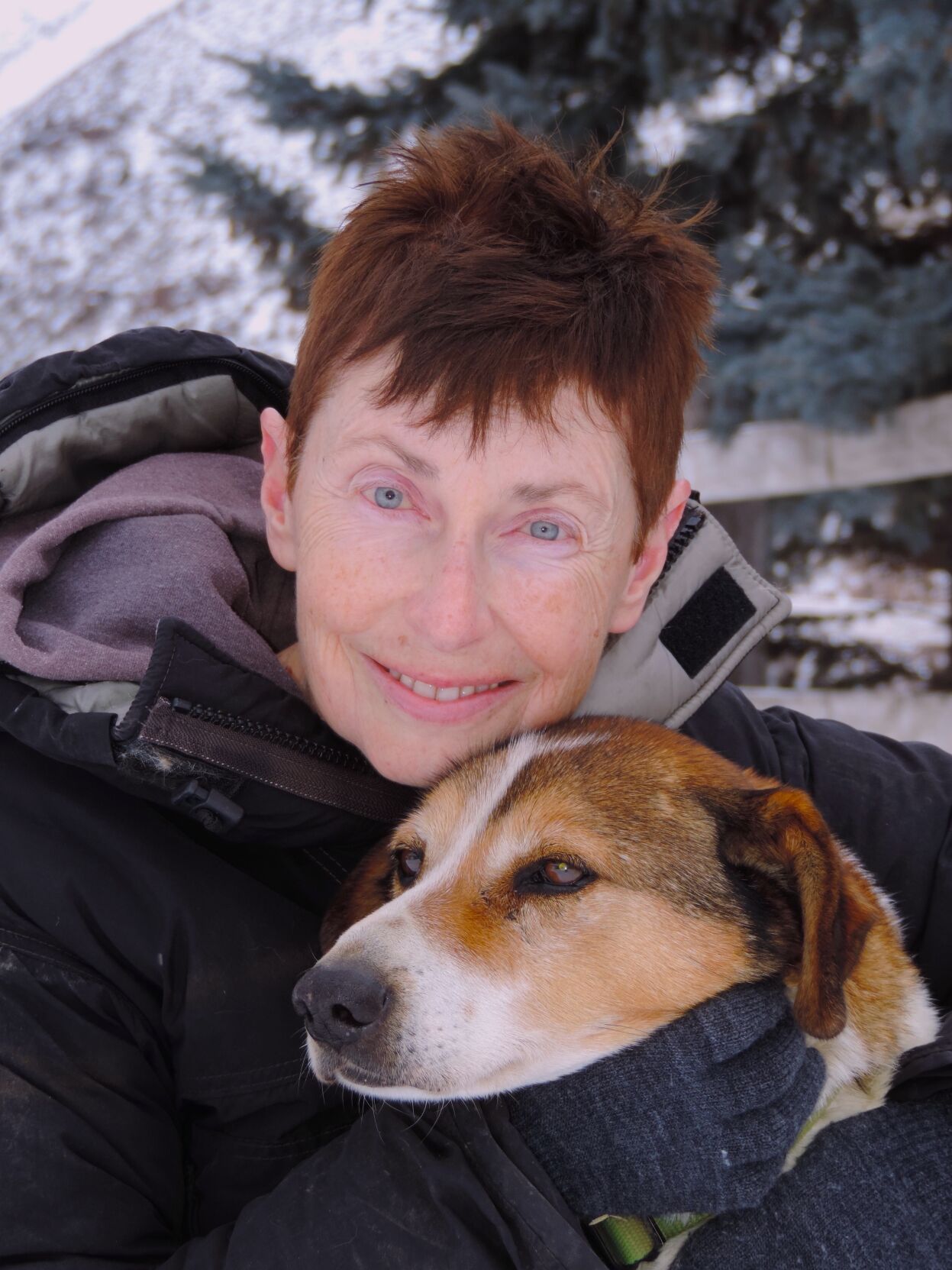
Although Dawson has retired from running, he plays an important role as a sled dog ambassador and accompanies Wilson when she gives presentations.
“Dawson is always a hit,” Wilson said. “He’s friendly, gentle, and loves to be petted and get attention.”
Lessons from the team
At presentations, Wilson shows students her truck with kennels and sledding equipment. She also introduces her dogs of mixed lineage that have been bred for various innate desires and characteristics — strength to pull, speed, hardiness, sociable attitude with other dogs and people, and hair coat. Her team averages about 13 mph.
“Dog-racing friends tell me about dogs that are available,” she said.
Two of her dogs, River and Ranger, were bred by Lance Mackey, a four-time winner of the 1,000-mile Yukon Quest and the Iditarod.
“Each dog has a different personality and skill to strengthen the team,” Wilson said. “I remind students — just like each dog on my team has a job — that they, too, are unique, have a talent, and are important.”
People tend to ask about the lead dog, she said, but the wheel dogs closest to the sled are important, too.
“They’re the strongest and do most of the pulling and turning,” Wilson said of Fenrir, named for Odin’s wolf in Norse mythology, and Borah, named for Idaho’s tallest peak. Jackson is her lead dog.
Wilson also tells students that dog sledding is all about problem-solving.
“Sometimes you have to repair a line or your sled, or they veer off, or the sled tips and they drag you. You have to be creative, imaginative, brave, and persistent.”
Tales from the trail
Wilson said students ask her to tell them of her ordeals and adventures.
During the dog derby in 2016, she and another musher were halfway through the race when they collided head-on. She and the other musher and their dogs were fine, but her light-weight racing sled was damaged.
Wilson said, “I lost one of the hand grips and cracked a major support piece and one of the runners. We limped through the rest of the course and managed to come in 12th out of 16 teams.”
On the second day of the derby, she was forced to use her backup sled.
“Our final placement of seventh was determined by adding together the times from the first and second day’s runs. Considering the collision, I was delighted,” Wilson said.
Another time during training, an energized team popped the sled’s hook that had been set in the snow and disappeared down the forest road.
“I watched the sun set, the moon rise and set, and the sun rise. I walked 16.5 miles looking for them,” Wilson said.
Finally, she found four of the 10 dogs tangled and happy to see her.
“Then I went out with a friend on a snowmobile and found the sled and the other six dogs.”
The hook had finally set and stopped the sled. The dogs had chewed out of their lines and were curled up under a tree, waiting.
Training fall, winter, spring
To maintain a competitive six-dog team, Wilson has 11 dogs — nine that run and two retirees.
“You really only need six dogs, but it’s always smart to have a few extras. I like to train with eight to 10 dogs.”
She is eager to run the Ashton race this weekend.
“Due to COVID, we lost races in the area that have not been restarted. Ashton, however, has maintained the race, with a lot of credit to the organizers,” Wilson said.
After the snow has melted, Wilson uses a four-wheeler instead of a sled to keep her team in shape, running three times a week during spring and fall.
“They get a three-month vacation in summer because it just gets too hot for them to run,” she said.
For Wilson, the occasional frustrations while running her dogs are outweighed by the pleasure of heading down a trail wondering what will happen.
“There are mushers on the circuit in their 70s,” Wilson said. “I’ll be doing this as long as the enthusiasm keeps flowing. That could be a long, long time.”
With the dogs in their harnesses, she releases the sled’s hook, and they really do become quiet as the content human-canine team disappears into the distance.
More information about the Ashton race may be found at americandogderby.com. To vicariously run the Iditarod, read “Winterdance,” by Gary Paulsen, who completed the storied race twice.

(0) comments
Welcome to the discussion.
Log In