

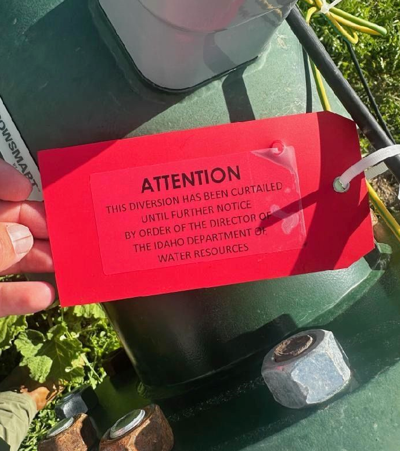
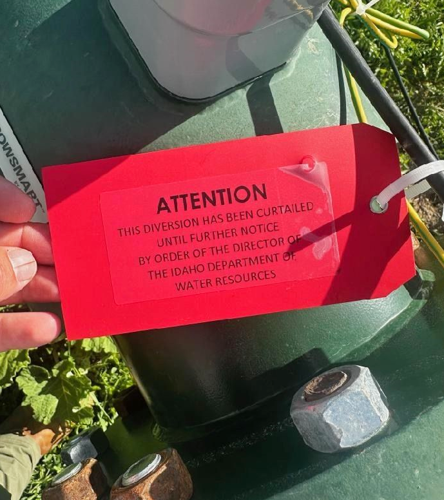
With Idaho Department of Water Resources agents red tagging farmers’ well pumps across Bingham County, more than 800 members of the Bingham Groundwater District gathered at Snake River High School and online Wednesday night to learn what has been done and what can be done about the curtailment order.
They learned that some major steps forward have been happening. For the first time in two years there is hope of a better, collaborative future between the groundwater users in East Idaho and the surface water users in Twin Falls and the Magic Valley.
The conflict revolves around preserving the Eastern Snake Plain Aquifer’s levels and honoring the senior water rights of the surface irrigation farmers. Surface water users in the Twin Falls area take their water shares directly from the river and flood irrigate their crops - a process that provides a natural recharge to the underground aquifer, generates power from hydroelectric plants on their canals and spills back into the Snake River which fills Idaho Power’s turbines for power production.
By contrast, groundwater farmers draw directly from the aquifer with wells and use pivots to irrigate their crops – a process that doesn’t naturally recharge the aquifer and doesn’t involve any other power generation. Having junior water rights, they only receive what the senior water users don’t need. In recent years, they have been mandated to return 240,000 acre feet of water to the aquifer each year to keep it sufficiently full.
The current battle really began with the drought years of 2021 and 2022. Before then, the groundwater districts, counties and other water users were recharging the aquifer at elevated levels, preparing for inevitable dry years. For instance, in 2017 they returned 495,384 acre feet, more than double what they were required to do. They understood the water agreement of 2016 would allow them to average aquifer yearly levels to satisfy the requirement. Since 2016, groundwater users have collectively returned an average of 325,082 acre feet annually – about 85,000 acre feet more than required – they thought they were in compliance with the agreement.
When the aquifer levels dropped in 2021, Magic Valley’s Surface Water Coalition (SWC) and IDWR got nervous and started demanding groundwater users to restore the aquifer or they would do it by restricting pumping from the aquifer until the senior water right owners had their shares.
They also decided that you can’t average aquifer levels. The aquifer needed to be at 240,000 every year, because that is what is used each year.
But it didn’t stop there. IDWR decided that the groundwater users would need to now supply 12,000 acre feet more each year, cumulatively, to bring the aquifer up to the 1991-2001 levels. This mandate means that in 2024 it would be 252,000 acre feet to restore instead of 240,000 acre feet and in 2025 it would be 264,000 acre feet, and in 2026, 276,000 acre feet.
According to Idaho Ground Water Appropriators (IGWA) Attorney T.J. Budge, this plan is one way to fill the aquifer, but it isn’t sustainable. It would require losing farms and livelihoods in East Idaho. For the last two years, Budge has been trying to get the IDWR to look at options that don’t require drying up farmland, with no success. Until this week.
With 2023 seeming like an abundant water year, IDWR’s demand to stop watering 103,000 acres of crops to supply an additional 74,100 af to satisfy Magic Valley farmers — an amount that is only 7 percent of their total water supply — didn’t make sense to the farmers and the public alike. Outcries locally, statewide and nationally have forced IDWR to look at options they had rejected previously.
On Monday in Sun Valley, the IDWR, SWC, and IGWA met and spent hours negotiating. Budge was able to get four key terms agreed to by each side concerning 2024. The SWC said they would agree if all the groundwater districts agree.
There are nine water districts in East Idaho that need to approve the 2024 terms. The next IDWR meeting is set for Thursday night. As of Wednesday night’s meeting of 800 BGWD members, six of the nine water districts had agreed to the negotiation items. BGWD, one of the largest districts, and the Bonneville-Jefferson District and the Jefferson-Clark District still need to make their decisions.
BGWD Manager Alan Jackson, BGWD attorney Dylan Anderson, and Budge explained the four negotiated points to a skeptical, angry, frustrated and scared crowd of farmers who occasionally shouted out questions and challenges.
Budge explained how they had negotiated the required 252,000 acre feet down to the 2016 level of 240,000 acre feet — for only 2024. They also agreed to honor the 2021 agreement and supply another 65,000 acre feet. The BGWD figures both of those requirements are doable with careful conservation and management.
The major breakthrough came after four hours: all parties agreed that the 2016 agreement was flawed and needs to be replaced or amended. This is the first time Gov. Brad Little or the IDWR have agreed to relook at the agreement. Public outcry appears to have made a huge difference - and, it is an election year.
The last term — to stop all current litigation cases until Oct. 1 — is the space the negotiation parties need to work on a new agreement. It is a hard deadline. If an agreement isn’t made by then, then the agreement update will become a key issue of the legislature’s season in January.
It was a hard sell to the gathered farmers, who had many valid questions. Gradually though, a cautious hope could be heard in the comments. One farmer even took the microphone and made a motion to accept the terms, even though that is the board’s role. Instead there was an unofficial vote of raised hands as to who would agree with the terms and who wouldn’t. Nearly everyone voted for and no one seemed to vote in opposition.
The board appreciated the vote of support, but wanted to read the comment cards before taking a vote. It wasn’t clear when that action would happen.
One added plus to accepting the 2024 terms, is that all fines would be canceled. There is a $300 per acre fine for non-compliance. So far, no wells have been locked for non-compliance.
With these negotiated terms, the IGWA and BGWD’s approach has shifted from detailing injustices to “How do we get to the future?” as BGWD’s chair Connie Christensen expressed it. Both organizations were clear that such a future would include a sustained aquifer and viable farms for both surface and groundwater users — without red tags or locked pumps.

(0) comments
Welcome to the discussion.
Log In