

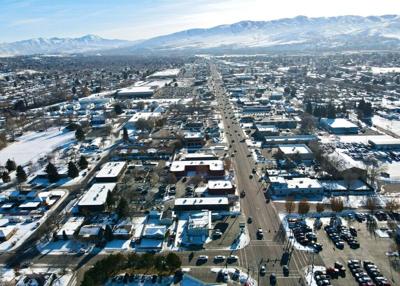

POCATELLO — Despite a relentlessly tight housing market, data from the 2020 U.S. census indicated the Gate City experienced little growth over the past decade.
But new data based on the U.S. Census Bureau’s 2021 American Community Survey, also known as the ACS, paints a much different picture, listing Pocatello as among the 20 fastest growing big cities in the nation.
A report released earlier this month by 24/7 Wall St., a Delaware corporation that runs a financial news and opinion company, says the Pocatello metropolitan statistical area, which includes Bannock and Power counties, has been the 17th fastest growing place in the U.S. over the past five years, with a population growth of over 13,000 people, or 15.7 percent.
The report uses data from the ACS and compiles the top 20 U.S. metropolitan statistical areas with at least 15 percent population growth from 2016 to 2021. The report is based on averages of census data collected in 2017, 2018, 2019, 2020 and 2021.
Pocatello Mayor Brian Blad says he is not surprised by the report’s findings. He believes the Pocatello area was undercounted in the 2020 census and says Idaho State University, several substantial employers and Southeast Idaho’s affordable cost of living are contributing factors to the area’s growth.
Add in the shortage of available homes for purchase and skyrocketing rental prices and Blad says there is no way our region hasn’t been growing.
“When we first got those numbers back from the (2020) census, I said I thought that we had missed a bunch of our community and that we didn’t get an accurate count,” Blad said. “I know there’s been some discussion about how we haven’t grown much but I knew that we were growing quite a bit. I think this report confirms everything that I thought was happening here.”
The metro areas of Boise and Coeur d’Alene joined Pocatello on the 24/7 Wall St. list of fastest growing places in the country, coming in at No. 15 and No. 14, respectively.
The inventory of available homes in the Gate City area, and across the entire state really, has been historically tight for months.
Real estate experts have said that Pocatello’s housing values have historically grown by no more than 5 percent annually. But home values in the Gate City have surged in recent years, increasing by 20 percent in 2019, 16 percent in 2020 and 25 percent in 2021.
The Pocatello metro area was listed earlier this year as one of the sixth most overvalued housing markets in the country, but still grew from about 84,377 people in 2016 to 97,645 people in 2021, according to the 24/7 Wall St. report.
The 24/7 Wall St. report suggests the Pocatello metro area and the rest of the state are growing “from an influx of people fleeing high-cost California.” Blad said he isn’t sure if it’s people fleeing from the Golden State alone, but he wouldn’t be surprised if people are leaving many large urban environments behind for a friendlier, slower pace in Southeast Idaho.
“If you’re moving from the outside into Pocatello, houses are extremely affordable, rent is extremely affordable,” Blad said. “But if you’ve lived in Pocatello your entire life, you’re not used to paying a higher cost for rent and for housing. I think you have a lot of people moving here that are selling houses somewhere else, buying one here and even paying cash for it.”
Blad continued, “Quite frankly, California is one of those places where you sell a house that’s 1,200 or 1,300 square feet for a million and a half dollars and then move to Pocatello, Idaho, and buy a 5,000-square-foot house for $400,000. It makes a difference.”
According to the census data, over 40 percent, about 19 million, of renter households in the country spent more than 30 percent of their income on housing costs during the 2017-2021 period. Households with higher housing costs have less money to spend on essential goods and services such as food, transportation and health care. The national median cost ratio for homeowners with a mortgage during the 2017-2021 period was about 21 percent. Both Power and Bannock counties were right around the average, at 20.2 percent and 19 percent, respectively.
Renters in Bannock County spent 26.6 percent of their income on housing and those in Power County spent less, about 17 percent, both of which are below the national median of 29.8 percent, according to the census data.
So while it may feel as if local rent amounts have been exorbitantly high, people in Bannock and Power counties are still paying less of their total income on rent or mortgages than the national average. Blad says the Pocatello area needs to add more affordable housing and that remains a focus for local officials and developers.
“We are working on it,” Blad said. “We are trying to get the high rental costs down and the only way you do that is by adding more rental units. We are working with Idaho Housing Alliance to get affordable rentals in the region. The problem is people are renting knowing it’s more expensive than it is to buy a house but you have to have a downpayment to buy the house and nobody has the money for the downpayment. It’s just a vicious cycle.”
Many Southeast Idaho employers are paying local residents a livable wage, which has helped to increase the population of the Pocatello metro area, said Blad, adding that there still aren’t enough good-paying jobs and that remains a focus for local officials.
The 24/7 Wall St. report included seasonally-adjusted employment figures from the Bureau of Labor Statistics to calculate employment growth from 2016 to 2021. Of 231 regions across the U.S., Pocatello had the 49th highest employment growth, with a 9.5 percent increase, and also boasted the 34th lowest unemployment rate out of 381 U.S. metro areas. Unemployment fell from 3.4 percent to 2.4 percent from 2016 to 2021 in the Pocatello metro area, according to the 24/7 Wall St. report.
“The FBI is a big contributing factor, as is LA Semiconductor and I think Idaho State University has continued to grow,” Blad said. “The FBI still hasn’t been able to hire and bring everybody in because of the housing shortage. We are trying to bring corporations and companies to our area that pay people enough money. We’ve done a pretty good job of that. In the last few years our median income has increased and the average hourly wage has almost doubled over the last 10 or 12 years.”
Blad continued, “The outlook for the future is great. I look at what WinCo has done over the last couple of years to increase employees’ wages by $4 or $5 an hour. Amy’s Kitchen has done that same thing. We’ve got good companies that have been taking those steps and doing the right thing. As we move forward into 2023, I think you’re going to see a number of businesses making even more of those efforts.”

(0) comments
Welcome to the discussion.
Log In