

There's little doubt that pit bulls have an image problem. They are muscular with powerful shoulders and jaws. And like all dogs, they can bite.
When members of this dog breed attack humans – like the brutal mauling of 61-year-old American Falls resident Nancy Davis last week or the fatal attack on a Lewiston woman's Yorkie terrier in Lewiston last May which left Renee Carter, 39, with bites to her hand – cries go out to ban the breed.
Davis is still recovering from serious wounds to her head and arms inflicted by a neighbor's two pit bulls when Davis tried to defend her dog from an attack. The pit bulls have been destroyed.
In 2010 there were three attacks involving pit bulls and humans in Blackfoot, Fort Hall and Idaho Falls. The attack of a 7-year-old girl in Idaho Falls in May of 2010 sent her to the hospital and required 60 stitches. The dogs were destroyed following all three incidents.
The resume of trouble for the breed is played out nationally. DogsBite.org, a public education website about dangerous dogs, claims 128 people in the U.S. were killed by pit bulls or pit bull crosses between 2005 and 2011.
Reaction to pit bull biting reports has led to the adoption of stringent pit bull laws in more than 375 U.S. cities with 200 cities, including Miami, Kansas City, and Denver banning the breed entirely.
There are many people who think the bad reputation is undeserved and when pit bulls or pit bull cross-breeds become dangerous, an owner is usually the reason. Chubbuck's Stormy Briscoe is one of them.
“I absolutely love the breed,” Briscoe said. “They're really smart and all they want to do is please you.”
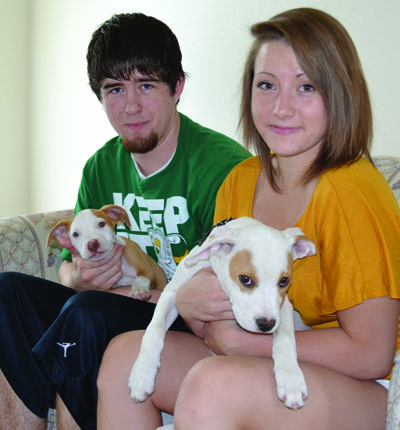
In the living room of her home in Chubbuck, Briscoe reaches down to scratch the belly of her 4-month-old female pit bull named Daisy. Perching his tiny head on Daisy's rump is a nine-week-old male puppy, Duke. Duke is also a pit bull All animals are cute and seemingly harmless when they are babies and Briscoe knows this.
“When he grows up, he's going to look scary,” Briscoe says about tiny Duke. “They will get bigger and look powerful.”
Briscoe is familiar with larger pit bulls because she previously owned a two-year-old female she had to give up to another family when she moved into an apartment that didn't accept pets. Parting with her pet was hard and Briscoe said she will make sure that doesn't happen with Daisy and Duke. In the meantime, she's putting in the time necessary for her pit bulls to be happy, well-adjusted animals.
“All dogs are a huge responsibility,” Briscoe said. “Some people get pit bulls because they're hardcore looking, but they don't take the responsibility for training them, especially when they are a puppy.”
Briscoe said dogs – especially pit bulls – need a lot of play time and training so they become socialized. She said the breed's intelligence and energy is daunting, but hard work by owners pays great dividends.
“The best way to train a dog is to spend time with them and not be afraid to say 'no,'” Briscoe said. “And you want to start when they are young before they are bigger and more powerful.”
Briscoe said she grew up with family dogs and even completed a 4-H project on dog handling and training when she was younger. The pit bull owner said the personality of the owners is often reflected in their dogs.
Shirley and David Stumbaugh also love the breed and David is still mourning the loss of his two pit bulls which he raised from puppies and owned for four years. Both the males were euthanized last week.
“They had never hurt a soul,” Shirley said.
However, when David went to leash the dogs one afternoon, the pair broke loose and ran into the street. This led to a confrontation with a neighbor's dog and that dog was bitten.
“They could've shredded that dog if they wanted to, but they're not that kind of dogs,” David said.
The Stumbaughs ended up surrendering the dogs to Pocatello Animal Control and the dogs were put down. Both Shirley and David said that is a reflection of a prejudice against the breed.
“Nobody likes pit bulls,” Shirley said. She shared that she suspects the Pocatello Animal Shelter harbors misgivings about the breed.
Manager of the Pocatello Animal Shelter, Mary Remer said the shelter staff recognizes that pit bulls require extra care and evaluation because of their intelligence and energy.
“That breed has a very high play drive,” Remer said. “They're very strong and very active. Pit bulls have to have things to do in kennels to keep them active or they go downhill pretty fast.”
Like with any other breed of dog, the shelter holds stray pit bulls for three days before evaluating whether they are fit for adoption. She said before a pit bull is given to a family for adoption, “we try to make sure people are willing to make the commitment.”
Remer was talking about the quality time that Briscoe said the breed demands from their owners.
And as far as a prejudice against the breed, Remer and her husband own an American bulldog-pit bull cross and she calls it “the best dog we've ever had.”
In her Chubbuck living room with her two young pit bulls napping at her feet, Briscoe's affection for the animals is obvious.
“They can be just like a person,” Briscoe said. “It makes me so sad when I hear that a pit bull has done something awful.”
But she is quick to place the blame on owners like herself.
“It takes a lot of patience to train them,” she said. “They all have different personalities.”
Pit bull facts:
The term pit bull can include the American Pit Bull Terrier, Staffordshire Bull Terrier, and the American Staffordshire Terrier, originated in the 1800s in the United Kingdom, where bull and terrier types were bred for fighting.
Several studies have identified pit bulls among the "high risk" breeds for biting incidents that include Akita, chow-chow, Doberman pinscher, rottweiler and wolf-dog mix.
Veterinary experts say there is no physiological mechanism for pit bulls to lock their jaws, However, pit bull-type dogs exhibit "bite, hold, and shake" behavior, which is seen in all breeds of dogs, and at times refuse to release when biting.
Pit bulls score an 83.4 percent passing rate with the American Temperament Test Society, according to Pitbulllovers.com. That's better than the popular border collie, a breed that scores 79.6 percent.

(3) comments
First off let me say that it is unfortunate that someone was harmed by the dogs mentioned in this story. However to judge an entire breed of dog based on the actions of a few is also unfortunate. I am a PROUD owner of a 1 ½ yr old Pit Bull. I am a stay at home mom of three girls ages 9, 6, and 3. The Pit Bull we have is the best dog for our family. Now before we got him I was very nervous because I had heard so many bad things about Pit Bulls. Story’s just like this one. So when my husband told me he wanted a Pit I was like NO way ARE YOU CRAZY? But after much research about the breed and speaking with people at my local shelter who deal only with Pit Bulls, I reconsidered. I am so glad I did. He is lovable and friendly with everyone he meets. And after training, socialization and love he is a very well behaved dog. For those of you who think so badly of Pit Bulls did you know that before about the last thirty years they where actually called the “nanny dogs” because they are so good with children? They are very energetic dogs who love to play and be praised. There are times when pit bulls can be very intimidating and sometimes even scary. Please don’t judge the whole breed based on a few “bad apples,” because for some family’s Pit Bulls are the best companions.
From a story at CBSNews.com (the bolding is mine):
“A study performed by the American Veterinary Medical Association, the CDC, and the Humane Society of the United States, analyzed dog bite statistics from the last 20 years and found that the statistics don’t show that any breeds are inherently more dangerous than others. The study showed that the most popular large breed dogs at any one time were consistently on the list of breeds that bit fatally. There were a high number of fatal bites from Doberman pinschers in the 1970s, for example, because Dobermans were very popular at that time and there were more Dobermans around, and because Dobermans’ size makes their bites more dangerous. The number of fatal bites from pit bulls rose in the 1980s for the same reason, and the number of bites from Rottweilers in the 1990s. The study also noted that there are no reliable statistics for nonfatal dog bites, so there is no way to know how often smaller breeds are biting.”
Pit Bulls in my opinion are more likely to be agressive and even vicious no matter how they are raised. It's just a shame that people who have pits either get a charge out of their dogs being agressive and show that off or they try to keep them mild deliberately. But when the pits turn viscious, the owners usually blame the victim. The Stumbaugh dogs have history where they live for their dogs chasing others dogs into neighbors homes, trying to attack other dogs and actually injuring a few animals in their neighborhood. They have been removed from their care before and somehow they were able to get them back. There are several pits in that neighborhood and I myself fell nervous when I take my children out for walks. I am personally happy that their dogs are gone and we don't have to worry about those two anymore. Oh yeah. I am not a dog hater, I have 2 of my own.
I think one of the biggest facts you have left out is that there are pit bulls out there who do wonderful things. There are pit bulls who are therapy dogs, service animals, and law enforcement animals.
I think Cesar Milan, a world famous dog trainer, is correct when he said, "The bad rap that pit bulls get here in the United States is, to my thinking, a crime. First of all, pit bulls are dogs first. They’re not wild animals; they’re domestic dogs like any other domestic dog. Of course, pit bulls are not always the right dogs for every family – but in blaming pit bulls as a breed for all those horrendous incidents we read about in the news, we’re forgetting the basic fact that we humans have created the very characteristics we vilify in pit bulls, simply to fill our own needs. We are responsible for them. Over the centuries, we have genetically engineered these dogs to have strong jaws, relentless staying power and a high tolerance for discomfort or pain. Those are the plain, unvarnished facts of their DNA. But even in the dog world, DNA isn’t destiny. Pit bulls are not born aggressive to dogs or to people – we make them that way…. Properly socialized and raised with the same consistent rules, boundaries and limitations that their natural pack would instill in them, it’s been my experience that pit bulls make the most amazing pets."
Welcome to the discussion.
Log In