

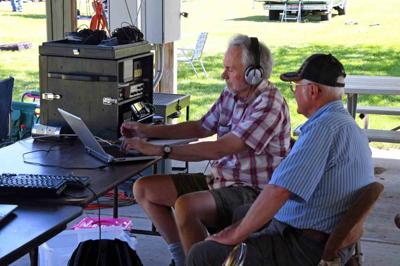
POCATELLO — Since 1933, American amateur radio operators have participated in a nationwide event called Field Day, and a local club is inviting area residents to come learn about the hobby.
From noon to 4 p.m. Saturday, June 27, at Heritage Park, the Pocatello Amateur Radio Club is inviting the community to participate in Field Day.
Participants will learn about amateur radio — also known as ham radio — how members use their radios to communicate beyond borders and how the club brings people together while providing essential communications in service of their community. The event also highlights how ham radio operators provide emergency communication when needed.
Amateur radio is a Federal Communications Commission-licensed radio service that requires passing a licensing test covering basic electronics principles, safety and radio fundamentals. The club meets monthly, and each ham radio operator may hold a different class of license, which determines their access to various frequencies. The organization has around 60 members.
“We can talk around the world from our house, if the ionosphere is cooperating,” said John Wilson, vice president of the Pocatello Amateur Radio Club. “Personally, I’ve talked to like 300 countries. We also have repeater systems — that’s a mountaintop radio that puts your signal up and amplifies it and sends it back out, so that people with walkie-talkies can communicate better amongst themselves over a large distance. Typically, a walkie-talkie on the ground might conceivably get five miles, but with the repeaters we can go all around. You could have a walkie-talkie at Blackfoot and easily be talking to somebody in American Falls through our system.”
Field Day highlights ham radio’s ability to work reliably under many conditions from almost any location. The radios are capable of creating an independent, wireless communications network that does not require telecommunications infrastructure such as a power grid, cellphone networks or the internet.
The event acts as an open house and emergency preparedness drill, where operators set up portable stations in parks or public spaces to make as many contacts as possible over an extended period.
“That’s what all this is all about,” Wilson said. “It’s a sort of a practice exercise in case we have a big emergency. We go out and set up radios. They do this all over the United States and quite a few places around the world are probably doing it too.”
Organizers are inviting everyone to come see ham radios in action, ask questions, talk with operators, learn how to get a license and potentially communicate with someone on the radio.

(0) comments
Welcome to the discussion.
Log In