

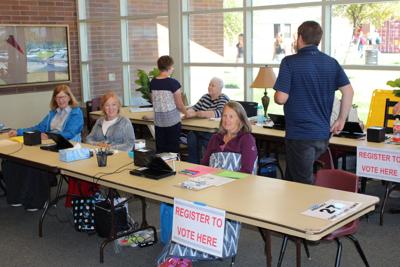
Idaho Secretary of State Phil McGrane is encouraging Idahoans to participate in the election process and help their fellow citizens by registering as poll workers.
McGrane visited Idaho Falls on Tuesday morning and spoke with local legislators about the integrity and security of the election process.
His office also launched a recruitment commercial for poll workers on X.com, formerly known as Twitter, last week.
The video featured a variety of election officials, including several from East Idaho. Bannock County Clerk Jason Dixon, Bingham County Clerk Pam Eckhardt and Madison County Clerk Kim Muir encouraged Idahoans to participate in elections by manning the polls.
“We want you to come help serve your community by becoming a poll worker,” McGrane said in the advertisement. “Each Election Day, thousands of Idahoans help serve at the polls as poll workers. Come experience how rewarding it can be to help Idahoans vote.”
Bonneville County Elections Supervisor Helena Welling said the campaign appears to be paying off.
“Just this last week, we have received about six to eight poll worker applications,” she said. “One of them was even bilingual, so that’s really a plus.”
Tuesday’s election for Bonneville County Joint School District 93’s $34.5 million bond proposal was staffed by four poll workers at each precinct. Voters from 29 precincts were able to vote in one of 25 assigned polling locations. Election results were not available before press time but will be posted online Wednesday and published in Friday’s print edition.
The 2024 presidential general election will require far more election workers — ranging from eight to 10 or more per precinct.
“Next year is when we will have to double down or triple down on our poll workers,” Welling said. “So it’s nice to get some of them, even if we don’t use them all this year. When it comes to the primary and especially the general presidential election that happens in November, we will need lots and lots of people. That will be probably more of a challenge.”
The election employees earn less than $200 per day as compensation, depending on their position.
While Tuesday’s election was fully staffed by poll workers, the Bonneville County Elections office always is looking for new volunteers.
“So far we have not had a shortfall,” Bonneville County Clerk Penny Manning said. “We appreciate them. An election would not run without the people who help us at the polls.”
Manning also addressed how the county ensures election integrity and security.
In the polling places, ballots are in the hands of a team of workers, she said.
“Voter equipment goes through certification processes,” Manning said. “In our office, we have cameras, motion detectors and alarms that we set. Two people (are) on the ballots at all times. (We have) chain of command. We make sure that we have paperwork indicating whose hands the ballots have been in and where they go, so that people understand that process.”
No ballots are left unattended, she said.
“We verify signatures on absentee ballots,” Manning said. “No person can vote twice.”
Idaho code requires elections to use a paper ballot.
“When a person comes in, they check in through an electronic poll book,” Welling said. “It’s a very quick process. The electronic poll book will accurately issue the correct ballot type. … Then we issue the paper ballot, and the person marks it. Then they put it through the precinct counter, which is the scan unit. That scan unit is not connected to the internet in any way at all. It’s more like a tabulating system. It tabulates the results, and then we will get those results at the end of the day when they are returned to us.”
The elections office contains a tally room. Here a computer drive from each voting machine is inserted into a computer that is not connected to the internet, which tallies up the results. Absentee ballots also are counted by machine in the office.
Finally, “the results are recorded on a different computer that is connected to internet, and then we publish the results,” Welling said.
All equipment is tested with test ballots before it is sent to the polling places.
“Everything is always sealed and recorded,” she said. “… We actually check sealed numbers on our equipment when they come back that the sealed number is the same seal that we issued to it before it left.”
The electronic poll book is connected to the internet on a secure connection provided by the elections office.
Federal elections also require audits.
“There are just a number of checks and balances to make sure that we always follow chain of command, that nothing is tampered with and that everything is done transparently,” Welling said.
Welling encouraged citizens — whatever their political views — to participate in local, state and national elections.
“I think sometimes we get a little calloused and think that our vote doesn’t have weight,” Welling said. “But especially in these local elections, they very much affect our lives.
“Whether you feel like there are not enough schools for the kids, and you want to support that, or whether you think that are taxes are going up much too high and we should be more conservative, that’s your ticket to tell those who are in power what you want done with your money and what you want to see in your community.”

(0) comments
Welcome to the discussion.
Log In